GitHub hosts HunyuanVideo, Tencent's open-source framework for large-scale video generation models, enabling AI-driven video creation.

Stanford NLP
$1Starting price
0Popularity
About Stanford NLP
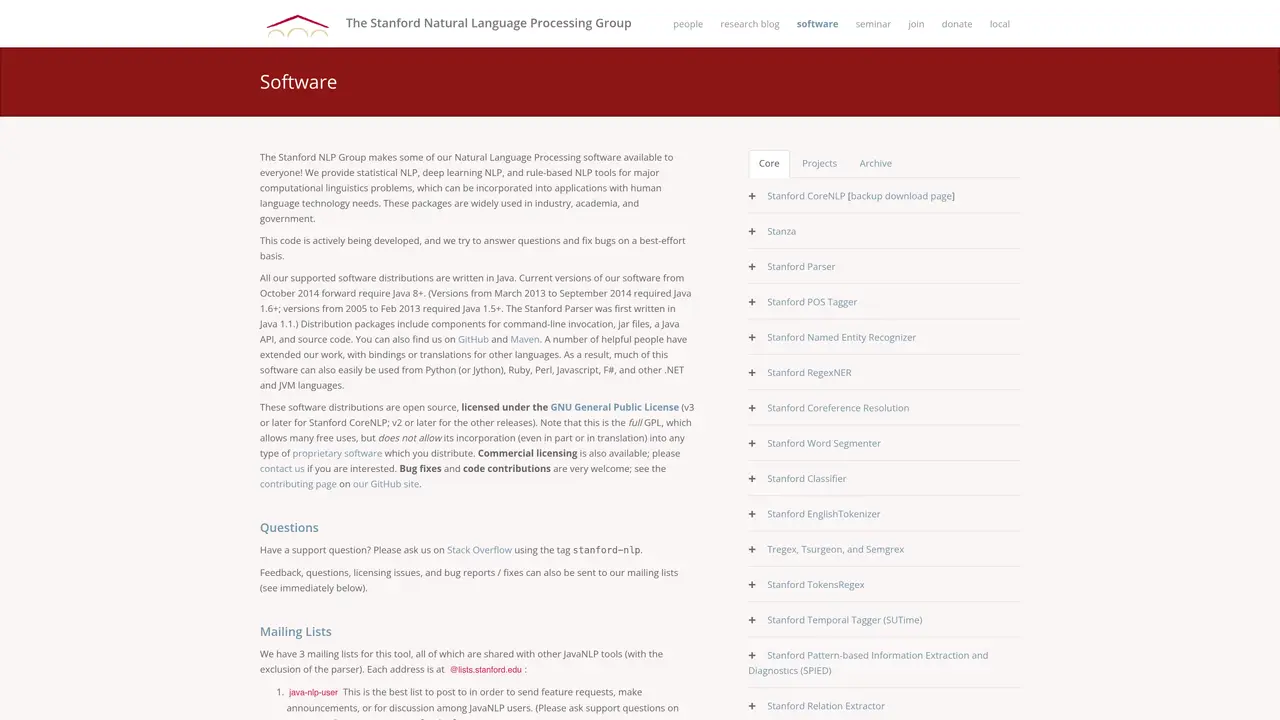
Stanford NLP is a suite of natural language processing tools developed and maintained by Stanford University. It provides a comprehensive set of libraries and models for analyzing and processing human language, including tasks such as tokenization, part-of-speech tagging, named entity recognition, sentiment analysis, and dependency parsing. The software is designed to handle text from diverse sources, including documents, emails, social media posts, and web content, enabling users to extract meaningful insights and structure from unstructured text data. The suite supports multiple languages and offers pre-trained models for common NLP tasks, as well as tools for training custom models. Stanford NLP is widely used in both academic research and industry applications, providing robust solutions for tasks like information extraction, text classification, and linguistic analysis. It also includes visualization tools to help users interpret and analyze the results of their NLP models, making it accessible for both technical and non-technical users.
Stanford University
Stanford, United States · Founded 1885
- Founders
- Leland Stanford, Jane Stanford
- Founded
- 1885
- Headquarters
- Stanford, United States
Key features
- Text processing and analysis
- Automated summarization
- Sentiment extraction
- Entity extraction
- Question answering
- Language translation
- Pattern and trend identification
- Visualization tools for data interpretation
- Support for multiple text-based sources
- Robust NLP capabilities for research and development
Use cases
- Analyzing customer feedback or reviews for sentiment trends
- Summarizing large documents or articles automatically
- Extracting key entities and relationships from unstructured text
Pros
- Open-source software with active development and community contributions
- Supports multiple programming languages including Java, Python, Ruby, Perl, JavaScript, and .NET
- Provides a comprehensive suite of NLP tools for tokenization, parsing, named entity recognition, and more
- Offers pre-trained models for over 70 languages in the Stanza package
- Widely used in industry, academia, and government for human language technology needs
Cons
- Requires Java 8+ for current versions, which may limit compatibility with some systems
- Full GPL license restricts incorporation into proprietary software without commercial licensing
- Primarily command-line or API-based, which may require technical expertise for integration
Frequently asked questions about Stanford NLP
What is Stanford NLP?
Stanford NLP is a suite of natural language processing tools developed by Stanford University, offering statistical, deep learning, and rule-based solutions for tasks like parsing, named entity recognition, and sentiment analysis.
Who should use Stanford NLP?
It is suitable for researchers, developers, and organizations needing robust NLP capabilities, particularly those working with multilingual text or requiring integration into applications.
How is Stanford NLP licensed?
Most tools are open-source under the GNU General Public License (GPL), while commercial licensing is available for proprietary use.
What programming languages does Stanford NLP support?
The core tools are written in Java, but many can be used from Python, Ruby, Perl, JavaScript, and other languages via bindings or translations.
How do I get started with Stanford NLP?
Download the software from the official website or GitHub, review the documentation, and use the provided APIs or command-line tools to integrate the NLP capabilities into your project.
Where can I find support for Stanford NLP?
Support questions can be posted on Stack Overflow using the 'stanford-nlp' tag, or by joining the java-nlp-user mailing list for discussions and announcements.