GitHub hosts HunyuanVideo, Tencent's open-source framework for large-scale video generation models, enabling AI-driven video creation.

RoBERTa
$0.07Starting price
0Popularity
About RoBERTa
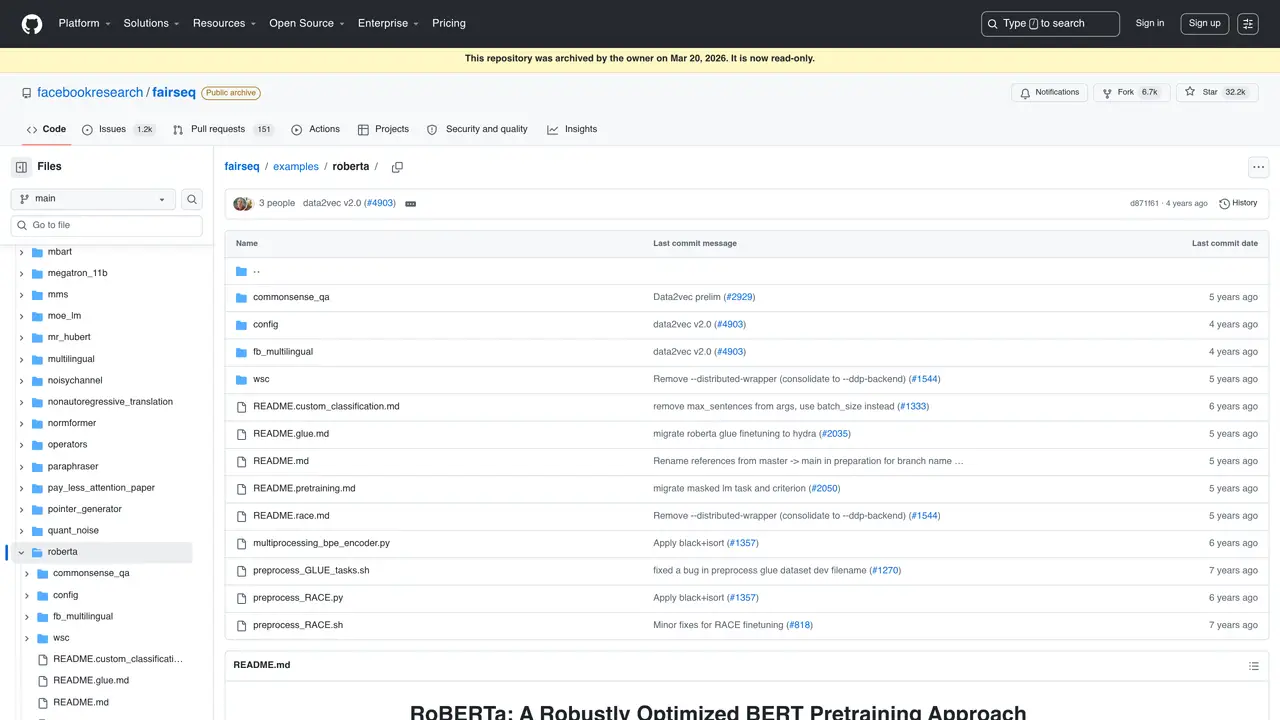
RoBERTa is a powerful natural language processing (NLP) tool designed to help improve accuracy and speed of text processing operations. It is based on an advanced version of the BERT model, and has been trained on massive datasets to achieve state-of-the-art performance. With RoBERTa, users can quickly and accurately identify entities, extract key phrases and topics, and categorize and classify text. This makes it an ideal tool for a wide range of use cases, such as question answering, text summarization, and language translation. RoBERTa is highly efficient and easy to use, enabling users to get up and running quickly. It is also highly customizable, allowing users to adjust parameters to match their specific needs and requirements. The tool is open source, meaning users can access the code and modify it as needed. Finally, RoBERTa can be used across multiple languages and environments, making it a great choice for any language processing task.
GitHub, Inc.
San Francisco, California, US · Founded 2008
- Founders
- Tom Preston-Werner, Chris Wanstrath, PJ Hyett, Scott Chacon
- Founded
- 2008
- Headquarters
- San Francisco, California, US
- Legal status
- Subsidiary of Microsoft (NASDAQ: MSFT)
Key features
- Automated Question Answering
- Text Summarization
- Language Translation
- Entity Identification
- Key Phrase Extraction
- Topic Categorization
Use cases
- Question answering systems
- Text summarization tools
- Language translation software
Pros
- Optimized pretraining procedure with longer training, larger batches, and dynamic masking for improved performance
- Supports multiple languages through models like XLM-RoBERTa and language-specific variants (e.g., CamemBERT, GottBERT)
- Achieves state-of-the-art results on benchmarks such as GLUE, SuperGLUE, SQuAD, and RACE
- Open-source implementation with pre-trained models available for fine-tuning
- Compatible with PyTorch and TensorFlow via libraries like Hugging Face Transformers
Cons
- Requires significant computational resources for training and fine-tuning large models
- Archived repository with no active maintenance or updates
- Complexity in implementation for users without deep learning expertise
- Limited support for newer architectures or recent advancements in NLP
Frequently asked questions about RoBERTa
What is RoBERTa and how does it differ from BERT?
RoBERTa is a robustly optimized version of BERT that improves pretraining by training longer with larger batches, removing the next sentence prediction objective, using longer sequences, and dynamically changing masking patterns. It achieves higher performance on downstream tasks compared to the original BERT model.
Who should use RoBERTa?
RoBERTa is suitable for researchers, developers, and organizations working on natural language processing tasks such as text classification, question answering, summarization, and language translation. It is particularly useful for those needing high accuracy and efficiency in NLP applications.
How do I get started with RoBERTa?
To get started, users can load pre-trained RoBERTa models from the fairseq library or integrate them via the PyTorch or Hugging Face Transformers libraries. The GitHub repository provides tutorials and scripts for fine-tuning and pretraining on custom datasets.
What pre-trained models are available for RoBERTa?
The repository offers several pre-trained models, including roberta.base (125M parameters), roberta.large (355M parameters), and fine-tuned variants like roberta.large.mnli and roberta.large.wsc. Multilingual models such as XLM-R are also available.
Can RoBERTa be used for multilingual tasks?
Yes, RoBERTa supports multilingual applications through models like XLM-RoBERTa, which is trained on data from multiple languages. This makes it suitable for cross-lingual tasks such as translation and multilingual text classification.
What tasks can RoBERTa perform effectively?
RoBERTa excels in tasks like GLUE benchmark evaluations, question answering (SQuAD), natural language inference (MNLI), commonsense reasoning (CommonsenseQA), and multilingual understanding (XNLI). It is optimized for high performance across a wide range of NLP benchmarks.