GitHub hosts HunyuanVideo, Tencent's open-source framework for large-scale video generation models, enabling AI-driven video creation.

UnifiedQA
$0.07Starting price
0Popularity
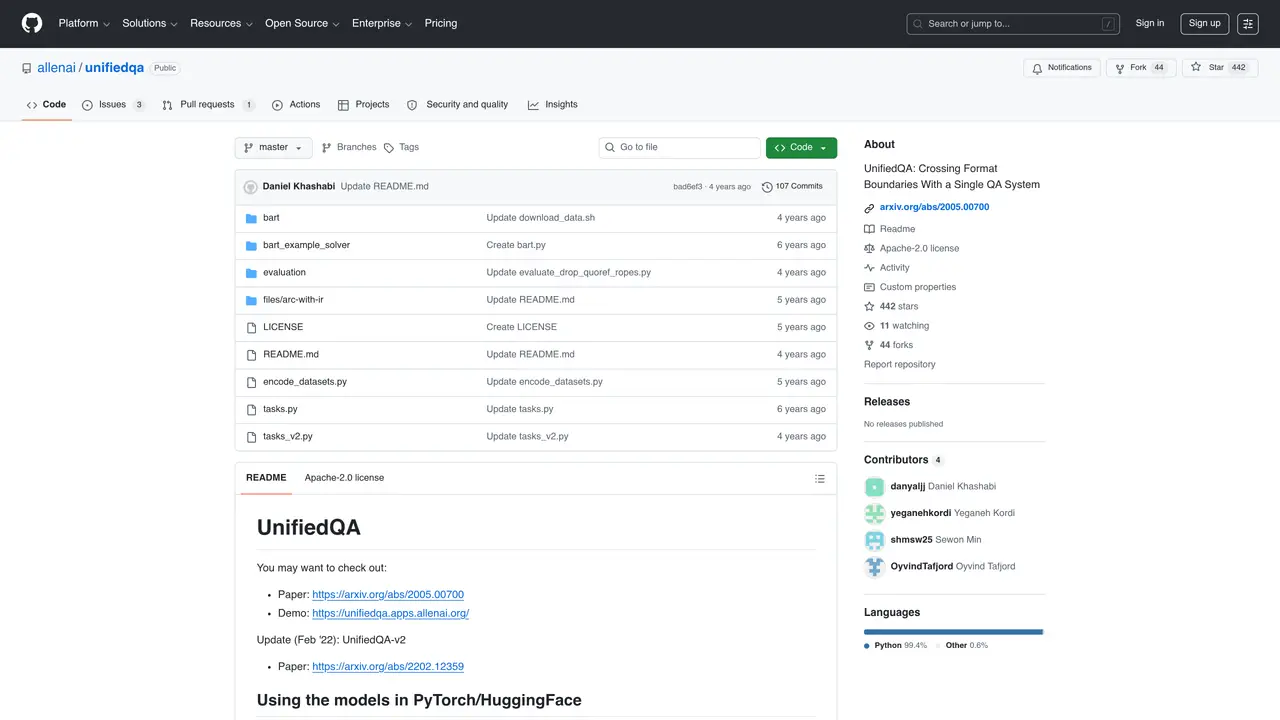
About UnifiedQA
UnifiedQA is an open source tool for building end-to-end question answering systems. It provides users with a comprehensive suite of components for creating powerful question-answering systems. This includes a library for pre-processing input data, a library of models for natural language understanding, and a library of models for generating answers. UnifiedQA also features a selection of evaluation metrics and data sets to help you evaluate your models.With UnifiedQA, developers of all skill levels can create custom question-answering systems quickly and easily. It provides a comprehensive set of tools, components, and resources that simplify the process of building and deploying QA systems. With its intuitive user interface, developers can quickly set up their systems and start training models. Plus, it offers easy integration with popular frameworks such as TensorFlow, PyTorch, and others.
GitHub, Inc.
San Francisco, California, US · Founded 2008
- Founders
- Tom Preston-Werner, Chris Wanstrath, PJ Hyett, Scott Chacon
- Founded
- 2008
- Headquarters
- San Francisco, California, US
- Legal status
- Subsidiary of Microsoft (NASDAQ: MSFT)
Key features
- Build custom question-answering systems
- Preprocess input data using library
- Evaluate models with metrics and datasets
- Intuitive user interface for quick setup and training
- Easy integration with popular frameworks like TensorFlow and PyTorch
Use cases
- Building end-to-end question answering systems
- Creating custom QA systems for various applications
- Evaluating models using metrics and datasets
Pros
- Supports multiple question-answering formats (extractive, multiple-choice, generative) within a single unified system
- Open-source and accessible via GitHub with Apache 2.0 license
- Compatible with popular frameworks like PyTorch and Hugging Face Transformers for easy integration
- Offers multiple model sizes (T5 variants from small to 11B) for scalability and flexibility
- Provides pre-trained models and evaluation datasets for benchmarking and testing
Cons
- Requires familiarity with Python and deep learning frameworks for effective use
- Input data must be pre-processed into a specific text-in/text-out format with strict formatting rules
- Model performance may vary depending on the complexity and domain of the question-answering task
- Limited built-in user interface, primarily designed for developers and researchers
Frequently asked questions about UnifiedQA
What is UnifiedQA?
UnifiedQA is an open-source question answering system designed to handle multiple QA formats with a single model. It supports tasks like extractive QA, multiple-choice, and abstractive QA through a unified text-to-text approach.
Who should use UnifiedQA?
Developers, researchers, and practitioners in natural language processing or machine learning who need a flexible, end-to-end QA system. It is suitable for those familiar with Python and frameworks like PyTorch or Hugging Face Transformers.
How does UnifiedQA work?
UnifiedQA converts input data into a text-to-text format, where questions are provided as input text and answers are generated as output. It uses T5-based models fine-tuned on various QA datasets to produce responses.
What models are available in UnifiedQA?
UnifiedQA offers multiple T5-based models of varying sizes, including small, base, large, 3B, and 11B variants. UnifiedQA-v2 models are also available with different checkpoints for enhanced performance.
How can I integrate UnifiedQA into my project?
UnifiedQA models can be loaded using the Hugging Face Transformers library. The models are hosted on the Hugging Face Model Hub and can be integrated with PyTorch or TensorFlow-based pipelines.
What input formats does UnifiedQA support?
UnifiedQA accepts input in a text-to-text format, where questions are provided first, followed by context or answer choices separated by newline characters. The input must be pre-processed consistently for best results.