GitHub hosts HunyuanVideo, Tencent's open-source framework for large-scale video generation models, enabling AI-driven video creation.

Bedrock
0Popularity
About Bedrock
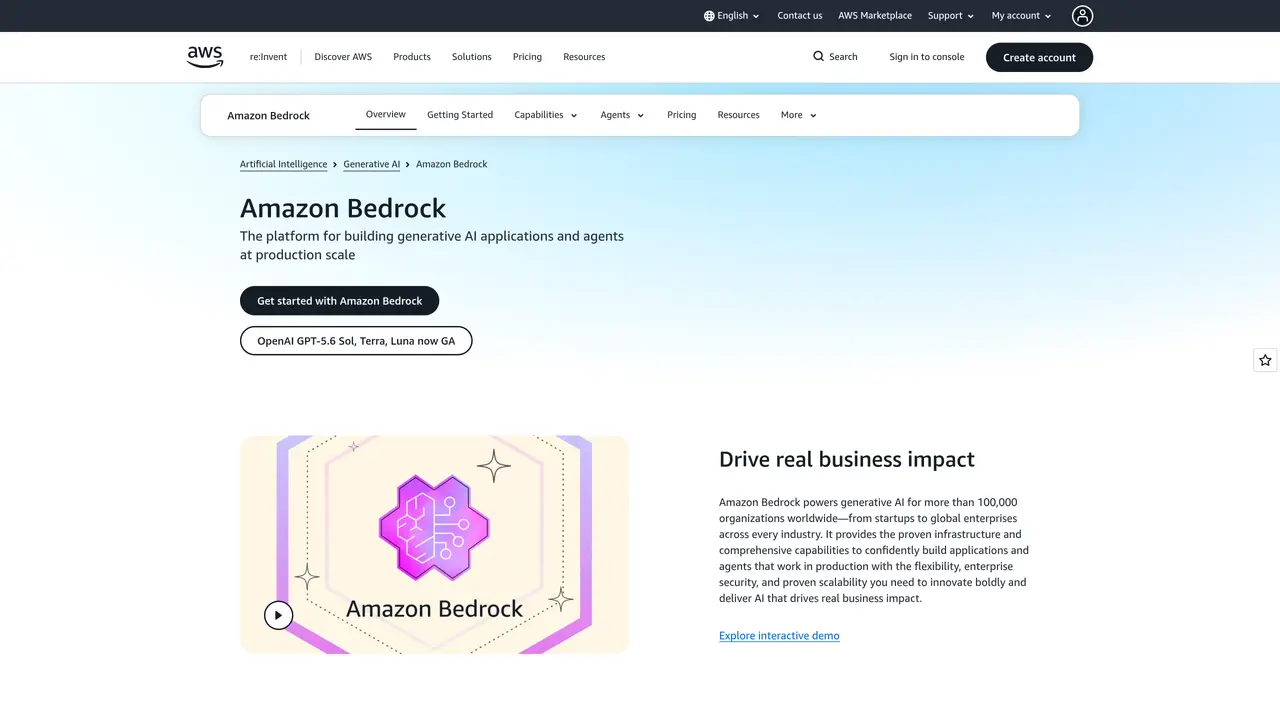
Amazon Bedrock is a fully managed service that provides access to foundation models (FMs) from Amazon and leading AI companies through a unified API. It enables developers to build generative AI applications without managing infrastructure, offering a choice of high-performing models optimized for different tasks such as text generation, summarization, image creation, and conversational assistants. The service supports customization through techniques like fine-tuning and Retrieval Augmented Generation (RAG), allowing users to adapt models to their specific use cases while maintaining data privacy and security within the AWS environment. Bedrock integrates seamlessly with other AWS services, including Lambda, S3, and SageMaker, to streamline workflows and enhance application functionality. It is designed for scalability, supporting projects of any size from prototyping to production deployment, and eliminates the need for users to handle model hosting or maintenance. The platform prioritizes security and compliance, offering features like VPC isolation and AWS IAM for access control. Developers can leverage Bedrock to rapidly prototype AI features, integrate advanced language models into applications, or deploy enterprise-grade solutions with minimal overhead.
Amazon
Seattle, United States · Founded 1994
- Founder
- Jeff Bezos
- Founded
- 1994
- Headquarters
- Seattle, United States
- Legal status
- Public company
Key features
- Access pre-built AI models
- Streamline development process
- Reduce manual coding
- Serverless architecture
- High scalability
- Cost-effective
Use cases
- Quickly access ready-made AI models for any project
- Streamline development and reduce manual coding for AI applications
- Easily scale serverless architecture for any AI project
Pros
- Provides access to foundation models from Amazon and third-party providers
- Enables building generative AI applications and agents at production scale
- Offers serverless architecture for scalability and reduced operational overhead
- Supports customization and integration of AI models into existing workflows
- Facilitates rapid development and deployment of AI-powered solutions
Cons
- May require familiarity with AWS services and cloud infrastructure
- Costs can vary based on usage and model selection
- Limited offline capabilities due to cloud dependency
Bedrock videos
Frequently asked questions about Bedrock
What is Amazon Bedrock?
Amazon Bedrock is an end-to-end platform for building generative AI applications and agents at production scale. It provides access to foundation models from Amazon and other leading providers, enabling developers to integrate AI capabilities into their applications.
Who should use Amazon Bedrock?
Amazon Bedrock is designed for developers, businesses, and organizations looking to build and deploy generative AI applications and agents. It suits those who need scalable, serverless access to foundation models without managing infrastructure.
How does Amazon Bedrock work?
Amazon Bedrock allows users to access and customize pre-built AI models through a serverless API. Developers can integrate these models into their applications, leveraging AWS infrastructure for scalability and reliability.
What models are available in Amazon Bedrock?
Amazon Bedrock offers a range of foundation models, including those from Amazon and other leading providers. These models deliver frontier intelligence and are optimized for performance and cost.
Can Amazon Bedrock be integrated with other AWS services?
Yes, Amazon Bedrock is designed to work seamlessly with other AWS services, enabling users to build comprehensive AI solutions by combining models with AWS tools for data, analytics, and infrastructure.
How do I get started with Amazon Bedrock?
To get started, users can access Amazon Bedrock through the AWS console or API. AWS provides documentation, tutorials, and resources to help developers integrate foundation models into their applications.