GitHub hosts HunyuanVideo, Tencent's open-source framework for large-scale video generation models, enabling AI-driven video creation.

ContextLane
0Popularity
About ContextLane
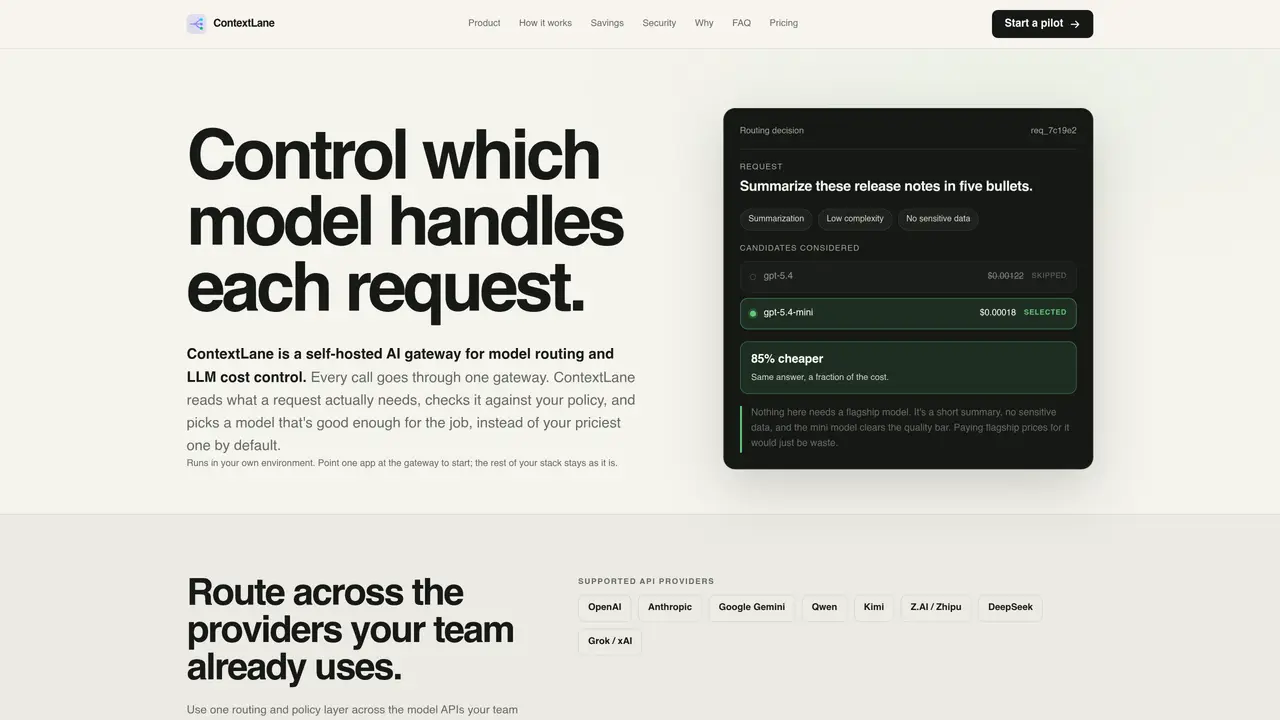
ContextLane is a self-hosted gateway that sits between applications and multiple LLM providers. It intercepts each request, classifies the task type and complexity, and applies configured policies before selecting the least expensive model that meets quality and security requirements. The gateway records routing decisions, baseline costs, actual spend, and savings for audit and cost attribution. It supports providers including OpenAI, Anthropic, Google, Qwen, Kimi, Zhipu, DeepSeek, and Grok, allowing teams to standardize routing across existing API integrations. Deployment occurs within the customer’s own environment, ensuring keys, prompts, and logs remain on-premises while only outbound model calls leave the network. The system is designed for platform engineering teams to centralize provider credentials, fallback rules, and policy enforcement rather than scattering them across individual services or applications.
Key features
- Task classification by complexity, risk, and confidence
- Policy-based model selection and provider allowlists
- Baseline cost comparison and savings tracking
- Audit logging for routing decisions and policy results
- Support for multiple LLM providers via a single endpoint
- Cost attribution by team, app, feature, and request type
- Fallback and exclusion rules for sensitive or high-capability requests
- Self-hosted deployment with on-premises data storage
Use cases
- Reducing LLM inference costs for internal services and products
- Standardizing model routing across engineering platforms and teams
- Auditing and attributing AI spend by department or feature
Pros
- Self-hosted deployment keeps data and credentials within the organization
- Routes requests to lower-cost models when quality thresholds are met
- Centralizes policy and provider management across multiple teams
- Records detailed routing decisions and cost metrics for audit
- Supports multiple major LLM providers through a single endpoint
Cons
- Requires deployment within the customer’s own environment
- No indication of a free tier or open-source option
- Limited to supported LLM providers listed on the site
Frequently asked questions about ContextLane
What is ContextLane?
ContextLane is a self-hosted AI gateway that intercepts LLM requests, classifies task requirements, applies configured policies, and routes each call to the least expensive model that meets quality and security standards. It operates within the user's own environment to centralize routing, enforce policies, and control costs.
Who should use ContextLane?
ContextLane is designed for platform engineering teams, product teams, and finance/FinOps teams. Platform engineers can centralize provider credentials and policies, product teams can reduce inference costs without custom routing logic, and finance teams can attribute model spend by team, app, or request type.
How does ContextLane reduce LLM costs?
ContextLane reduces costs by analyzing each request's complexity, sensitivity, and policy requirements, then selecting a lower-cost model that still meets the task's needs. It compares actual spend against a baseline cost to calculate savings, avoiding unnecessary use of premium models for simple tasks.
Which LLM providers does ContextLane support?
ContextLane supports multiple providers including OpenAI, Anthropic, Google (Gemini), Qwen, Kimi, Zhipu, DeepSeek, and Grok. Users can route across these providers while maintaining centralized control over policies and credentials.
How is ContextLane deployed?
ContextLane is deployed within the customer's own environment, ensuring that API keys, prompts, and audit logs remain on-premises. Only outbound model calls leave the network, and the gateway integrates seamlessly with existing applications by replacing their endpoints.
Can ContextLane enforce policies like sensitivity checks or provider allowlists?
Yes, ContextLane allows administrators to configure policies such as provider allowlists, model exclusions, sensitivity rules, and fallback mechanisms. These policies are applied before model selection to ensure compliance and quality standards are met.