GitHub hosts HunyuanVideo, Tencent's open-source framework for large-scale video generation models, enabling AI-driven video creation.

DistilBERT
$0.03Starting price
0Popularity
About DistilBERT
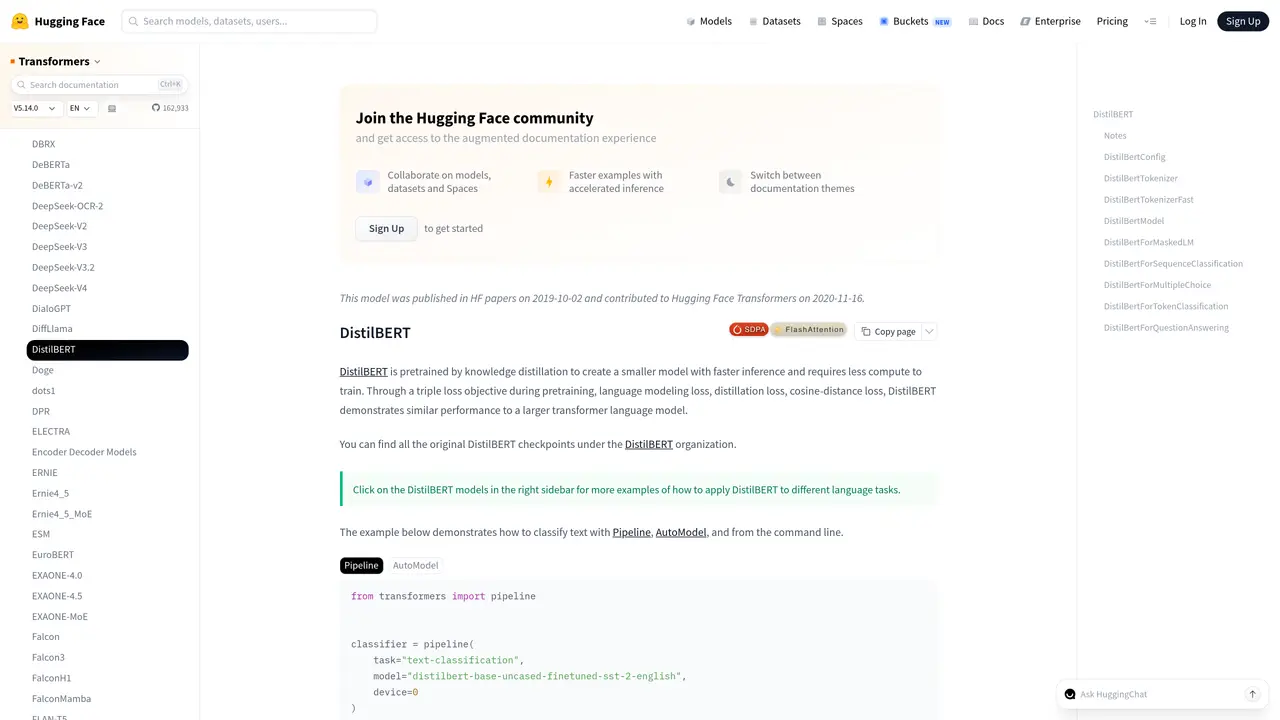
DistilBERT is an advanced natural language processing (NLP) model developed by Hugging Face. This powerful model enables users to quickly and easily extract meaning from text and convert that into actionable insights. With DistilBERT, users can quickly understand the sentiment and intent of text, and easily identify relevant terms, topics, and entities. DistilBERT is ideal for businesses looking to leverage NLP capabilities in their operations. It is a fast, simple, and cost-effective way to gain insights from text, allowing users to uncover hidden trends, identify opportunities, and optimize operations. The model’s lightweight architecture makes it easy to deploy and integrate with existing systems.
Key features
- Quickly extract meaning from text
- Convert text into actionable insights
- Understand sentiment and intent of text
- Identify relevant terms, topics, and entities
- Customize NLP experience with comprehensive set of features
- Deploy and integrate with existing systems easily
Use cases
- Uncover hidden trends in business operations
- Leverage powerful NLP capabilities for text analysis
- Optimize operations by identifying opportunities
Pros
- Lightweight architecture with faster inference compared to larger transformer models
- Reduced computational requirements for training and deployment
- Maintains performance close to larger models through knowledge distillation
- Pre-trained checkpoints available for immediate use in various NLP tasks
- Compatible with Hugging Face Transformers library for easy integration
Cons
- Limited context window compared to some larger transformer models
- May require fine-tuning for specialized tasks to achieve optimal performance
- Lacks certain features like token_type_ids and position_ids in its default configuration
Frequently asked questions about DistilBERT
What is DistilBERT and how does it work?
DistilBERT is a smaller, faster, and lighter version of the BERT model created through knowledge distillation. It is pretrained using a triple loss objective combining language modeling loss, distillation loss, and cosine-distance loss to maintain performance while reducing computational requirements.
Who should use DistilBERT?
DistilBERT is ideal for developers, researchers, and businesses seeking efficient NLP capabilities without the high resource demands of larger transformer models. It suits applications requiring fast inference and lower training costs.
How do I get started with DistilBERT?
You can start using DistilBERT by installing the Hugging Face Transformers library and loading a pretrained or fine-tuned DistilBERT model. The library provides pipelines and classes like AutoModel for quick implementation in text classification or other NLP tasks.
Does DistilBERT support token_type_ids or position_ids?
No, DistilBERT does not include token_type_ids or position_ids options by default. Input segments are separated using the tokenizer's sep_token, and position handling is managed internally by the model.
What are the typical use cases for DistilBERT?
Common use cases include text classification, sentiment analysis, named entity recognition, and other NLP tasks where efficiency and speed are critical. It is often used in production environments requiring real-time processing.
Can DistilBERT be integrated with existing systems?
Yes, DistilBERT is designed for easy integration with existing systems due to its lightweight architecture. It can be deployed on various platforms and integrated with tools like Hugging Face Transformers for seamless workflows.