GitHub hosts HunyuanVideo, Tencent's open-source framework for large-scale video generation models, enabling AI-driven video creation.

Dopamine
$0.07Starting price
0Popularity
About Dopamine
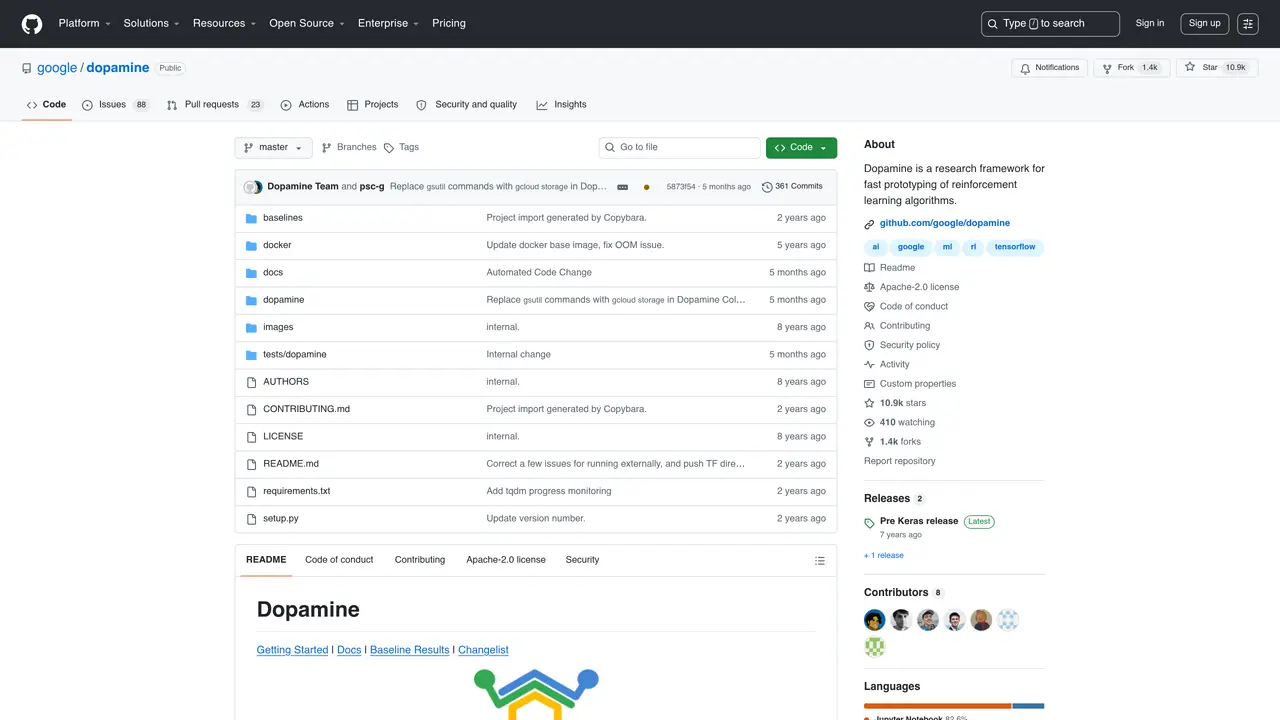
Dopamine is an open source research framework designed by Google to help developers and researchers explore and create reinforcement learning algorithms. It’s designed to be easily extensible, allowing developers to quickly prototype and experiment with different approaches while providing reliable, reproducible results. With its intuitive interface and comprehensive library of algorithms, Dopamine allows developers to quickly assess potential solutions and create powerful reinforcement learning systems. Dopamine is ideal for developers and researchers who are looking to develop and deploy powerful reinforcement learning algorithms. It provides a comprehensive library of algorithms and tools, making it easy to build and test different approaches. Additionally, its intuitive interface and powerful set of features make it simple to quickly prototype and experiment with different solutions. By taking advantage of its wide range of features and tools, developers can easily create powerful reinforcement learning systems that are reliable and reproducible.
GitHub, Inc.
San Francisco, California, US · Founded 2008
- Founders
- Tom Preston-Werner, Chris Wanstrath, PJ Hyett, Scott Chacon
- Founded
- 2008
- Headquarters
- San Francisco, California, US
- Legal status
- Subsidiary of Microsoft (NASDAQ: MSFT)
Key features
- Develop and deploy powerful reinforcement learning algorithms quickly
- Prototype and experiment with different approaches
- Create reliable and reproducible systems
- Comprehensive library of algorithms and tools
- Intuitive interface for easy use
- Extensible framework for customizing solutions
Use cases
- Developing and deploying reinforcement learning algorithms in research projects
- Prototyping and experimenting with different approaches to reinforcement learning
- Creating reliable and reproducible systems for decision-making and optimization
Pros
- Open source research framework for reinforcement learning algorithms
- Supports fast prototyping with a compact and reliable codebase
- Provides implementations of battle-tested algorithms like DQN, Rainbow, and SAC
- Designed for reproducibility with recommended setup practices
- Offers both TensorFlow (legacy) and JAX (actively maintained) agent implementations
Cons
- Primarily focused on research rather than production deployment
- Requires familiarity with reinforcement learning concepts to leverage effectively
- Legacy TensorFlow implementations may not be actively updated
Frequently asked questions about Dopamine
What is Dopamine and what does it do?
Dopamine is an open-source research framework designed for fast prototyping of reinforcement learning algorithms. It provides a compact and flexible codebase to experiment with new ideas, implement benchmark algorithms, and ensure reproducible results.
Who is Dopamine designed for?
Dopamine is aimed at developers and researchers in reinforcement learning who need an easily extensible framework for prototyping algorithms and running benchmark experiments. It supports both new users and experienced practitioners.
How do I get started with Dopamine?
Users can install Dopamine from source, via pip, or use provided Docker containers. Installation requires setting up dependencies and environments like Atari or Mujoco, followed by running basic tests to verify the setup.
What reinforcement learning algorithms does Dopamine support?
Dopamine includes implementations of several algorithms such as DQN, C51, Rainbow, IQN, SAC, and PPO, with JAX as the actively maintained backend and TensorFlow as a legacy option for some algorithms.
Can I use Dopamine with environments like Atari or Mujoco?
Yes, Dopamine supports Atari and Mujoco environments. Users must install these environments separately before using Dopamine, as they are not included in the framework itself.
Is Dopamine suitable for production use?
Dopamine is designed as a research framework for experimentation and prototyping, not for production deployment. It prioritizes flexibility, reproducibility, and ease of modification over production-grade optimization.