GitHub hosts HunyuanVideo, Tencent's open-source framework for large-scale video generation models, enabling AI-driven video creation.

Gitingest
72KMonthly visits
31Popularity
About Gitingest
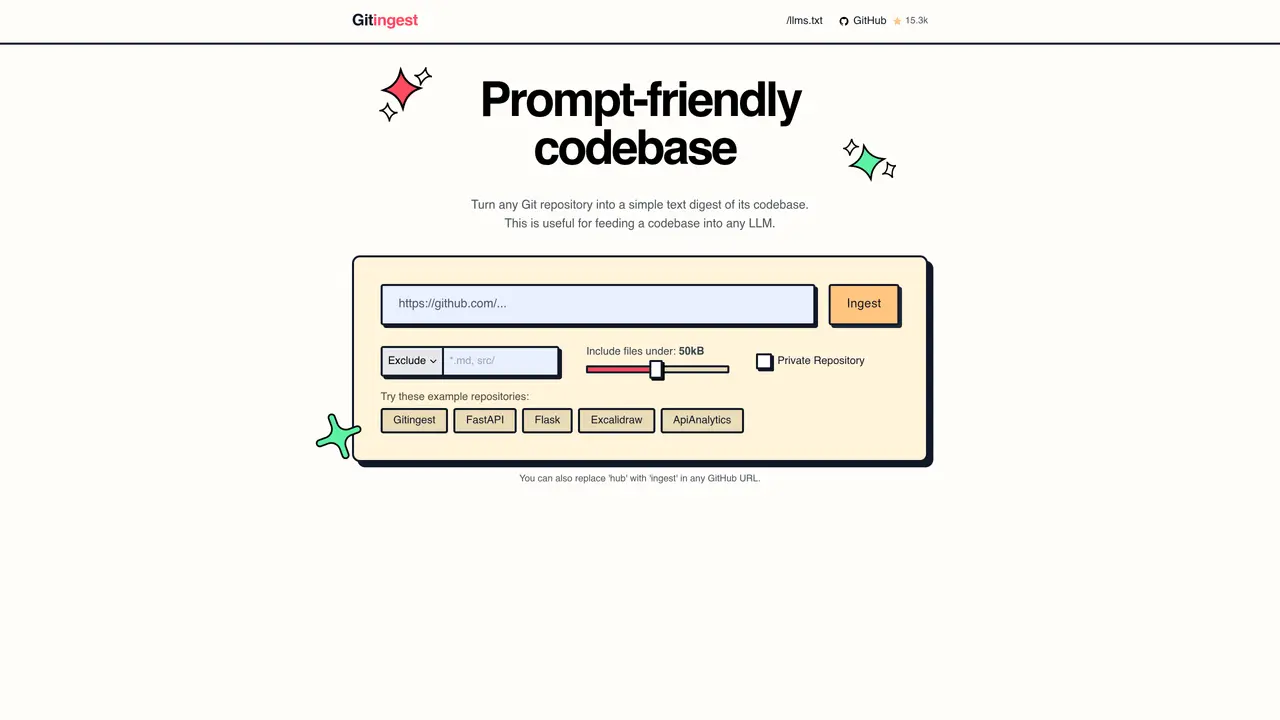
Gitingest transforms GitHub code into plain-text prompts that large language models can process, streamlining code analysis and AI-assisted workflows. It removes the need for manual prompt engineering by automatically formatting repositories into structured inputs for tools like ChatGPT. Developers, data scientists, and technical teams use it to accelerate tasks such as code review, documentation generation, and model training. The tool supports quick repository ingestion and produces optimized prompts that highlight key code elements without requiring data collection or external dependencies. By simplifying the interface between codebases and AI systems, Gitingest reduces the time spent preparing inputs and enables more consistent outputs from language models. It is particularly useful for teams integrating AI into their development pipelines or seeking to automate repetitive code-related tasks.
Key features
- Converts GitHub repositories into AI-readable text
- Generates optimized prompts for large language models
- Supports fast repository analysis without data collection
- Provides structured formatting for code insights
- Works with existing AI tools like ChatGPT
- Enables quick codebase ingestion
- Simplifies prompt engineering for developers
- Maintains compatibility with open-source workflows
Use cases
- Automating code review with AI-generated feedback
- Training AI models on specific codebases
- Generating documentation from repository structure
Pros
- Converts GitHub repositories into plain-text prompts optimized for large language models
- Supports private repositories via temporary personal access tokens (PAT) without storing credentials
- Processes repositories in memory with no browser caching or persistent storage
- Provides a directory structure summary and file content for easy ingestion
- Offers a Chrome extension and Python package for integration flexibility
Cons
- Requires a GitHub personal access token for private repository ingestion
- Processed repositories are deleted after processing, limiting reuse without re-ingestion
- May not handle extremely large repositories efficiently due to memory constraints
Frequently asked questions about Gitingest
What does Gitingest do?
Gitingest converts GitHub repositories into plain-text summaries optimized for large language models, enabling easier code analysis and AI-assisted workflows.
Who should use Gitingest?
Developers, data scientists, and technical teams use Gitingest to streamline tasks like code review, documentation generation, and model training by preparing codebases for AI tools.
How does Gitingest handle private repositories?
Gitingest uses a Personal Access Token (PAT) to clone private repositories, which is immediately discarded after processing and never stored in the backend.
Does Gitingest store or cache repository data?
No, Gitingest does not use browser caching, and cloned repositories are deleted from memory after processing to ensure data privacy.
Can I use Gitingest with any GitHub repository?
Yes, you can process any GitHub repository by replacing 'hub' with 'ingest' in the URL or using the tool's interface to ingest the codebase.
What formats does Gitingest provide for the output?
Gitingest generates a summary, directory structure, and full file contents, which can be copied or downloaded for use with AI models.
Gitingest Website Engagement
Last Update: 9 days ago
Total Monthly Visits
0
Bounce Rate
0%
Visit Duration (avg)
0.00s
Pages Per Visit
0
Country Rank
0
India
Global Rank
0
Category Rank
#0
Programming & Developer Software
Monthly Traffic
Traffic Sources
Traffic Share By Country
- India37.9%
- United States27.1%
- Israel6.1%
- Vietnam5.4%
- Russia3.5%