GitHub hosts HunyuanVideo, Tencent's open-source framework for large-scale video generation models, enabling AI-driven video creation.

Giving GPT-3 a Turing Test
$1Starting price
0Popularity
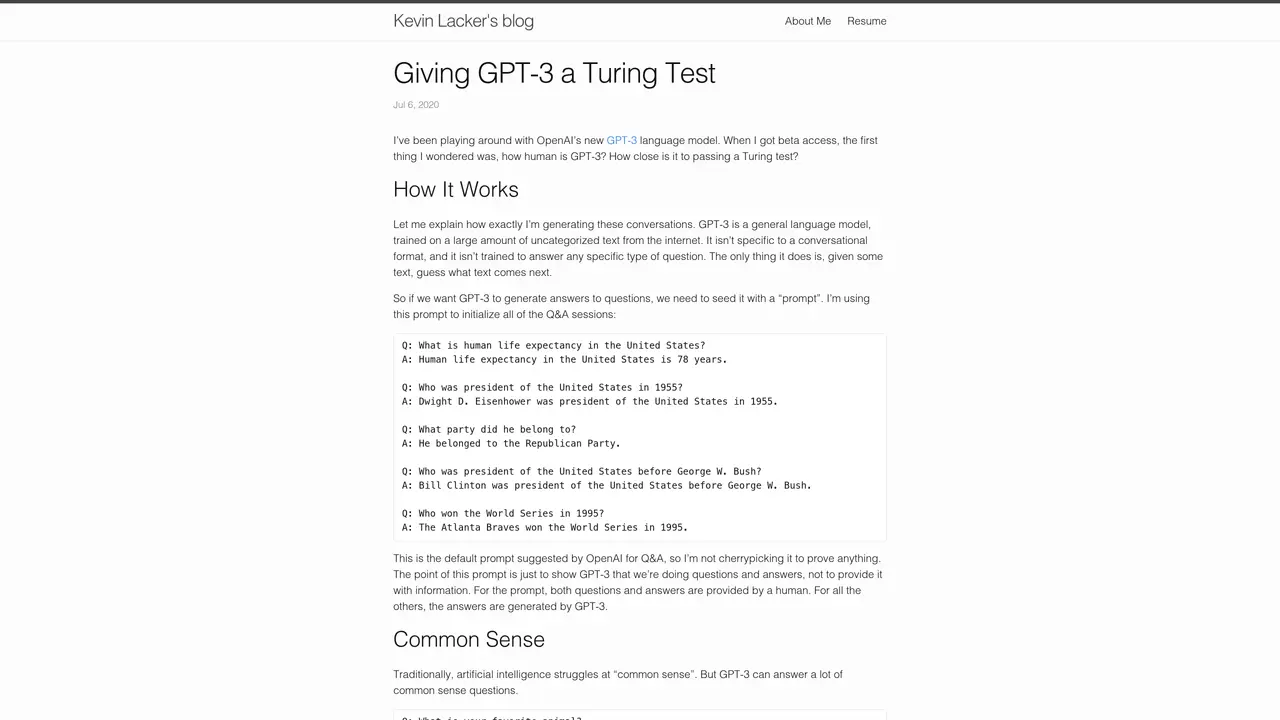
About Giving GPT-3 a Turing Test
Giving GPT-3 a Turing Test is an online service designed to assess the capabilities of natural language processing models by comparing GPT-3’s responses to human answers in a Turing Test setting. Users can interact directly with GPT-3 and receive a detailed analysis of its performance, highlighting strengths and weaknesses in generating human-like text. The tool provides insights into how well the model handles conversational nuances, coherence, and contextual understanding. It is particularly useful for researchers, data scientists, and developers who need to evaluate NLP models before deployment or integration. The evaluation process is straightforward, requiring no specialized setup, and delivers actionable feedback on model behavior. By using this service, users can make informed decisions about model selection, fine-tuning, or improvements. The tool also serves as a benchmark for comparing different AI language models in a standardized way.
Key features
- Direct interaction with GPT-3 for performance evaluation
- Detailed analysis comparing AI responses to human answers
- Turing Test format for assessing human-like conversational ability
- Insights into model strengths and weaknesses in text generation
- No specialized setup required for evaluation
- Benchmarking for comparing AI language models
- Quick and easy performance assessment
- Comprehensive feedback on model behavior and coherence
Use cases
- Evaluating GPT-3 or other NLP models before deployment
- Researching AI language model capabilities and limitations
- Benchmarking different AI models for performance comparison
Pros
- Assesses GPT-3’s human-like conversational abilities through direct interaction
- Provides detailed analysis of model performance in generating coherent and contextually relevant responses
- Highlights strengths and weaknesses in handling conversational nuances and common-sense reasoning
- Offers a standardized benchmark for comparing AI language models in a controlled setting
- Requires no specialized setup, making it accessible for quick evaluations
Cons
- Limited to evaluating GPT-3 and similar models, not a general-purpose NLP testing tool
- Relies on predefined prompts, which may not capture all real-world conversational scenarios
- Does not provide debug output to explain model reasoning or errors
- May struggle with highly abstract or surreal questions, as demonstrated in the test
Frequently asked questions about Giving GPT-3 a Turing Test
What does Giving GPT-3 a Turing Test do?
It evaluates how human-like GPT-3’s responses are by comparing them to human answers in a conversational setting, providing insights into coherence, contextual understanding, and common-sense reasoning.
Who should use this tool?
Researchers, data scientists, and developers who need to assess the performance of language models like GPT-3 before deployment or integration.
How does the evaluation process work?
Users interact with GPT-3 through a series of prompts and questions, and the tool analyzes the responses to determine how closely they resemble human-like answers.
Can this tool be used to evaluate other AI models?
The tool is designed specifically for GPT-3 and similar models, but the methodology could theoretically be adapted for other language models.
What kind of questions does the tool use to test GPT-3?
It uses a mix of common-sense, trivia, and surreal questions to assess the model’s ability to handle different types of conversational challenges.
Does the tool provide explanations for GPT-3’s responses?
No, it does not offer debug output to explain why GPT-3 answered a question in a particular way, only an analysis of its performance.