GitHub hosts HunyuanVideo, Tencent's open-source framework for large-scale video generation models, enabling AI-driven video creation.

GPT-4
$20/mStarting price
0Popularity
About GPT-4
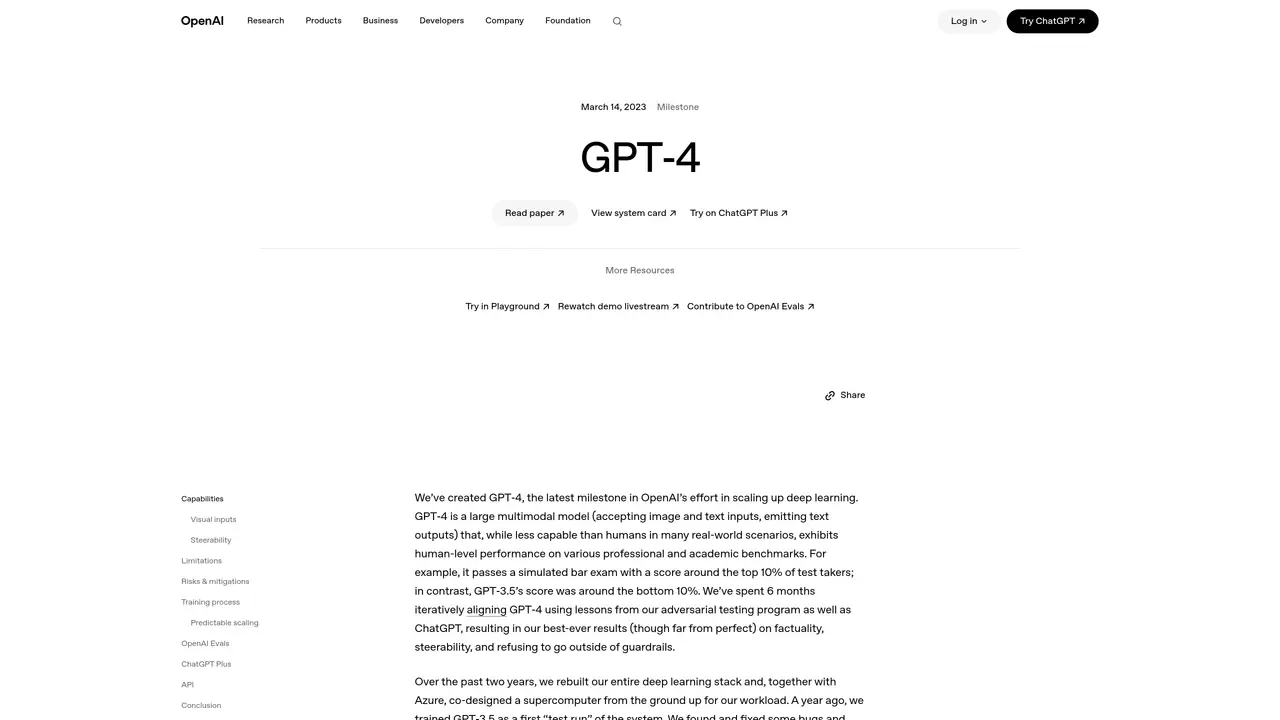
GPT-4 is a large multimodal model developed by OpenAI, capable of processing both text and image inputs to generate human-like text outputs. It builds on the foundation of its predecessors with enhanced reasoning, creativity, and problem-solving abilities, enabling it to perform complex tasks across diverse domains. The model excels in generating coherent, contextually relevant, and grammatically accurate language, making it suitable for professional, academic, and creative applications. GPT-4 is designed to handle nuanced instructions and adapt to specific use cases, whether for drafting documents, answering questions, or assisting with research. Its advanced capabilities support a wide range of workflows, from content creation and summarization to coding assistance and data analysis. OpenAI emphasizes its improved safety and alignment features, reducing harmful outputs while maintaining high performance. The model is particularly valuable for users seeking reliable, high-quality text generation in real-world scenarios. It is accessible through OpenAI’s API, allowing integration into various applications and platforms.
OpenAI
San Francisco, California, US · Founded 2015
- Founders
- Sam Altman, Greg Brockman, Ilya Sutskever, Elon Musk, Wojciech Zaremba, John Schulman
- Founded
- 2015
- Headquarters
- San Francisco, California, US
- Legal status
- Private (capped-profit)
Key features
- Generate compelling language outputs for business or academic applications
- Automate workflow with real-world outputs of high quality
- Quickly create grammatically correct and contextually appropriate language
- Achieve human-level performance across a variety of tasks
- Process text, video, PDFs, and other complex data types
- Improved multilingual capabilities
Use cases
- Businesses looking to streamline their workflow and improve output quality
- Academics seeking to generate high-quality language outputs for research and publications
- Developers using GPT-4 as a tool for chatbots, personal assistants, and language translation
Pros
- Demonstrates human-level performance on various professional and academic benchmarks
- Supports both text and image inputs for multimodal tasks
- Generates contextually appropriate and grammatically correct language outputs
- Capable of producing high-quality, persuasive, and engaging content
- Enables streamlined workflows for businesses and organizations through automation
Cons
- Limited availability due to restricted access and usage policies
- Potential for generating biased or inaccurate outputs without proper oversight
- Requires significant computational resources for training and deployment
- May produce plausible but incorrect or nonsensical information, necessitating human review
Frequently asked questions about GPT-4
What is GPT-4?
GPT-4 is a large multimodal model developed by OpenAI that can process both text and image inputs to generate human-like text outputs. It is designed to perform a wide range of language tasks with advanced reasoning and contextual understanding.
Who is GPT-4 suitable for?
GPT-4 is suitable for professionals, researchers, businesses, and organizations that require high-quality text generation, content creation, or language-based problem-solving. Its versatility makes it useful across industries such as education, marketing, and software development.
How does GPT-4 work?
GPT-4 uses deep learning techniques trained on vast amounts of data to understand and generate text. It leverages advanced algorithms to analyze input and produce coherent, contextually appropriate responses, whether for text or image-based prompts.
What are the typical use cases for GPT-4?
GPT-4 is commonly used for tasks such as drafting documents, generating creative content, answering complex questions, translating languages, and assisting with coding or technical writing. Its multimodal capabilities also allow it to interpret images and describe them in text.
Does GPT-4 support integrations with other tools?
Yes, GPT-4 can be integrated into various applications and platforms through APIs provided by OpenAI. This allows developers to embed its capabilities into their own software, workflows, or services.
How can I get started with GPT-4?
To get started with GPT-4, visit the OpenAI website to access its documentation and API. Users can sign up for access, review usage guidelines, and begin integrating or using the model depending on their needs and the available access tiers.