GitHub hosts HunyuanVideo, Tencent's open-source framework for large-scale video generation models, enabling AI-driven video creation.

H20 Driverless AI
$0.66Starting price
0Popularity
About H20 Driverless AI
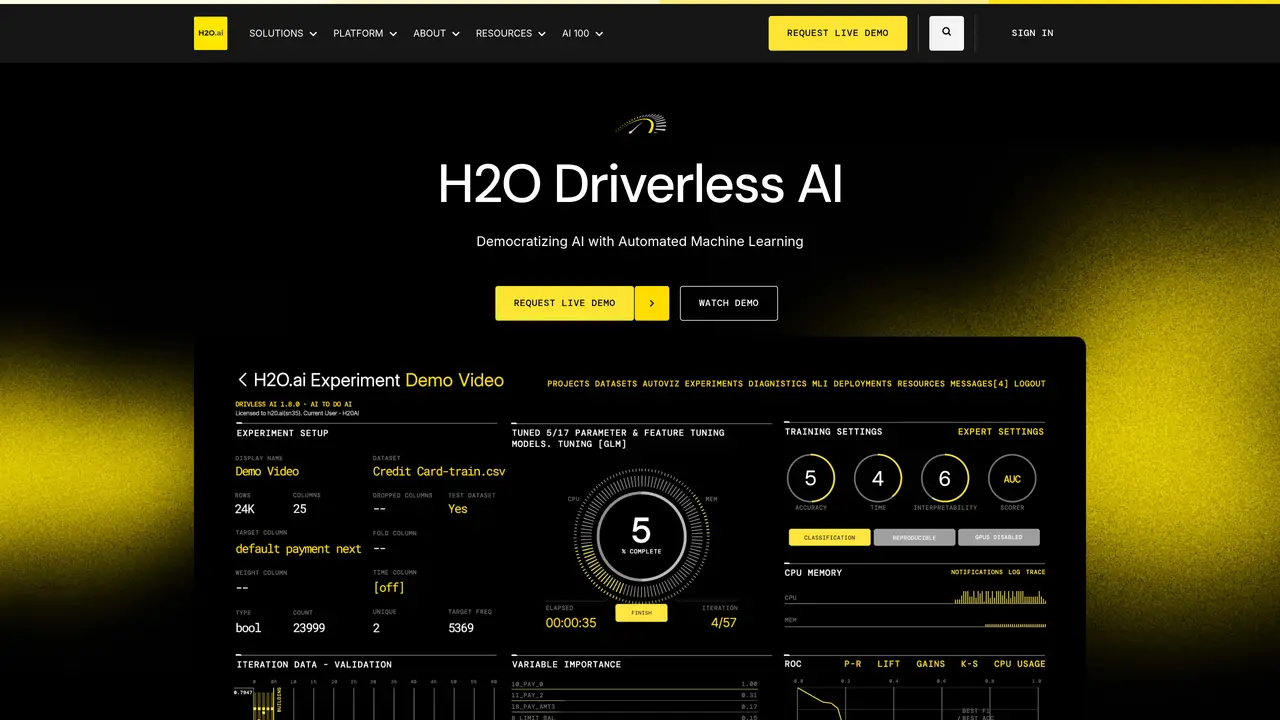
H20 Driverless AI is an advanced artificial intelligence (AI) platform that simplifies and accelerates the process of building and deploying predictive models. It allows users to access the latest machine learning algorithms and technologies with an intuitive, easy-to-use interface. With H20 Driverless AI, users can quickly and accurately build accurate predictive models from large datasets, without needing to write code. It also provides powerful tools for feature engineering and model optimization, making it the ideal choice for data scientists and developers alike. H20 Driverless AI is the perfect solution for businesses looking to leverage the latest AI technology without needing to hire an expert. With its intuitive interface and drag-and-drop design, users of any skill level can quickly and easily build powerful predictive models. Additionally, the platform provides automated feature engineering, model selection, and hyperparameter optimization, so users don’t need to worry about manual tuning.
Key features
- Automate feature engineering
- Optimize models
- Intuitive interface for all skill levels
- Drag-and-drop design to quickly build predictive models
- Automated feature engineering
- Model selection and hyperparameter optimization
Use cases
- Businesses looking to leverage the latest AI technology without hiring an expert
- Data scientists and developers building accurate predictive models from large datasets
- Users of any skill level who want to quickly and easily build powerful predictive models
Pros
- Automates the entire machine learning pipeline, from data ingestion to model deployment
- Provides intelligent feature engineering and transformation without manual coding
- Offers comprehensive model explainability and interpretability tools
- Includes an expert recommender system for guided model development
- Supports deployment across multiple environments, including cloud services and edge devices
Cons
- May require initial setup and configuration for optimal performance
- Limited customization for advanced users who prefer manual control over the modeling process
H20 Driverless AI videos
Frequently asked questions about H20 Driverless AI
What is H2O Driverless AI and what does it do?
H2O Driverless AI is an automated machine learning platform that accelerates the development of predictive models by automating key data science tasks such as feature engineering, model development, validation, and explainability. It enables users to build accurate models without requiring extensive coding expertise.
Who should use H2O Driverless AI?
The platform is designed for data scientists, developers, and business users who want to leverage AI for predictive modeling without needing deep coding skills. It is particularly useful for organizations aiming to scale AI adoption across teams with varying technical backgrounds.
How does H2O Driverless AI handle data integration and preparation?
H2O Driverless AI allows users to ingest data from various sources, including Hadoop HDFS and Amazon S3. It automatically visualizes data, addresses quality issues, and performs advanced feature engineering to transform raw data into an optimal modeling dataset.
Does H2O Driverless AI support model explainability?
Yes, the platform provides a comprehensive explainability toolkit that helps users understand the 'why' behind model predictions, offering both global and local explanations for model outputs. This is critical for building trust and ensuring compliance in production environments.
Can models built with H2O Driverless AI be deployed easily?
Yes, H2O Driverless AI supports automated deployment of models across multiple environments, including REST endpoints for web applications, cloud-based services, and optimized Java code for edge devices. This flexibility ensures models can be integrated into various production workflows.
What types of data can H2O Driverless AI process?
The platform can process a variety of data types within a single dataset, including structured, semi-structured, and unstructured data. It is designed to handle diverse datasets, making it suitable for a wide range of use cases across industries.