GitHub hosts HunyuanVideo, Tencent's open-source framework for large-scale video generation models, enabling AI-driven video creation.

Interviewing Albert Einstein via GPT-3
$1Starting price
0Popularity
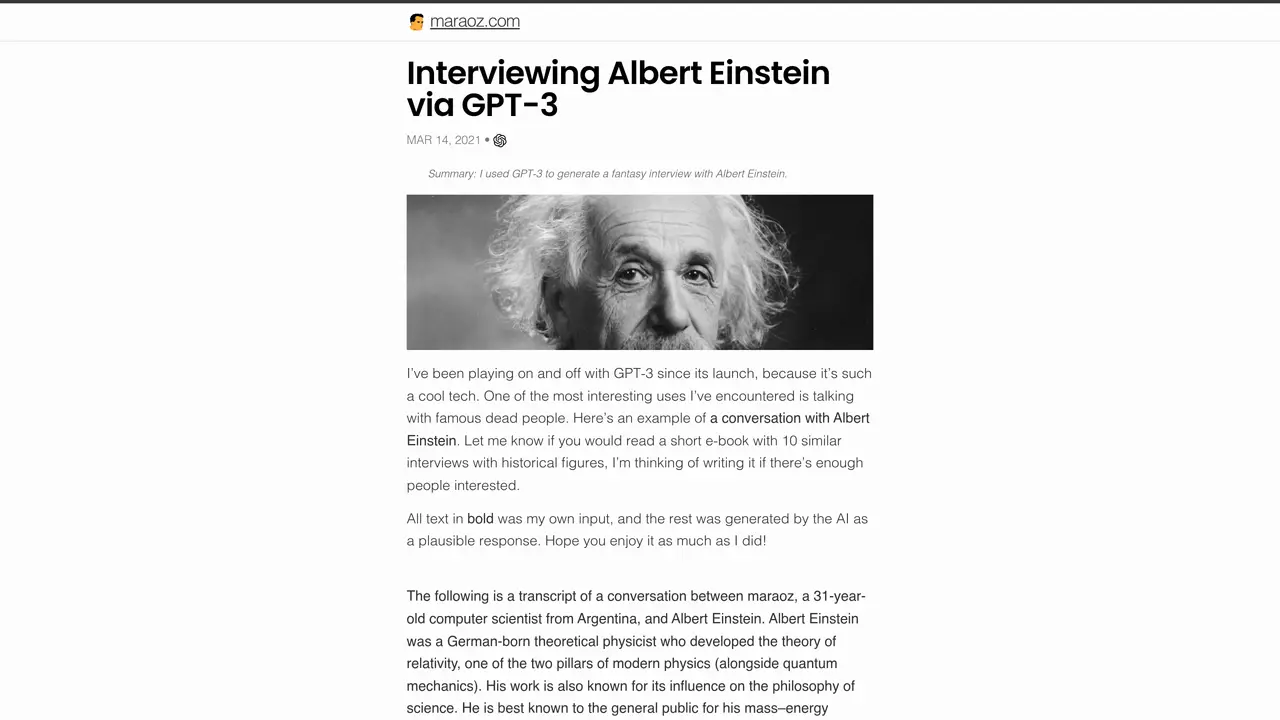
About Interviewing Albert Einstein via GPT-3
Interviewing Albert Einstein via GPT-3 enables users to pose questions about science, world events, philosophy, and ethics and receive responses crafted to reflect Einstein’s distinctive perspective. The tool leverages GPT-3’s language model, which has been fine-tuned to emulate Einstein’s writing and reasoning patterns, creating an interactive experience that simulates a dialogue with the physicist. This approach is designed for anyone seeking to gain insights from one of history’s most influential thinkers, whether for educational purposes, personal curiosity, or creative exploration. The service delivers personalized answers tailored to each question, fostering a sense of direct engagement with Einstein’s intellectual legacy. By bridging past and present thought, it offers a unique way to examine fundamental questions about the universe, human knowledge, and societal values. Users can explore topics ranging from theoretical physics to ethical dilemmas, all framed through Einstein’s historical context and intellectual framework.
Key features
- Simulated conversation with Albert Einstein via GPT-3
- Replication of Einstein’s writing and thinking style
- Support for questions on science, philosophy, ethics, and world events
- Personalized responses tailored to each user’s inquiry
- Interactive dialogue format for deeper exploration
- Accessible to scientists, students, and general audiences
- No prior knowledge of Einstein required to engage
Use cases
- Explore scientific concepts through Einstein’s perspective
- Gain insights into philosophy and ethics via historical lens
- Use for educational demonstrations or thought experiments
Pros
- Enables interactive dialogue with a historically accurate simulation of Albert Einstein’s perspectives
- Leverages GPT-3’s advanced language model to emulate Einstein’s reasoning and writing style
- Facilitates exploration of complex topics such as science, philosophy, and ethics through Einstein’s lens
- Designed for educational, personal, and creative inquiry into historical intellectual thought
- Provides personalized responses tailored to individual questions and topics
Cons
- Responses are simulated and may not fully reflect Einstein’s actual views or historical context
- Limited to text-based interaction without visual or contextual depth
- Dependent on the accuracy of GPT-3’s fine-tuning for Einstein’s persona
Frequently asked questions about Interviewing Albert Einstein via GPT-3
What is Interviewing Albert Einstein via GPT-3?
It is an interactive tool that simulates a dialogue with Albert Einstein using GPT-3’s language model, fine-tuned to reflect his writing and reasoning patterns.
Who is this tool designed for?
The tool is designed for anyone interested in exploring science, philosophy, ethics, or historical thought through Einstein’s perspective, including educators, students, and curious individuals.
How does the tool work?
Users pose questions to the system, which generates responses crafted to emulate Einstein’s intellectual style and historical context.
What topics can I explore with this tool?
Users can explore a wide range of topics, including theoretical physics, world events, philosophy, and ethical dilemmas, framed through Einstein’s perspective.
Are the responses based on Einstein’s actual writings?
The responses are generated by GPT-3 and designed to reflect Einstein’s style and reasoning, but they are simulated rather than direct quotes or exact reproductions.
How can I get started with the tool?
Visit the tool’s webpage to begin posing questions and receiving simulated responses in Einstein’s voice.