GitHub hosts HunyuanVideo, Tencent's open-source framework for large-scale video generation models, enabling AI-driven video creation.

Kielo
$4.28/hrStarting price
0Popularity
About Kielo
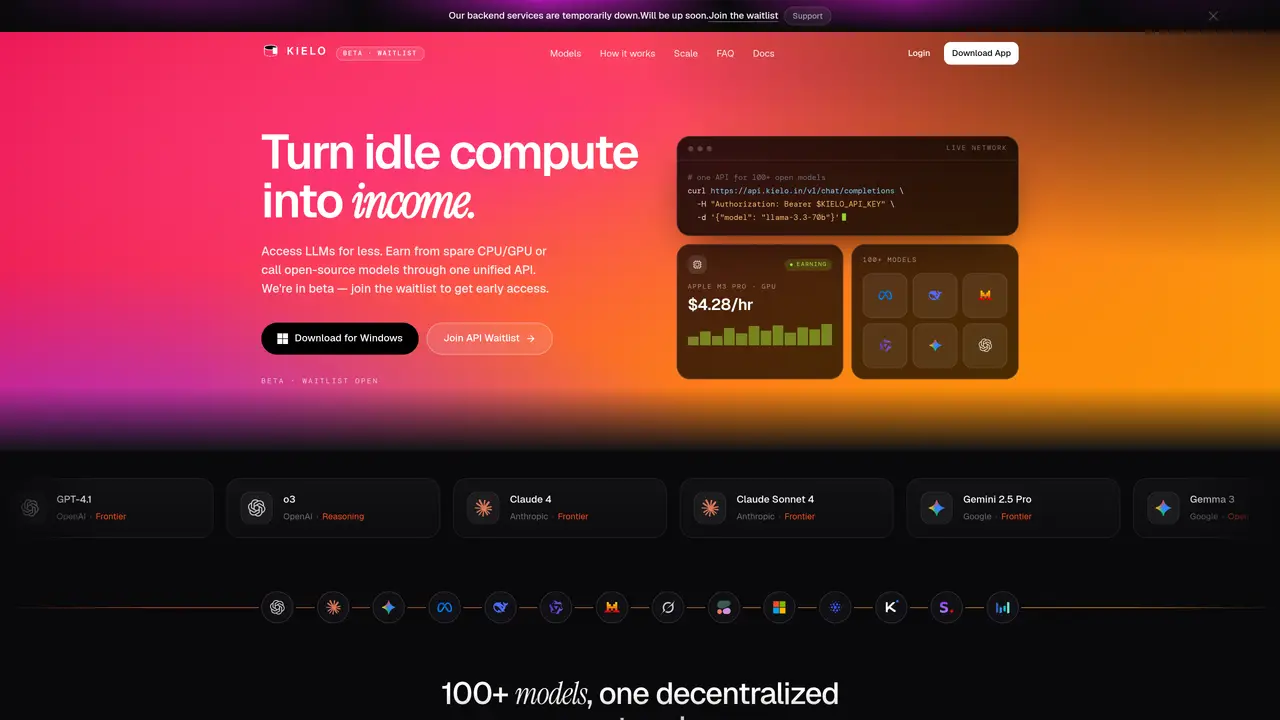
Kielo provides a unified API endpoint that aggregates access to over 100 large language models, vision models, text-to-image, text-to-video, speech-to-text, and other AI services. The platform operates by routing user requests across a decentralized network of verified hardware, selecting nodes based on factors such as latency, reputation, and availability while ensuring automatic failover for reliability. Users can interact with models either through the API or by installing a desktop application, which also enables them to monetize idle CPU and GPU resources by accepting inference jobs. The service supports both open-weight models and frontier models from providers including Meta, Mistral AI, DeepSeek, and others. Requests are processed in real time, with transparent performance metrics provided to users. Contributors to the network receive payouts for their computational resources. The platform is designed to offer flexibility, scalability, and cost-efficiency for developers and organizations seeking to integrate diverse AI capabilities without managing multiple provider relationships.
Key features
- 100+ supported models including Llama, Mistral, Qwen, DeepSeek, and frontier models
- OpenAI-compatible API endpoint for seamless integration
- Decentralized routing with latency, reputation, and availability scoring
- Automatic failover for uninterrupted service
- Desktop app for monetizing idle GPU/CPU resources
- Transparent payouts and performance metrics for contributors
- Support for LLMs, vision models, text-to-image, text-to-video, and speech services
- Benchmarking and thermal safeguards for contributor hardware
Use cases
- Accessing multiple AI models through a single API for development and production
- Monetizing unused GPU resources by contributing to the decentralized network
- Running inference jobs with automatic load balancing across verified hardware
Pros
- Single unified API for 100+ models across LLMs, vision, audio, and multimodal services
- Decentralized routing with automatic failover and latency-based node selection
- Option to monetize idle GPU/CPU resources via desktop app
- OpenAI-compatible endpoint requiring minimal code changes
- Transparent performance metrics and payout tracking for contributors
Cons
- Backend services currently down with no specified timeline for restoration
- Waitlist-only access during beta phase
- Requires installation of desktop app for earning functionality
Frequently asked questions about Kielo
What is Kielo?
Kielo is a decentralized platform that provides a single API endpoint for accessing over 100 AI models, including large language models, vision models, text-to-image, text-to-video, speech-to-text, and other services. It routes requests across a network of verified hardware with intelligent selection based on performance metrics.
Who should use Kielo?
Kielo suits developers, researchers, and businesses seeking cost-effective access to a wide range of AI models through a unified API. It also appeals to individuals with idle GPU or CPU resources who wish to monetize their hardware by contributing to the network.
How does Kielo's pricing model work?
Kielo offers access to AI models at competitive rates by leveraging a decentralized network of hardware providers. Users pay for the compute resources consumed, while contributors earn by sharing their idle hardware. Pricing varies based on model and demand.
What integrations does Kielo support?
Kielo provides an OpenAI-compatible API, allowing users to integrate existing OpenAI SDKs with minimal changes. It supports models from providers like Meta, Mistral AI, DeepSeek, and others, as well as multimodal and audio services.
What are the limitations of Kielo?
As a decentralized network, Kielo's performance may vary depending on node availability and network conditions. Users may experience latency or occasional downtime during peak demand or network adjustments. The platform is currently in beta, with limited access.
How do I get started with Kielo?
To get started, users can join the waitlist for early access or download the desktop application to contribute idle hardware. Once access is granted, users can generate an API key and begin making requests to supported models through the unified endpoint.