
Collaboration and version control platform for software development and AI model hosting.
746M visits/mo+15.5%#1 Coding & Development

Unified API gateway for routing AI model requests with data residency controls
Be the first member to say you use it
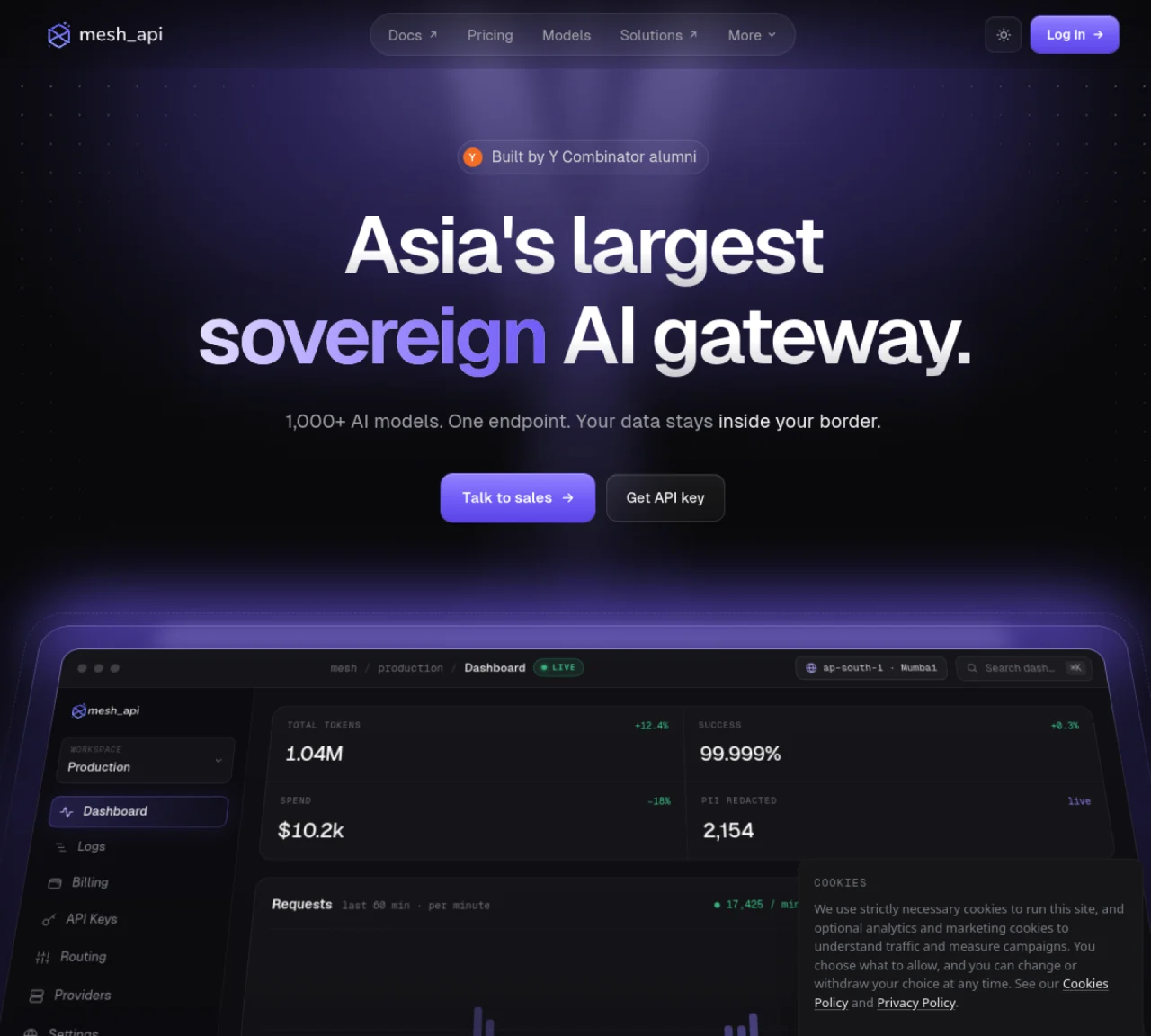
Mesh API functions as a gateway that routes AI model requests through a single endpoint while enforcing data residency, governance, and cost controls. It supports over 1,000 AI models from multiple providers and allows organizations to specify regional routing to keep data within designated borders. The platform provides observability features to track every AI call, including request traces, spend tracking by team, and provider health monitoring. Governance controls include model allowlists, spend caps, role-based access, and rate limiting to manage usage across teams. Security measures encompass PII redaction, zero data retention, and end-to-end encryption for all requests. Mesh offers multiple deployment options, including a managed cloud service, dedicated regional instances, and self-hosted deployments within a customer’s infrastructure. The service integrates with existing security and monitoring tools and supports multi-currency billing with no forced currency conversion.
Mesh API is a sovereign AI gateway that routes AI model requests through a single endpoint while enforcing data residency, governance, and cost controls. It supports over 1,000 AI models from multiple providers and allows organizations to specify regional routing to keep data within designated borders.
Mesh API is designed for enterprises and organizations that require strict data residency, governance, and cost management for their AI workloads, particularly those in regulated industries or operating across multiple regions.
Mesh API enforces data residency by routing requests within specified regions, and it provides enterprise-grade security features such as PII redaction, zero data retention, and end-to-end encryption for all requests.
Mesh API offers multiple deployment options, including a managed cloud service, dedicated regional instances, and self-hosted deployments within a customer’s infrastructure.
Yes, Mesh API integrates with existing security and monitoring tools, allowing organizations to send security events to tools they already use, such as CrowdStrike and Palo Alto Networks.
Mesh API provides observability features to track spend by team, model allowlists, spend caps, and auto-routing to the most cost-efficient model for each request, helping organizations optimize AI spending.
meshapi.ai · third-party estimates from Similarweb
Last 3 months · grows by one month every month
Share of visits by channel
No measurable traffic from Paid Referrals.
Share of visits · estimated visits
Coding & Development · Oct 2026
Traffic figures are third-party estimates, good for scale and trends; they can differ from a company's own numbers. Updated monthly.
We use essential cookies to run aitoolnavio™, and optional cookies to analyze traffic and measure our marketing. You choose what we use — optional cookies stay off unless you turn them on. See our Privacy Policy.
One short email a week: fresh tools worth trying, honest takes and the updates that actually matter. No spam, unsubscribe any time.
Collaboration and version control platform for software development and AI model hosting.
Scales efficient language processing with open-source accessibility.
Tesla’s AI stack powers Full Self-Driving, Optimus humanoid robots, and real-world autonomy with neural networks, custom hardware, and Dojo-scale training.
AI-powered website builder that generates a professional site in under a minute and includes tools for content, SEO, and analytics.
Integrates AI into Airtable to analyze data, summarize insights, draft content, and automate workflows without prior AI experience.
Meta's free AI assistant for chat, answers and image generation, built into WhatsApp, Instagram, Facebook and the web.
Unified platform to access and switch between hundreds of AI models like ChatGPT, Claude, and Gemini via a single API.
xAI builds Grok frontier AI models for reasoning, coding, voice, images, video, enterprise workflows, and developer APIs.
Crowdsourced platform for blind, side-by-side AI model comparisons with a public leaderboard.
Independent benchmarks comparing AI models on quality, speed, and cost across multiple capabilities.
Chat, build, and explore with open AI models.
Customize, deploy, and control AI models securely.
Matched on what this tool does — grouped by the job you would be replacing.
matches Unified AI model routing · Regional data residency enforcement · Request observability and tracing
Unified API gateway for routing and managing AI model requests
Unified API gateway for routing, comparing, and operating across 200+ AI models via a single
Unified AI gateway routing requests to multiple LLM providers and MCP servers via one OpenAI-compatible
An LLM Gateway that functions as an intelligent middleware for all your LLM needs.