GitHub hosts HunyuanVideo, Tencent's open-source framework for large-scale video generation models, enabling AI-driven video creation.

Model Proxy
$9/moStarting price
0Popularity
About Model Proxy
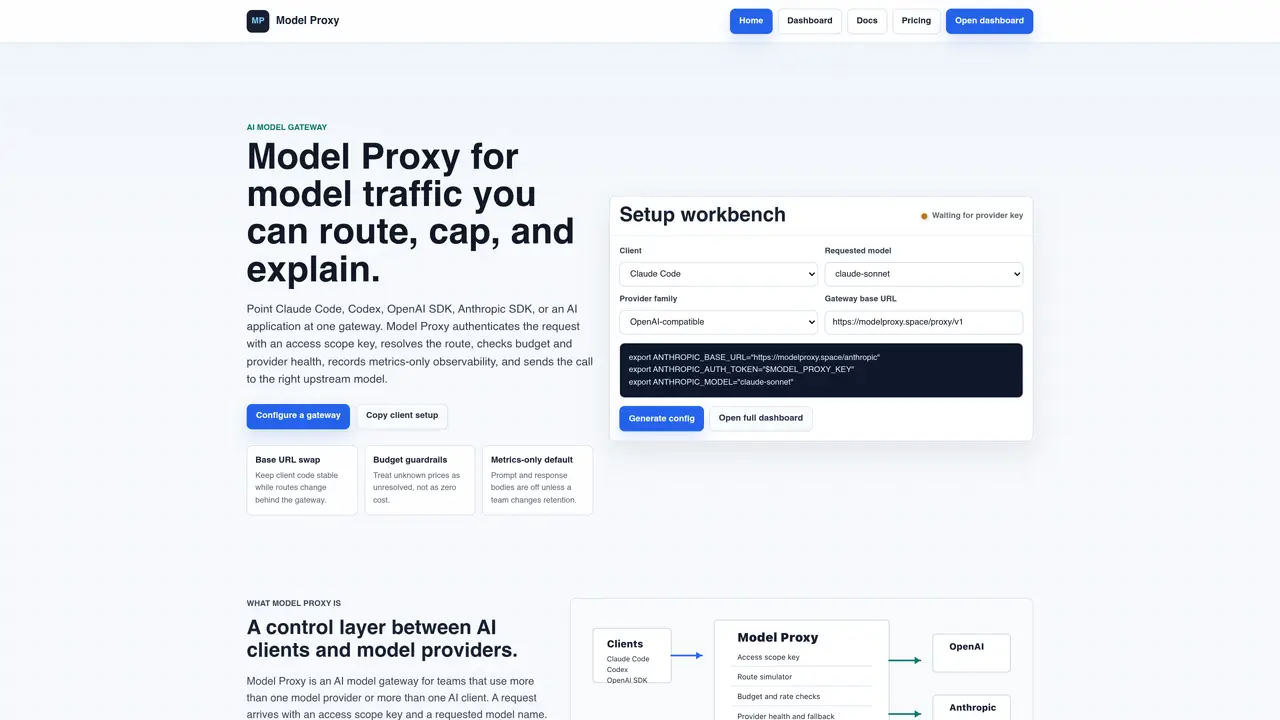
Model Proxy acts as a control layer between AI clients and model providers, routing requests to the appropriate upstream model while enforcing budget, rate, and health policies. Teams configure a gateway with provider profiles, model aliases, and access scope keys, then point existing AI clients such as Claude Code, Codex, OpenAI SDK, or Anthropic SDK to the gateway’s base URL. The gateway resolves the requested model alias to an enabled provider, checks budgets and provider health, and records metadata for monitoring without storing prompt or response bodies by default. Operators use the console to simulate routes, probe provider capabilities, and manage access keys before production traffic. The tool supports chat, streaming, tool use, embeddings, and search bridges, with fallback and kill-switch controls for production incidents. Configuration is generated per client, allowing stable client code while routing decisions change behind the gateway.
Key features
- Gateway base URL for stable client configuration
- Access scope keys for authentication and scoping
- Budget guardrails with unknown-price blocking
- Route simulation and provider readiness checks
- Metrics-only logging by default
- Fallback and rollback controls
- Search provenance tracking with source URLs
- Workspace-based provider and route management
Use cases
- Centralizing multi-provider AI traffic for cost control
- Testing cheaper or alternative model routes before production
- Enforcing budget and rate limits across multiple AI clients
Pros
- OpenAI-compatible interface for existing SDKs and clients
- Budget and rate-limit enforcement in the request path
- Provider health checks with fallback and kill-switch controls
- Metrics-only observability by default
- Route simulation and capability probing before production
Cons
- No free tier beyond trial
- Limited to OpenAI-compatible endpoints
- No public API documentation visible on homepage
- Pricing page incomplete in scraped text
Frequently asked questions about Model Proxy
What is Model Proxy and what does it do?
Model Proxy is an AI model gateway that acts as a control layer between AI clients and model providers. It routes requests to the appropriate upstream model while enforcing budget, rate, and health policies. The tool authenticates requests with access scope keys, resolves model aliases to enabled providers, and records metadata for monitoring without storing prompt or response bodies by default.
Who should use Model Proxy?
Model Proxy is designed for teams that use multiple AI model providers or multiple AI clients. It is particularly useful for organizations that need centralized control over routing, budgeting, and observability across different entry points such as Claude Code, Codex, OpenAI SDK, or Anthropic SDK.
How does Model Proxy handle budget and rate limits?
Model Proxy enforces budget and rate rules in the request path before dispatching to the upstream provider. It checks provider health, known pricing, requests per minute (RPM), tokens per minute (TPM), monthly budgets, and retention rules. If any check is unresolved, the tool stops the request with a clear status rather than sending traffic to an incorrect provider.
Can I change routing decisions without modifying client code?
Yes, Model Proxy allows teams to rotate upstream provider credentials, change fallbacks, test cheaper routes, or stop a failing provider without editing every application. Clients only need to point to the gateway’s base URL, while routing decisions are managed centrally in the gateway.
What kind of monitoring and observability does Model Proxy provide?
Model Proxy records request metadata for monitoring, including which client sent the request, the access scope key used, the resolved route, provider health, cost status, latency, and failure boundaries. By default, it does not store prompt or response bodies unless explicitly configured otherwise.
How do I get started with Model Proxy?
To get started, generate client-specific configuration from the Model Proxy console, create provider profiles with base URLs and known prices, map public model aliases to providers, and run the route simulator to test configurations before production. Access scope keys are generated only after these steps are completed.