GitHub hosts HunyuanVideo, Tencent's open-source framework for large-scale video generation models, enabling AI-driven video creation.

NMF
0Popularity
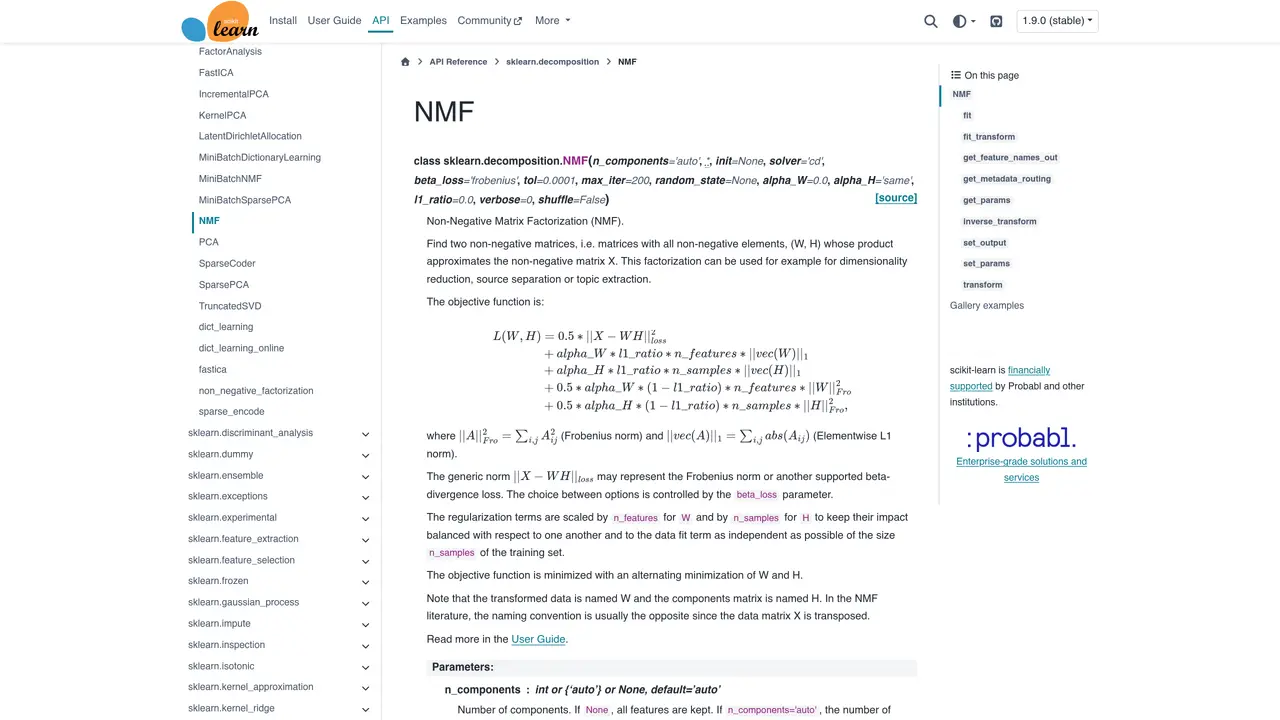
About NMF
NMF (Non-negative Matrix Factorization) is a powerful machine learning technique for analyzing complex data sets. It is used to uncover hidden patterns and relationships in large datasets, and it is especially useful in applications such as topic modeling, image processing, and speech recognition. NMF can quickly identify meaningful trends in large datasets, making it an invaluable tool for data scientists. It works by decomposing a large dataset into a set of smaller, more manageable components. The components are non-negative and represent the underlying structure of the data in an interpretable way. NMF is simple to use and can be applied to a variety of problem domains. It is especially useful for uncovering latent structure in datasets, as well as for extracting meaningful features from noisy data. In addition, NMF can be used to identify relationships between data points and generate insightful visualizations.
Key features
- Uncover hidden patterns in large datasets
- Extract meaningful features from noisy data
- Identify relationships between data points
- Decompose large datasets into smaller components
- Represent underlying structure of data in an interpretable way
- Simple to use and apply to various problem domains
Use cases
- Topic modeling
- Image processing
- Speech recognition
Pros
- Decomposes data into non-negative components for interpretable results
- Works well with sparse and high-dimensional datasets
- Integrated into scikit-learn, ensuring compatibility with other machine learning tools
- Supports dimensionality reduction and feature extraction
- Provides a straightforward API for model training and prediction
Cons
- Assumes non-negativity of input data, limiting applicability to certain datasets
- May require careful tuning of hyperparameters for optimal performance
- Computationally intensive for very large datasets without optimization
Frequently asked questions about NMF
What is NMF and how does it work?
NMF, or Non-negative Matrix Factorization, is a dimensionality reduction technique that decomposes a data matrix into two non-negative matrices, revealing latent patterns. It works by approximating the original data as a product of two lower-dimensional matrices with non-negative elements.
Who should use NMF?
NMF is suitable for data scientists and researchers working with large datasets where interpretability and non-negativity constraints are important, such as in topic modeling, image processing, or feature extraction.
How do I get started with NMF in scikit-learn?
To use NMF, import it from scikit-learn's decomposition module and initialize it with your data matrix. Fit the model and transform the data to obtain the decomposed matrices. The scikit-learn documentation provides examples and guidance.
What are the typical use cases for NMF?
NMF is commonly used for topic modeling in text data, image processing tasks like face decomposition, and feature extraction in datasets where non-negative components are meaningful.
Does NMF support incremental learning?
Yes, scikit-learn provides a MiniBatchNMF variant that supports incremental learning, allowing it to process large datasets in smaller batches.
What are the limitations of NMF?
NMF requires non-negative input data and may struggle with datasets where negative values are meaningful. The decomposition is not unique, and results can vary based on initialization.