GitHub hosts HunyuanVideo, Tencent's open-source framework for large-scale video generation models, enabling AI-driven video creation.

OpenAI Cookbook
$0.07Starting price
0Popularity
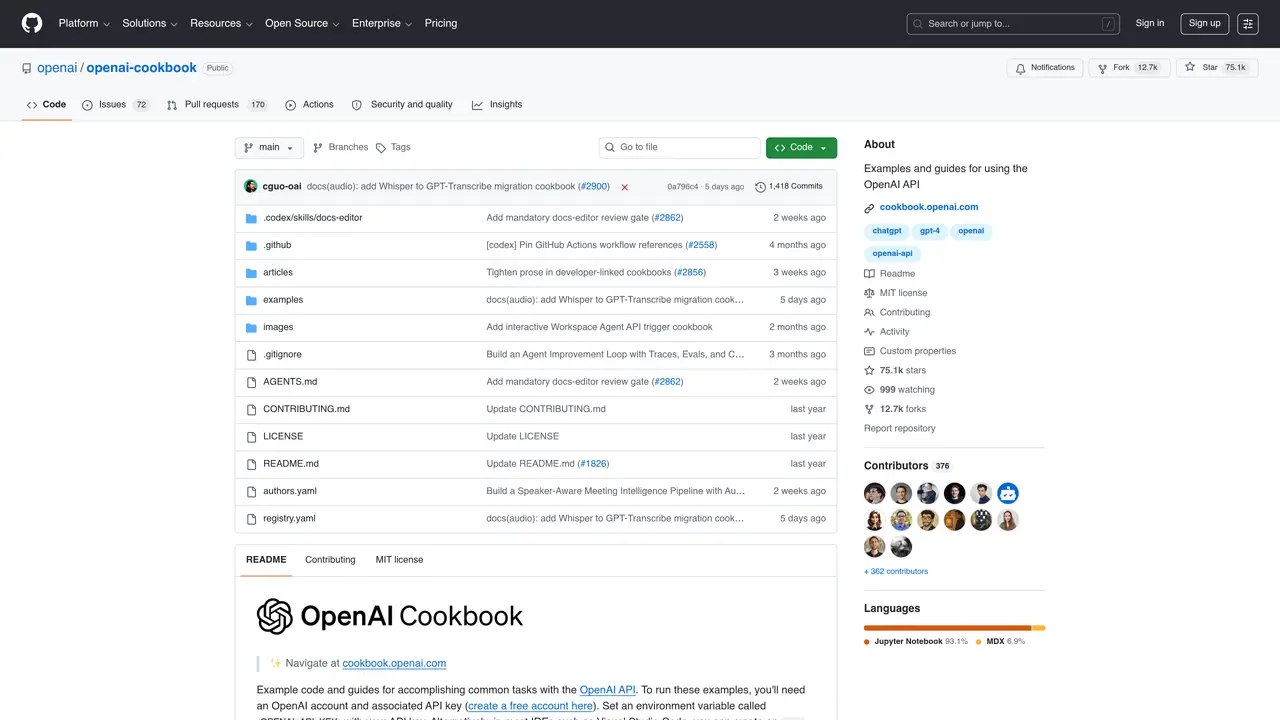
About OpenAI Cookbook
OpenAI Cookbook is an online resource for machine learning developers, researchers, and enthusiasts. It provides a comprehensive collection of recipes that enable users to quickly and easily build and deploy powerful AI models. With OpenAI Cookbook, users can develop innovative applications by leveraging the latest advances in deep learning and reinforcement learning. The recipes span a variety of topics, including natural language processing, computer vision, robotics, and generative models. Each recipe is designed to be easy to understand and implement, and is accompanied by sample code, detailed explanations, and helpful tips. Furthermore, the recipes are written in a way that makes them accessible to users of all skill levels. With OpenAI Cookbook, users can easily create unique and powerful AI models that can be used to power a variety of applications.
GitHub, Inc.
San Francisco, California, US · Founded 2008
- Founders
- Tom Preston-Werner, Chris Wanstrath, PJ Hyett, Scott Chacon
- Founded
- 2008
- Headquarters
- San Francisco, California, US
- Legal status
- Subsidiary of Microsoft (NASDAQ: MSFT)
Key features
- Create customized AI models
- Utilize advanced deep learning algorithms
- Access accessible tutorials for users of all skill levels
- Develop innovative applications with the latest advances in deep learning and reinforcement learning
- Build and deploy powerful AI models quickly and easily
- Span a variety of topics, including natural language processing, computer vision, robotics, and generative models
Use cases
- Building and deploying custom AI models for various applications
- Developing innovative applications with the latest advances in deep learning and reinforcement learning
- Creating powerful AI models for tasks such as natural language processing, computer vision, and robotics
Pros
- Provides practical, ready-to-use code examples for implementing OpenAI API tasks
- Covers a wide range of use cases across natural language processing, computer vision, and generative models
- Includes detailed explanations and step-by-step guides for each recipe
- Accessible to users of varying skill levels, from beginners to advanced developers
- Actively maintained and updated with contributions from the developer community
Cons
- Requires an OpenAI API key for most examples, which may incur usage costs
- Primarily focused on Python, limiting accessibility for users preferring other programming languages
- Examples may become outdated as the OpenAI API evolves, requiring manual updates
Frequently asked questions about OpenAI Cookbook
What is the OpenAI Cookbook?
The OpenAI Cookbook is a public GitHub repository providing examples and guides for using the OpenAI API. It includes code snippets, tutorials, and explanations to help developers implement AI models and applications.
Who should use the OpenAI Cookbook?
The Cookbook is designed for developers, researchers, and enthusiasts working with machine learning, natural language processing, computer vision, or generative models. It is suitable for users of varying skill levels.
What do I need to start using the OpenAI Cookbook?
To use the examples, you need an OpenAI account and an associated API key. Set the API key as an environment variable named OPENAI_API_KEY or include it in an .env file at the root of your repository.
Are the examples in the OpenAI Cookbook language-specific?
Most code examples are written in Python, but the concepts can be applied in other programming languages. The repository also includes guides and resources for broader use cases.
Where can I find additional resources related to the OpenAI Cookbook?
The Cookbook links to related tools, guides, and courses from around the web. It also provides access to documentation and community discussions for further support.
Is the OpenAI Cookbook free to use?
Yes, the OpenAI Cookbook is an open-source resource available under the MIT license, allowing free use, modification, and distribution.