GitHub hosts HunyuanVideo, Tencent's open-source framework for large-scale video generation models, enabling AI-driven video creation.

OpenAI’s CLIP
$1Starting price
0Popularity
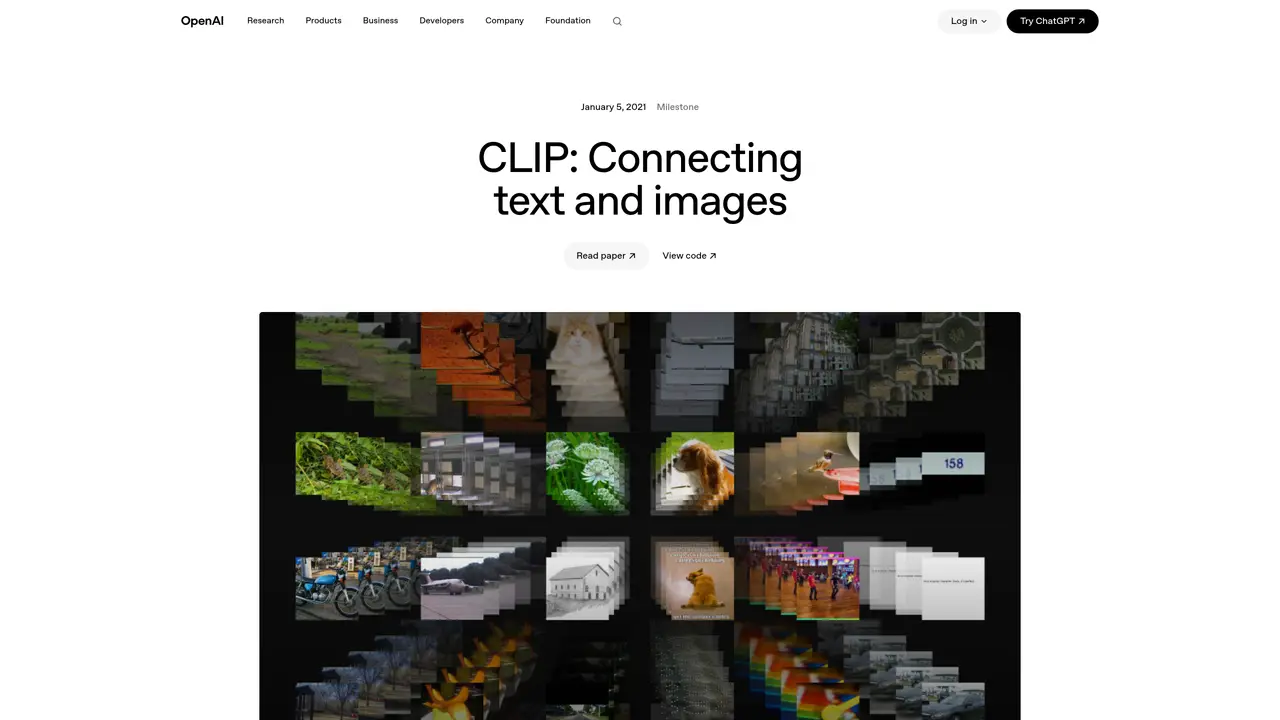
About OpenAI’s CLIP
OpenAI’s CLIP is an advanced artificial intelligence technology that enables machines to see and understand the world around them. It does this by combining computer vision and natural language processing to create an incredibly powerful system that can recognize images and interpret textual data. With CLIP, machines can learn to recognize objects and identify patterns, allowing them to make intelligent decisions and perform complex tasks. This technology is highly scalable and can be used in a variety of applications, from autonomous vehicles to robotics. CLIP is designed to be intuitive and easy to use for developers of all skill levels. It utilizes a state-of-the-art architecture that allows for rapid prototyping, so users can quickly build and deploy applications. Additionally, CLIP is open source and can be integrated into existing systems, giving users the flexibility to customize their solutions according to their needs. With its powerful capabilities and simple tools, CLIP can help developers create smarter, more efficient applications.
OpenAI
San Francisco, California, US · Founded 2015
- Founders
- Sam Altman, Greg Brockman, Ilya Sutskever, Elon Musk, Wojciech Zaremba, John Schulman
- Founded
- 2015
- Headquarters
- San Francisco, California, US
- Legal status
- Private (capped-profit)
Key features
- Combines computer vision and natural language processing
- Recognizes images and interprets textual data
- Scalable for various applications
- Intuitive and easy to use for developers of all skill levels
- Rapid prototyping capabilities
- Open source and integratable into existing systems
Use cases
- Automate vehicles with CLIP's computer vision
- Leverage natural language processing to interpret data
- Rapidly prototype and customize applications with open source tools
Pros
- Combines computer vision and natural language processing for multimodal understanding
- Trained on a large dataset of images and text, enabling broad generalization
- Open-source availability allows for customization and integration into existing systems
- State-of-the-art architecture supports rapid prototyping and deployment
- Scalable for applications in autonomous systems, robotics, and content moderation
Cons
- Requires significant computational resources for training and inference
- Performance may vary depending on the quality and diversity of input data
- Limited interpretability due to the complexity of the model architecture
Frequently asked questions about OpenAI’s CLIP
What is OpenAI's CLIP and what does it do?
CLIP is a model that connects images and text by learning visual concepts from natural language supervision. It can recognize objects in images and match them with corresponding textual descriptions without needing task-specific training data.
Who should use CLIP?
CLIP is designed for developers, researchers, and organizations working in computer vision, robotics, or AI-driven applications that require image understanding and text alignment capabilities.
How does CLIP work?
CLIP uses a combination of computer vision and natural language processing to learn from a large dataset of image-text pairs, enabling it to associate images with relevant textual descriptions.
Is CLIP open source?
Yes, CLIP is open source, allowing users to access, modify, and integrate the model into their own projects or systems.
What are the typical use cases for CLIP?
Common applications include zero-shot image classification, visual search, content moderation, and tasks requiring alignment between images and text.
Can CLIP be integrated with other tools or platforms?
CLIP can be integrated into existing systems and workflows, and it supports compatibility with various AI frameworks and libraries for customization.