

Scales efficient language processing with open-source accessibility.
357M visits/mo+1%#2 Coding & Development
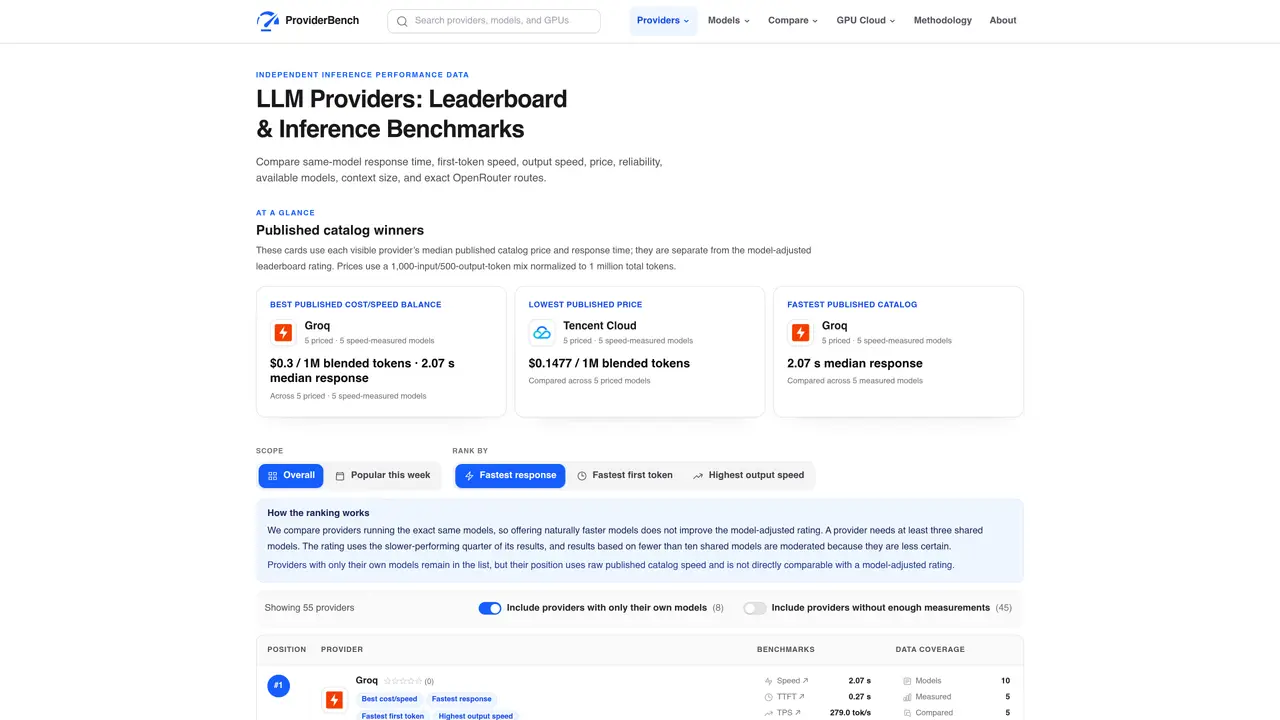
ProviderBench aggregates and ranks large language model inference providers using standardized benchmarks. It measures response time, time to first token, output tokens per second, price, reliability and available models across providers running the same models. The platform normalizes prices using a 1,000-input/500-output-token mix scaled to 1 million total tokens, allowing direct cost comparisons. Providers are evaluated both on raw published catalog data and on model-adjusted performance where at least three shared models are available. Rankings incorporate the slower-performing quarter of results and moderate data from providers with fewer than ten shared models. The site also offers comparison tools for GPU clouds, exact GPU configurations and curated model sets, enabling users to assess coverage-adjusted pricing and performance.
ProviderBench aggregates and ranks large language model inference providers using standardized benchmarks. It measures response time, time to first token, output tokens per second, price, reliability, and available models across providers running the same models.
The platform is designed for developers, researchers, and businesses who need to compare and select LLM inference providers based on performance, cost, and reliability metrics.
ProviderBench normalizes prices using a 1,000-input/500-output-token mix scaled to 1 million total tokens, allowing direct cost comparisons across providers.
Yes, ProviderBench offers comparison tools for GPU clouds, exact GPU configurations, and curated model sets to assess coverage-adjusted pricing and performance.
Providers are ranked based on model-adjusted performance where at least three shared models are available. Rankings incorporate the slower-performing quarter of results and moderate data from providers with fewer than ten shared models.
Users can start by searching for inference providers, models, GPU clouds, or GPUs directly on the ProviderBench website to access leaderboards, comparisons, and benchmarks.
providerbench.ai · third-party estimates from Similarweb
Last 2 months · grows by one month every month
Share of visits by channel
Share of visits · estimated visits
How people reach this site from other AI tools
7 a month · 0.4% of all visits
Coding & Development · Sep 2026
Traffic figures are third-party estimates, good for scale and trends; they can differ from a company's own numbers. Updated monthly.
We use essential cookies to run aitoolnavio™, and optional cookies to analyze traffic and measure our marketing. You choose what we use — optional cookies stay off unless you turn them on. See our Privacy Policy.
One short email a week: fresh tools worth trying, honest takes and the updates that actually matter. No spam, unsubscribe any time.
Scales efficient language processing with open-source accessibility.
Collaboration and version control platform for software development and AI model hosting.
Tesla’s AI stack powers Full Self-Driving, Optimus humanoid robots, and real-world autonomy with neural networks, custom hardware, and Dojo-scale training.
Integrates AI into Airtable to analyze data, summarize insights, draft content, and automate workflows without prior AI experience.
AI-powered website builder that generates a professional site in under a minute and includes tools for content, SEO, and analytics.
Unified platform to access and switch between hundreds of AI models like ChatGPT, Claude, and Gemini via a single API.
xAI builds Grok frontier AI models for reasoning, coding, voice, images, video, enterprise workflows, and developer APIs.
Meta AI enhances machine learning, NLP, and computer vision capabilities.
Crowdsourced platform for blind, side-by-side AI model comparisons with a public leaderboard.
Customize, deploy, and control AI models securely.
Independent benchmarks comparing AI models on quality, speed, and cost across multiple capabilities.
Chat, build, and explore with open AI models.
Matched on what this tool does — grouped by the job you would be replacing.
matches Model-adjusted performance rankings · Raw catalog speed and price comparisons · GPU cloud price comparison
Independent benchmarks comparing AI models on quality, speed, and cost across multiple capabilities.
Compare and benchmark 100+ large language models by price, performance, speed, and context window in one place.
Compares AI models across capability, price, speed and benchmarks in one place
AI performance measurement and provider comparison platform
matches Single endpoint routing LLM API calls to minimize inference costs · Unified API gateway for routing, comparing, and operating across 200+ AI models · Unified API for routing requests to multiple LLM providers with price comparison
matches Exact GPU configuration search · GPU cloud price comparison · Exact VRAM breakdown (weights + KV cache + activations + overhead)
Single endpoint routing LLM API calls to minimize inference costs
Unified API gateway for routing, comparing, and operating across 200+ AI models via a single
An API load balancer that routes LLM requests across providers via a unified OpenAI-compatible endpoint for production AI teams.
Unified API for routing requests to multiple LLM providers with price comparison
LLM inference GPU sizing calculator with validated throughput predictions
Curated reviews and comparisons of AI and software tools for developers and creators