GitHub hosts HunyuanVideo, Tencent's open-source framework for large-scale video generation models, enabling AI-driven video creation.

RetinaNet
$0.07Starting price
0Popularity
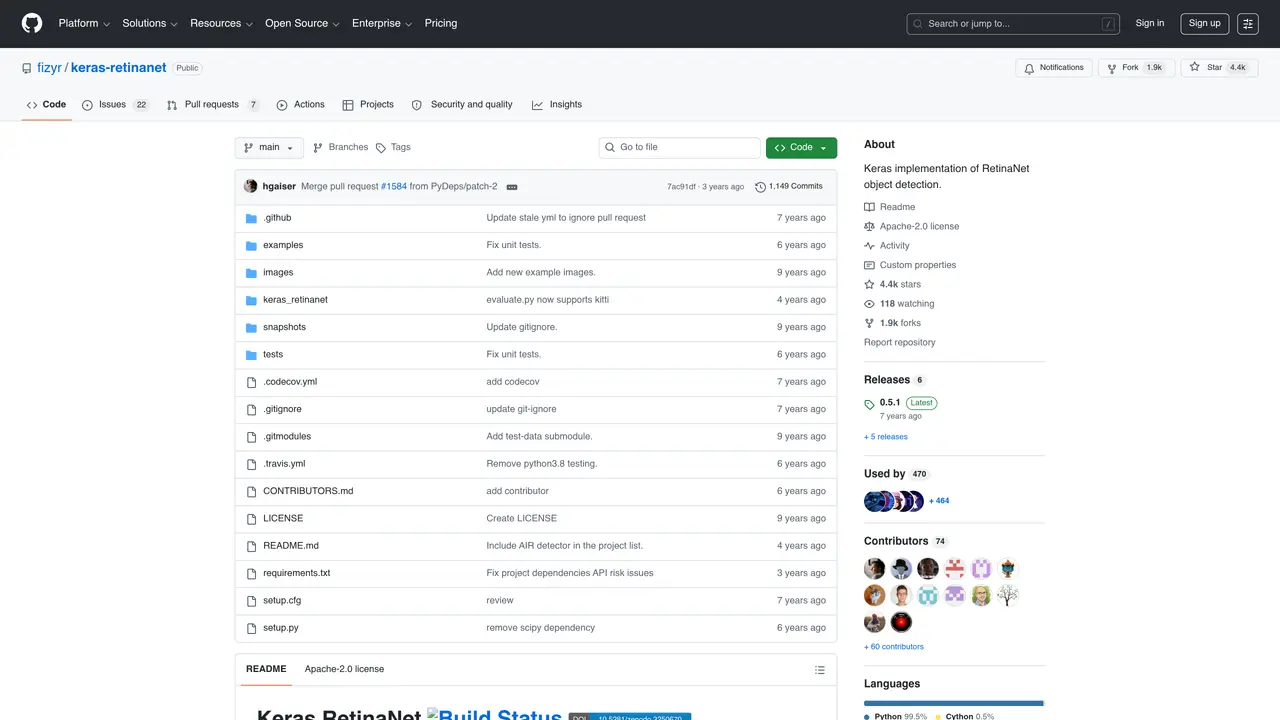
About RetinaNet
RetinaNet is an advanced object detection system that uses a state-of-the-art deep learning model to detect, classify, and localize objects in images and videos. RetinaNet is an ideal solution for any project where you need to identify multiple objects in a single frame. It is easy to use and provides accurate results with a high degree of precision. RetinaNet was specifically designed to provide high accuracy even on small objects, making it a great choice for applications like autonomous driving, medical imaging, and video surveillance. The system is highly optimized and can process multiple images simultaneously, making it a great tool for large-scale projects. Additionally, RetinaNet is open source, and you can customize, extend, and integrate it into your own projects. RetinaNet offers a great balance of performance and scalability, making it a great choice for data scientists, developers, and engineers.
GitHub, Inc.
San Francisco, California, US · Founded 2008
- Founders
- Tom Preston-Werner, Chris Wanstrath, PJ Hyett, Scott Chacon
- Founded
- 2008
- Headquarters
- San Francisco, California, US
- Legal status
- Subsidiary of Microsoft (NASDAQ: MSFT)
Key features
- Advanced object detection system
- Deep learning model for accurate results
- Highly optimized for large-scale projects
- Open source for customization and integration
- Balances performance and scalability
- Ideal for autonomous driving, medical imaging, and video surveillance
Use cases
- Automate object detection in autonomous driving
- Identify multiple objects in medical imaging
- Detect, classify, and localize objects in video surveillance
Pros
- Open-source implementation of RetinaNet for object detection
- Supports customization and integration into existing projects
- Designed for high accuracy, particularly on small objects
- Compatible with Keras and TensorFlow frameworks
- Provides pre-trained models and training scripts for ease of use
Cons
- Deprecated in favor of PyTorch's torchvision implementation
- Limited support for newer versions of Keras and TensorFlow
- Requires manual installation of dependencies like TensorFlow and pycocotools
- Compilation of Cython code may be necessary for direct execution
RetinaNet videos
Frequently asked questions about RetinaNet
What is RetinaNet and what does it do?
RetinaNet is an object detection system implemented in Keras that detects, classifies, and localizes objects in images and videos using a deep learning model. It is designed to handle dense object detection with high accuracy, including small objects.
Who is RetinaNet suitable for?
RetinaNet is suitable for developers, data scientists, and engineers working on projects requiring object detection, such as autonomous driving, medical imaging, video surveillance, and other computer vision applications.
How does RetinaNet work?
RetinaNet uses a backbone network (e.g., ResNet50) to extract features from images, followed by a detection head that predicts bounding boxes, class scores, and labels. The model can be trained and then converted to an inference model for deployment.
What are the integration options for RetinaNet?
RetinaNet can be integrated into custom projects as an open-source tool. It supports training and inference workflows and can be extended with additional backbones or datasets, such as MS COCO.
What are the limitations of RetinaNet?
RetinaNet is deprecated in favor of torchvision's implementation, and its compatibility is limited to specific versions of Keras and TensorFlow. Users may need to adjust installation and dependencies manually.
How do I get started with RetinaNet?
To get started, clone the repository, install dependencies (including TensorFlow and Keras), and follow the provided scripts for training, evaluation, or inference. Pre-trained models can be loaded and converted for inference as needed.