GitHub hosts HunyuanVideo, Tencent's open-source framework for large-scale video generation models, enabling AI-driven video creation.

Sagemaker Studio
0Popularity
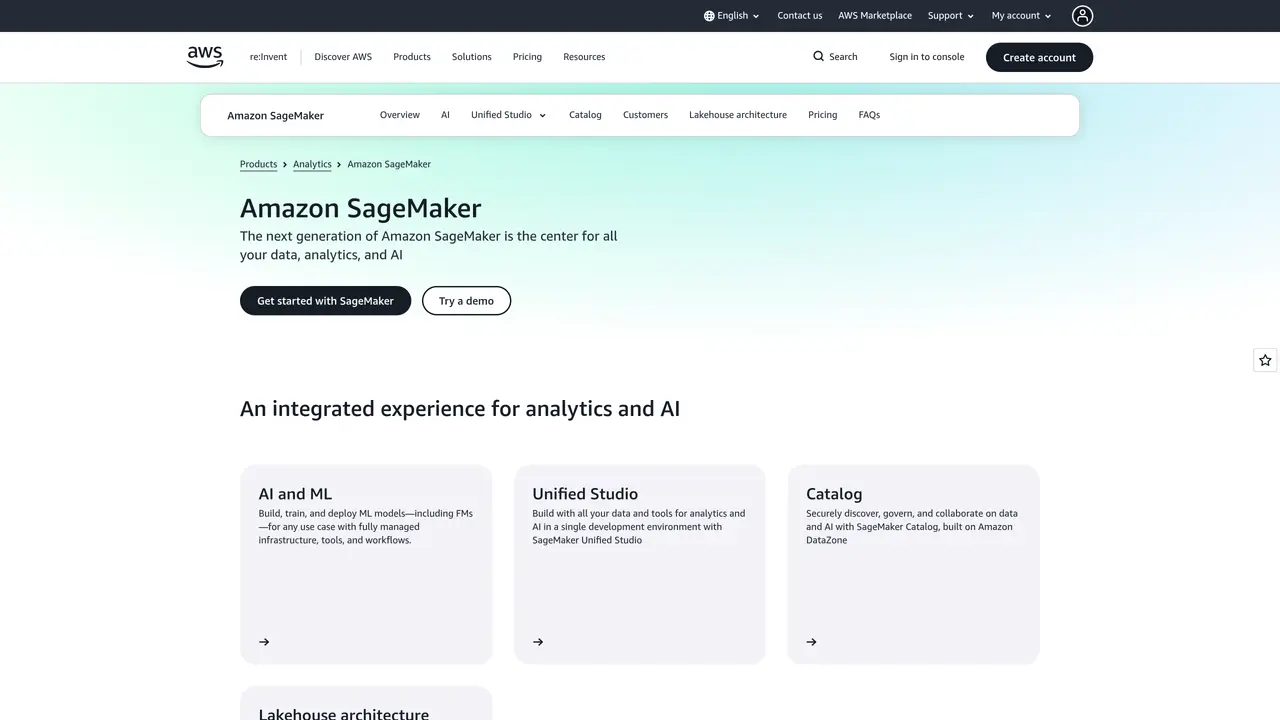
About Sagemaker Studio
Sagemaker Studio is an AI-powered machine learning platform from Amazon Web Services (AWS). It helps data scientists and machine learning developers quickly build, train, and deploy models with powerful yet easy-to-use tools and resources. Sagemaker Studio helps them streamline the entire machine learning workflow, from data exploration to model training and deployment. With Amazon’s high-performance computing infrastructure, it also allows developers to scale their ML solutions and get results faster. The platform provides access to a wide range of algorithms, model frameworks, and libraries. Additionally, Sagemaker Studio offers an intuitive drag-and-drop interface, allowing users to quickly build, debug, and monitor machine learning applications. With its comprehensive set of features, Sagemaker Studio gives users the power to easily develop and deploy machine learning models.
Amazon
Seattle, United States · Founded 1994
- Founder
- Jeff Bezos
- Founded
- 1994
- Headquarters
- Seattle, United States
- Legal status
- Public company
Key features
- Quickly build, train, and deploy models with easy-to-use tools
- Streamline ML workflow from data exploration to model training & deployment
- Access to algorithms, model frameworks, and libraries to scale ML solutions
- Intuitive drag-and-drop interface for building machine learning applications
- High-performance computing infrastructure for scaling ML solutions
- Comprehensive set of features for developing and deploying machine learning models
Use cases
- Data scientists and machine learning developers can quickly build, train, and deploy models with Sagemaker Studio.
- Sagemaker Studio helps streamline the entire machine learning workflow from data exploration to model training and deployment.
- Developers can scale their ML solutions using Amazon’s high-performance computing infrastructure.
Pros
- Integrates seamlessly with AWS ecosystem for unified cloud-based workflows
- Provides access to a wide range of pre-built algorithms, frameworks, and libraries
- Supports end-to-end machine learning workflows from data preparation to deployment
- Offers scalable compute resources to handle large datasets and complex models
- Includes built-in tools for debugging, monitoring, and managing ML models
Cons
- Requires familiarity with AWS services and cloud infrastructure
- May involve additional costs for compute, storage, and data transfer
- Steep learning curve for users new to machine learning or AWS
- Limited offline functionality due to cloud dependency
Sagemaker Studio videos
Frequently asked questions about Sagemaker Studio
What is Amazon SageMaker Studio?
Amazon SageMaker Studio is a fully integrated development environment (IDE) for machine learning that provides a single, web-based interface to build, train, deploy, and monitor machine learning models at scale.
Who should use Amazon SageMaker Studio?
It is designed for data scientists, machine learning engineers, and developers who need to streamline the end-to-end machine learning workflow, from data preparation to model deployment.
How does Amazon SageMaker Studio work?
The platform offers tools for data exploration, model training, hyperparameter tuning, and deployment, all within a unified interface that leverages AWS’s scalable infrastructure.
What integrations does Amazon SageMaker Studio support?
It integrates with AWS services like Amazon S3 for data storage, AWS Lambda for serverless computing, and AWS Bedrock for generative AI applications, among others.
What are the key features of Amazon SageMaker Studio?
Key features include a Jupyter notebook interface, built-in algorithms, automated model training, real-time inference endpoints, and monitoring tools for model performance.
How do I get started with Amazon SageMaker Studio?
Users can begin by signing into the AWS Management Console, navigating to Amazon SageMaker, and launching SageMaker Studio to access the integrated development environment.