GitHub hosts HunyuanVideo, Tencent's open-source framework for large-scale video generation models, enabling AI-driven video creation.

SearchAI Inference Server
FreeStarting price
0Popularity
About SearchAI Inference Server
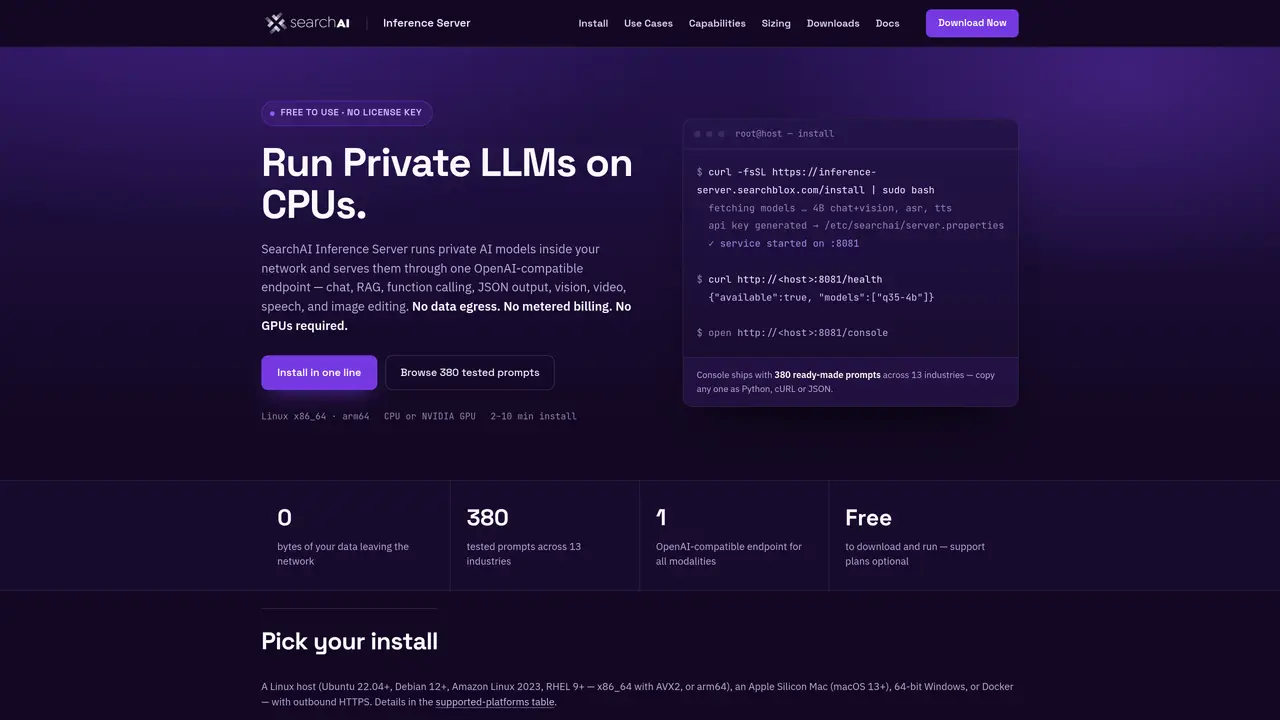
SearchAI Inference Server enables private deployment of large language models within a local network, eliminating the need for cloud-based inference or GPU acceleration. The tool serves models through a single OpenAI-compatible endpoint supporting chat, retrieval-augmented generation (RAG), function calling, JSON output, vision, video, speech, and image editing capabilities. It operates without data egress, metered billing, or GPU requirements, making it suitable for on-premises, air-gapped, regulated, and edge environments. Installation is streamlined via a one-line command across supported platforms including Linux x86_64, arm64, macOS (Apple Silicon), 64-bit Windows, and Docker. The server includes a built-in console with 380 tested prompts across 13 industries, a model workbench for comparison and optimization, and auditable features such as HTTPS, Bearer-key authentication, and deterministic outputs. It supports a catalog of models ranging from 0.8B to 35B parameters, with options for CPU-only or optional GPU acceleration for specific workloads.
Key features
- OpenAI-compatible endpoint for chat, RAG, and function calling
- Multimodal support including vision, video, speech, and image editing
- Built-in console with 380 prompts across 13 industries
- Model workbench with side-by-side comparison and prompt optimization
- Cluster-ready with model-aware routing and load balancing
- Auditable by design with HTTPS, Bearer-key auth, and deterministic outputs
- Supports CPU-only and optional GPU acceleration
- Self-contained artifact with predictable latency
Use cases
- Private enterprise AI deployments without cloud dependency
- Regulated or air-gapped environments requiring local data processing
- Edge deployments for low-latency multimodal inference
Pros
- OpenAI-compatible endpoint for all modalities
- No GPU required for standard operations
- No data egress or metered billing
- Built-in console with 380 tested prompts
- Supports on-premises, air-gapped, and edge deployments
Cons
- GPU acceleration required for long open-ended generation or very large models
- Windows installation requires additional steps due to unsigned binary
- Limited to models listed in the catalog
Frequently asked questions about SearchAI Inference Server
What is SearchAI Inference Server?
SearchAI Inference Server is a tool for deploying large language models privately within a local network, serving them through a single OpenAI-compatible endpoint. It supports capabilities such as chat, retrieval-augmented generation (RAG), function calling, JSON output, vision, video, speech, and image editing without requiring cloud-based inference or GPU acceleration.
Who is SearchAI Inference Server suitable for?
The tool is designed for on-premises, air-gapped, regulated, and edge environments, making it ideal for organizations prioritizing data privacy, compliance, or low-latency requirements. It supports deployment across Linux, macOS, Windows, and Docker.
How does the installation process work?
Installation is streamlined via a one-line command across supported platforms, including Linux x86_64, arm64, macOS (Apple Silicon), 64-bit Windows, and Docker. The process includes fetching models, generating an API key, and starting the service automatically.
Does SearchAI Inference Server require GPUs?
No, the tool can run fully on CPU, though GPU acceleration is optional for specific workloads such as long open-ended generation or handling very large models and high concurrency. GPU support is available via a one-flag add-on.
What models does SearchAI Inference Server support?
The server supports a catalog of models ranging from 0.8B to 35B parameters, including text-only, multimodal, and mixture-of-experts models. Models can be downloaded and deployed directly from the built-in console.
Can I use external OpenAI-compatible endpoints with SearchAI Inference Server?
Yes, the tool includes a model workbench that allows side-by-side comparison with any external OpenAI-compatible endpoint, enabling users to evaluate and optimize prompts and outputs.