GitHub hosts HunyuanVideo, Tencent's open-source framework for large-scale video generation models, enabling AI-driven video creation.

Semantic Kernel (SK)
$1Starting price
0Popularity
About Semantic Kernel (SK)
Semantic Kernel (SK) is an advanced low-level machine learning technology designed to elevate applications by integrating large language model (LLM) capabilities. It seamlessly embeds into existing solutions, enabling developers to rapidly incorporate powerful new features without extensive rework. SK processes diverse data sources with speed and accuracy, leveraging advanced AI algorithms to identify meaningful patterns and extract actionable insights from large datasets. The framework is highly customizable, allowing users to tailor its functionality to specific requirements, whether for anomaly detection, trend prediction, or automated decision-making. By automating complex tasks, SK reduces manual effort and enhances the efficiency of applications across industries. Its flexibility makes it suitable for developers and organizations seeking to build intelligent systems that operate with minimal human intervention while maximizing data utility.
Microsoft
Redmond, United States · Founded 1975
- Founders
- Bill Gates, Paul Allen
- Founded
- 1975
- Headquarters
- Redmond, United States
- Legal status
- Public company
Key features
- Seamless integration with existing applications
- Advanced pattern recognition in large datasets
- Automated anomaly detection
- Customizable AI-driven decision-making
- Support for diverse data source processing
- Low-level machine learning technology
- Rapid feature addition to applications
- Highly adaptable to specific user needs
Use cases
- Building intelligent applications for data analysis
- Automating decision-making processes in business systems
- Enhancing existing software with AI-driven insights
Pros
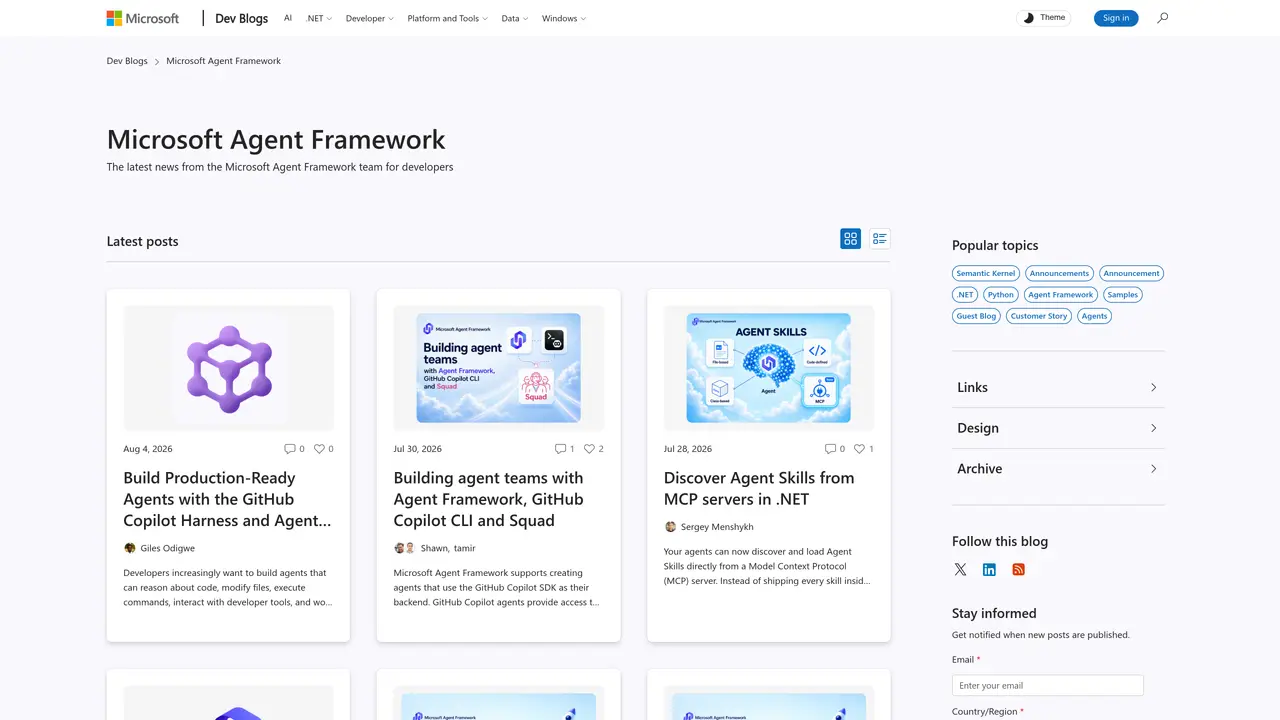
- Open-source framework with support for multiple programming languages including C# and Python
- Integrates with Model Context Protocol (MCP) servers for dynamic skill discovery and loading
- Supports declarative workflows in YAML for explicit agent orchestration and easier maintenance
- Provides a stable agent harness with built-in capabilities like planning, memory, and telemetry
- Enables multi-agent collaboration with GitHub Copilot integration for enhanced functionality
Cons
- Primarily focused on agent development, which may limit its suitability for non-agent use cases
- Requires familiarity with agent frameworks and orchestration concepts for effective implementation
- Integration with MCP servers depends on the availability and quality of external skill servers
Frequently asked questions about Semantic Kernel (SK)
What is Semantic Kernel (SK) and what does it do?
Semantic Kernel is an open-source framework designed to build AI agents that can reason, plan, and execute tasks. It provides tools and libraries to create agents that interact with code, execute commands, and integrate with developer tools.
Who is Semantic Kernel suitable for?
Semantic Kernel is suitable for developers and organizations looking to build production-ready AI agents, particularly those requiring multi-step task execution, orchestration, and integration with external tools and services.
How does Semantic Kernel integrate with other tools?
Semantic Kernel integrates with Model Context Protocol (MCP) servers to dynamically load skills, supports GitHub Copilot for enhanced agent capabilities, and offers declarative workflows for orchestration. It is designed to work within existing development pipelines.
What are declarative workflows in Semantic Kernel?
Declarative workflows allow users to define agent coordination, state changes, branching, and human-in-the-loop steps in YAML. This makes orchestration explicit and easier to review, version, and modify compared to embedding logic in code.
Does Semantic Kernel support multi-agent systems?
Yes, Semantic Kernel supports creating and managing teams of agents that can collaborate, share skills, and coordinate tasks, particularly through its integration with GitHub Copilot and MCP servers.
How do I get started with Semantic Kernel?
Start by exploring the official documentation and samples available for C# and Python. The framework provides stable APIs and harnesses to build agents, with guidance on integrating skills and workflows.