GitHub hosts HunyuanVideo, Tencent's open-source framework for large-scale video generation models, enabling AI-driven video creation.

Wu Dao 1
0Popularity
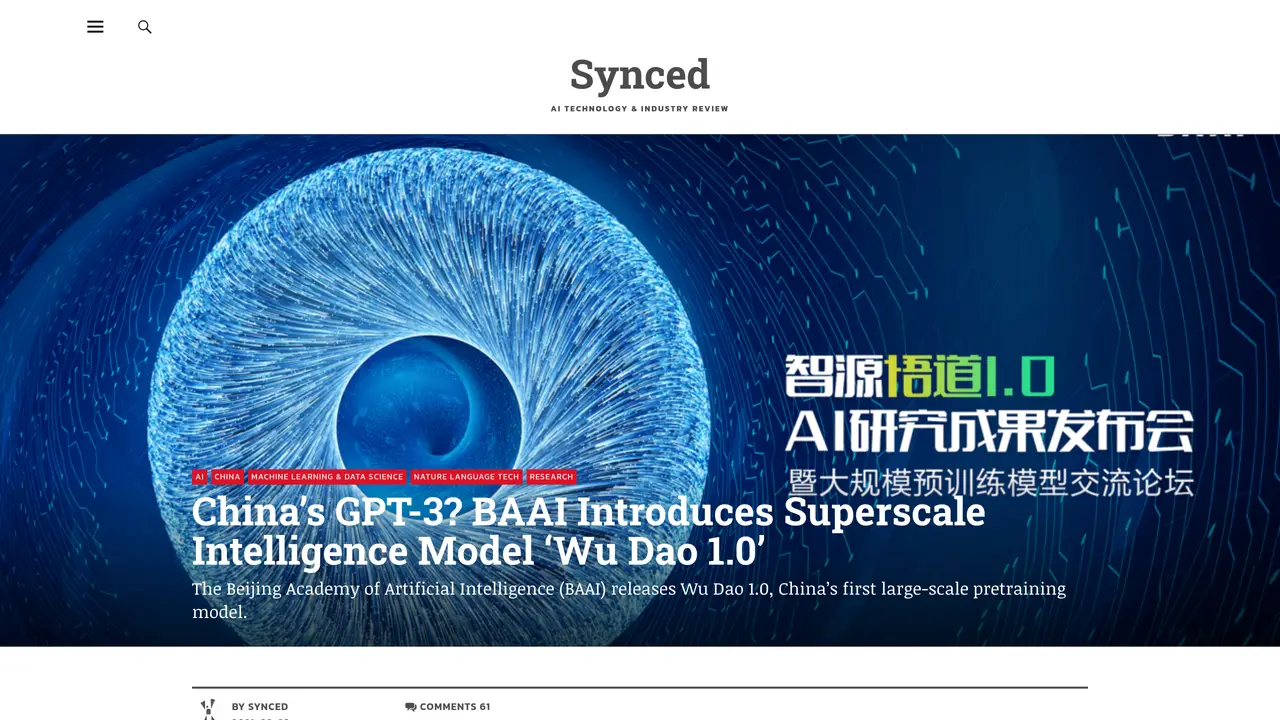
About Wu Dao 1
Wu Dao 1 is a superscale intelligence model developed by China’s GPT-3 BAAI. This AI-powered technology is designed to help enterprises and research institutions make faster and more accurate decisions. With Wu Dao 1, users can improve their understanding of complex data sets and gain valuable insights into the behavior of their target markets. It is also capable of deep learning and natural language processing, which makes it easier for users to communicate with their customers and generate more accurate predictions. Additionally, Wu Dao 1’s performance is continuously monitored and improved, allowing users to stay up-to-date with the latest advancements in AI technology. With its intuitive interface and powerful features, Wu Dao 1 is an ideal choice for businesses and research institutions looking to maximize their data-driven decisions.
Key features
- Natural language processing
- Deep learning
- Improved understanding of complex data sets
- Valuable insights into target markets
- Easier customer communication
- More accurate predictions
Use cases
- Simplify communication with customers using natural language processing.
- Monitor and improve performance with latest AI advancements.
- Gain valuable insights into the behavior of target markets.
Pros
- Developed by the Beijing Academy of Artificial Intelligence (BAAI) with contributions from over 100 AI scientists from leading Chinese institutions
- Includes four specialized models (Wu Dao – Wen Yuan, Wen Lan, Wen Hui, Wen Su) covering language, multimodal, cognitive, and biomolecular domains
- Wu Dao – Wen Yuan surpasses human benchmarks in text categorization, sentiment analysis, and reading comprehension with 2.6 billion parameters
- Wu Dao – Wen Lan achieves state-of-the-art (SOTA) performance in multimodal tasks, including image captioning and visual entailment
- Wu Dao – Wen Hui demonstrates near-human performance in poetry generation and supports complex reasoning tasks
Cons
- Lacks common sense and cognitive abilities for complex reasoning tasks like open dialogue and knowledge-based Q&A
- Models are highly specialized, requiring separate fine-tuning for different applications
- Limited public availability, with only Wu Dao – Wen Lan being publicly accessible among the four models
Frequently asked questions about Wu Dao 1
What is Wu Dao 1.0 and who developed it?
Wu Dao 1.0 is China’s first large-scale pretraining model developed by the Beijing Academy of Artificial Intelligence (BAAI), led by Professor Tang Jie and a team of over 100 AI scientists from leading Chinese institutions.
What are the main components of Wu Dao 1.0?
Wu Dao 1.0 consists of four related models: Wu Dao – Wen Yuan (language model), Wu Dao – Wen Lan (multimodal model), Wu Dao – Wen Hui (cognitive-oriented model), and Wu Dao – Wen Su (biomolecular structure prediction model).
What tasks can Wu Dao – Wen Yuan perform?
Wu Dao – Wen Yuan excels in text categorization, sentiment analysis, natural language inference, reading comprehension, open-domain answering, grammar correction, and multilingual processing, achieving GPT-3 comparable performance on 20 Chinese NLP tasks.
How does Wu Dao – Wen Lan differ from other multimodal models?
Wu Dao – Wen Lan is China’s first publicly available universal graphic multimodal pretraining model, designed to process graphics, text, and video simultaneously, achieving state-of-the-art performance on tasks like image captioning and visual entailment.
What is the purpose of Wu Dao – Wen Hui?
Wu Dao – Wen Hui focuses on enhancing logic, consciousness, and reasoning-based cognitive capabilities of pretraining models, enabling tasks such as poetry generation, video creation, image drawing, text retrieval, and complex reasoning with near-human performance.
What applications does Wu Dao – Wen Su support?
Wu Dao – Wen Su is a biomolecular structure prediction model that handles long biomolecular structures, achieving state-of-the-art performance in protein training, gene analysis, and drug-resistant bacteria research using large-scale biological datasets.