Transform ideas into fully functional applications with Lovable, a groundbreaking AI tool.
Krate
FreeStarting price
0Popularity
About Krate
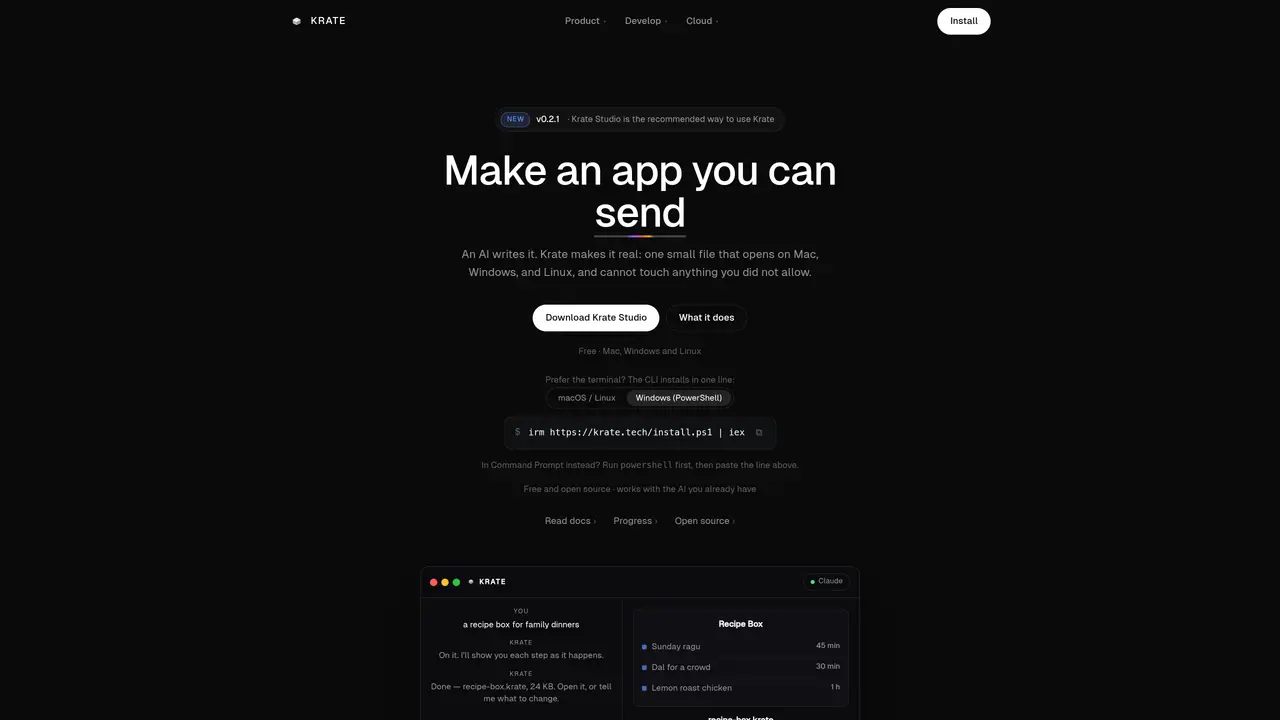
Krate converts plain-language descriptions into native desktop applications that run on Mac, Windows, and Linux. Users describe the desired app in a sentence or two, and Krate’s workflow writes the code, compiles it, checks its safety, and packages it into a single file typically 15–60 KB in size. The resulting file opens by double-click with no installer or runtime, and it runs in a sandbox that restricts access to files, network, or hardware unless explicitly permitted. Krate integrates with existing AI services such as Claude, Codex, Gemini, Copilot, or Grok, and can incorporate screenshots or design references to refine the output. The tool provides a CLI for local use and a cloud service for publishing apps as shareable links that others can run with a one-line install if they lack Krate. Each app is accompanied by verifiable reports confirming its build, import safety, runtime behavior, and visual output, enabling trust without requiring an account or telemetry.
Key features
- Converts plain-language descriptions into native apps
- Compiles and packages apps into single portable files
- Sandboxes apps by default with explicit permission prompts
- Provides CLI and Krate Studio GUI for local use
- Publishes apps to Krate Cloud with shareable URLs
- Generates verifiable reports for build, import, and runtime checks
- Supports screenshots or design references for refinement
- Runs on Intel and ARM across all three desktop systems
Use cases
- Creating small utility apps from simple descriptions
- Sharing portable apps via links or files without installers
- Prototyping native interfaces using AI-generated code
Pros
- Single-file distribution that runs on Mac, Windows, and Linux
- Sandboxed execution with plain-English permission prompts
- Verifiable safety checks including import audits and headless testing
- CLI and GUI options for local and cloud workflows
- Open-source tool with no account or telemetry required
Cons
- No native mobile or web targets
- Requires an external AI service for code generation
- Limited to desktop platforms
Frequently asked questions about Krate
What is Krate and how does it work?
Krate converts plain-language descriptions into native desktop applications that run on Mac, Windows, and Linux. Users describe the desired app in a sentence or two, and Krate’s workflow writes the code, compiles it, checks its safety, and packages it into a single file.
Who is Krate designed for?
Krate is designed for anyone who wants to create and share small desktop applications without needing to write code or set up complex development environments. It suits developers, designers, and non-technical users alike.
How does Krate ensure the safety of the apps it generates?
Krate compiles the app, checks its safety, and packages it into a single file that runs in a sandbox. The sandbox restricts access to files, network, or hardware unless explicitly permitted, and the user must approve any requested permissions before the app can use them.
Can Krate integrate with existing AI services?
Yes, Krate integrates with existing AI services such as Claude, Codex, Gemini, Copilot, or Grok. Users can leverage the AI service they already use to generate the app code within Krate Studio.
What are the typical use cases for Krate?
Krate is typically used for creating small, shareable desktop applications like tools, games, notes apps, or utilities. These apps can be sent to others as a single file that opens without an installer or runtime.
How do recipients run an app sent via Krate?
Recipients can run the app by double-clicking the file, which opens it in a sandbox. The app cannot access anything unless explicitly permitted, and the recipient must approve any requested permissions before the app can use them.