AI-powered website builder that generates a professional site in under a minute and includes tools for content, SEO, and analytics.
52M visits/mo+0.7%#4 Coding & Development
Local agent orchestration tool that selects and manages multiple AI coding agents
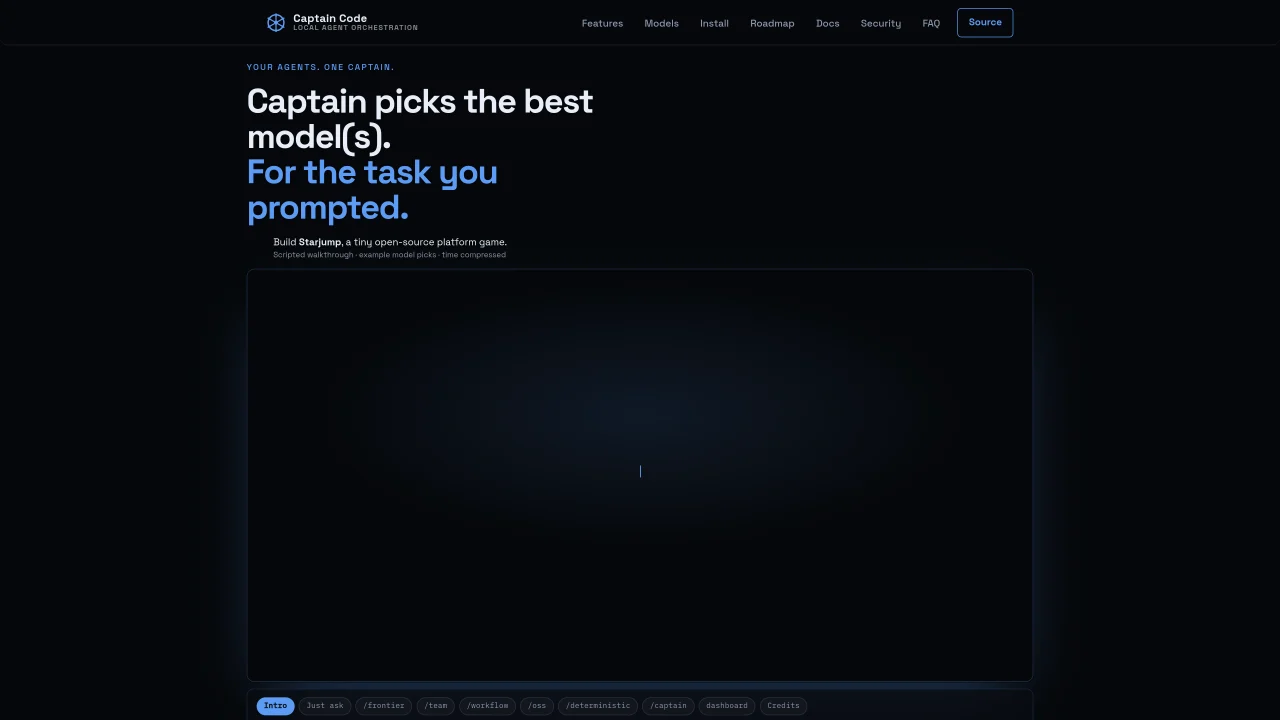
Captain Code is a local agent orchestration tool designed for users who already operate multiple AI coding agents. It acts as a central coordinator that classifies tasks and routes them to the most suitable model or team from existing subscriptions, API keys, and connected open-source models. The tool eliminates the need for manual model selection by automatically choosing between providers such as Claude, Codex, Cursor, Grok, and others based on task requirements and constraints. Captain Code supports both routine and demanding tasks, allowing users to set preferences for cost efficiency, speed, or frontier-level performance. It includes features for quota management, workflow automation, and mid-turn steering to adjust running agents. The system maintains unified memory and ledgers to prevent context loss and supports inspectable decision-making through commands like /captain why. Users can also enforce policies such as open-weight model constraints or deterministic serving tuples.
Captain Code is a local agent orchestration tool designed for builders who already run multiple AI coding agents. It acts as a central coordinator that classifies tasks and routes them to the most suitable model or team from existing subscriptions, API keys, and connected open-source models.
Captain Code automatically classifies every prompt and routes it to the right model or team based on task requirements, constraints, and user preferences for cost efficiency, speed, or frontier-level performance. Users can also enforce policies like open-weight model constraints or deterministic serving.
Yes, Captain Code supports open-source models and allows users to connect them alongside proprietary models. Open-source models can be added through providers like OpenRouter, Hugging Face, or NVIDIA NIM.
Captain Code includes features for quota management, workflow automation, and mid-turn steering to adjust running agents. It records reset times and hands off tasks to another available worker when limits are hit, preserving partial output and context.
Users can inspect every model selection using the /captain why command. They can also steer the process mid-turn with commands like /frontier, /team, /repeat, /workflow, /cheap, /parallel, /oss, /deterministic, and /interrupt.
Captain Code supports a variety of models and providers, including Claude, Codex, Cursor, Grok, OpenRouter, NVIDIA NIM, Hugging Face, and others. It also includes built-in legs for local subscription CLIs and remote models through OpenCode.
We use essential cookies to run aitoolnavio™, and optional cookies to analyze traffic and measure our marketing. You choose what we use — optional cookies stay off unless you turn them on. See our Privacy Policy.
One short email a week: fresh tools worth trying, honest takes and the updates that actually matter. No spam, unsubscribe any time.
AI-powered website builder that generates a professional site in under a minute and includes tools for content, SEO, and analytics.
AI-powered coding platform that uses agents to plan, write, and test software with real-time feedback and verifiable artifacts.
Automate code, research, and documents using agents.
AI-powered code assistant that generates, reviews, optimizes, and debugs code with natural language prompts and editor integrations.
AI assistant for safe, reliable productivity with code, collaboration, and integrations.
AI-powered IDE for autonomous coding tasks and agentic development workflows
Privacy-focused AI chatbot that generates uncensored text, code, images, and translations without storing conversations or requiring an account.
A free web-based AI chatbot and agent for writing, coding, research, and content creation with multilingual support.
Write & run code in 50+ languages, auto-complete with AI, and code faster with an intuitive interface.
An IDE that automates legacy-to-modern code migration using autonomous coding agents.
AI models that return typed decisions with calibrated confidence for software automation
Practice coding challenges, improve technical skills, get detailed explanations, compare performance with peers.
Matched on what this tool does — grouped by the job you would be replacing.
matches Agent routing and model selection · Quota and budget management · Mid-turn steering with /btw
Orchestrates multi-agent AI teams for complex tasks across models
Intelligent model router for coding agents optimizing cost and quality
AI coding assistant with a routing engine that selects the cheapest capable model for each task
Self-hosted gateway that routes LLM requests to cost-efficient models based on policy
matches Workflow automation with /workflow · Cost-saving preferences with /cheap · Team-based task execution with /team
matches Team-based task execution with /team · Workflow automation with /workflow · Cost-saving preferences with /cheap
Open-source agent orchestration platform for managing teams of AI agents with org charts, goals, and governance in a self-hosted deployment.
Open-source, model-agnostic platform for autonomous cloud coding agents that plan, edit, test, debug, and apply real code changes across software projects.
Define and run cloud agents in YAML with API control for automation and code review
Kanban-style orchestration layer for local AI coding agents
Automate code, research, and documents using agents.
Autonomous AI agents that plan and execute multi-step workflows to turn goals into completed work across apps and files.
No-code platform to build, orchestrate, and deploy AI agents for business workflow automation without coding.
Build, run, and govern autonomous AI agents with an AI-powered IDE, code analysis, and smart routing.