OpenAI builds and deploys advanced AI models like GPT-4o for autonomous agents and workflows.

Cooper&Wright
0Popularity
About Cooper&Wright
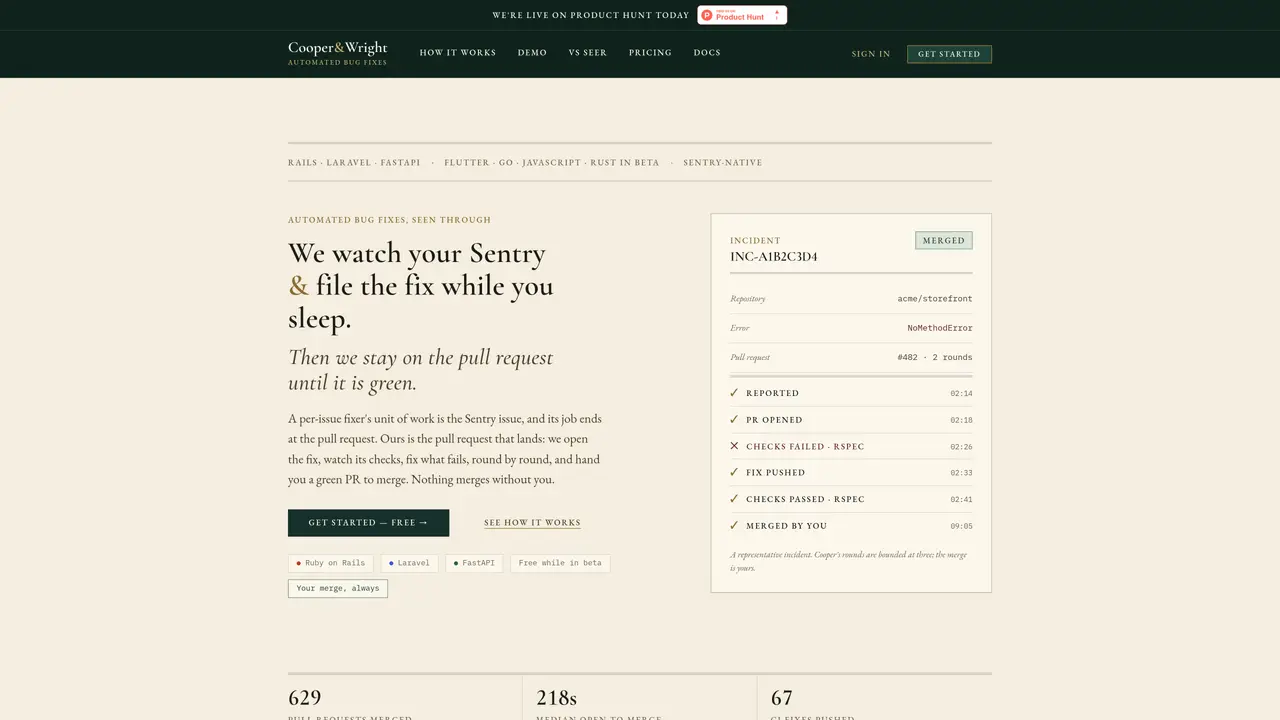
Cooper&Wright automates the resolution of software bugs by monitoring Sentry issues and GitHub pull requests. It generates fixes using an AI model, opens pull requests, and iteratively corrects CI failures until the changes pass all checks. The tool only merges changes when explicitly approved by the user, ensuring control remains with the development team. It operates through three distinct loops: one for Sentry-reported issues, another for monitoring failed CI checks on manually opened pull requests, and a third for automatically merging Dependabot dependency updates after resolving CI failures and conflicts. Each loop performs a bounded number of fix attempts before handing off to human review. The system also learns from human fixes by analyzing merged pull requests and creating reusable rules that apply across repositories and stacks. Lessons can be promoted to broader scopes or muted if disagreed with.
Key features
- Sentry issue monitoring and automated fix generation
- CI failure detection and iterative correction
- Dependabot pull request auto-merge with CI resolution
- Multi-language and framework support
- Rule-based learning from human fixes
- Repository and stack-wide lesson propagation
- Email notifications for each fix attempt
- Self-checks patches for syntax and conflict markers
Use cases
- Automating bug fixes for Sentry-reported issues
- Monitoring and fixing failed CI checks on pull requests
- Automatically merging Dependabot dependency updates
Pros
- Monitors Sentry issues and GitHub pull requests for automated fixes
- Iteratively corrects CI failures until checks pass
- Generates fixes using an AI model before opening pull requests
- Learns from human fixes to improve future automated resolutions
- Supports multiple programming languages and frameworks
Cons
- No merges performed without explicit user approval
- Bounded to three fix attempts per issue before handing off
- Requires installation as a GitHub App
- Limited to GitHub repository integration
Frequently asked questions about Cooper&Wright
What does Cooper&Wright do?
Cooper&Wright automates the resolution of software bugs by monitoring Sentry issues and GitHub pull requests. It generates fixes using an AI model, opens pull requests, and iteratively corrects CI failures until the changes pass all checks.
Who is Cooper&Wright designed for?
Cooper&Wright is designed for development teams using GitHub and Sentry who want to automate bug fixes while maintaining control over merges. It supports multiple stacks including Ruby on Rails, Laravel, FastAPI, Flutter, Go, JavaScript, and Rust.
How does Cooper&Wright handle merges?
Cooper&Wright never merges changes automatically; it only opens pull requests and iteratively fixes CI failures. The final merge decision always rests with the user.
What are the three loops Cooper&Wright operates through?
Cooper&Wright operates through three loops: one for Sentry-reported issues, another for monitoring failed CI checks on manually opened pull requests, and a third for automatically merging Dependabot dependency updates after resolving CI failures and conflicts.
How does Cooper&Wright learn from human fixes?
When a human fixes what Cooper&Wright could not, or closes its PR, Cooper&Wright reads the diff against its own and writes a reusable rule that applies across repositories and stacks.
How do I get started with Cooper&Wright?
To get started, install the Cooper&Wright GitHub App once and turn on each loop per repository. The tool is free while in beta.