
OpenAI builds and deploys advanced AI models like GPT-4o for autonomous agents and workflows.

Deepnote
$39Starting price
0Popularity
About Deepnote
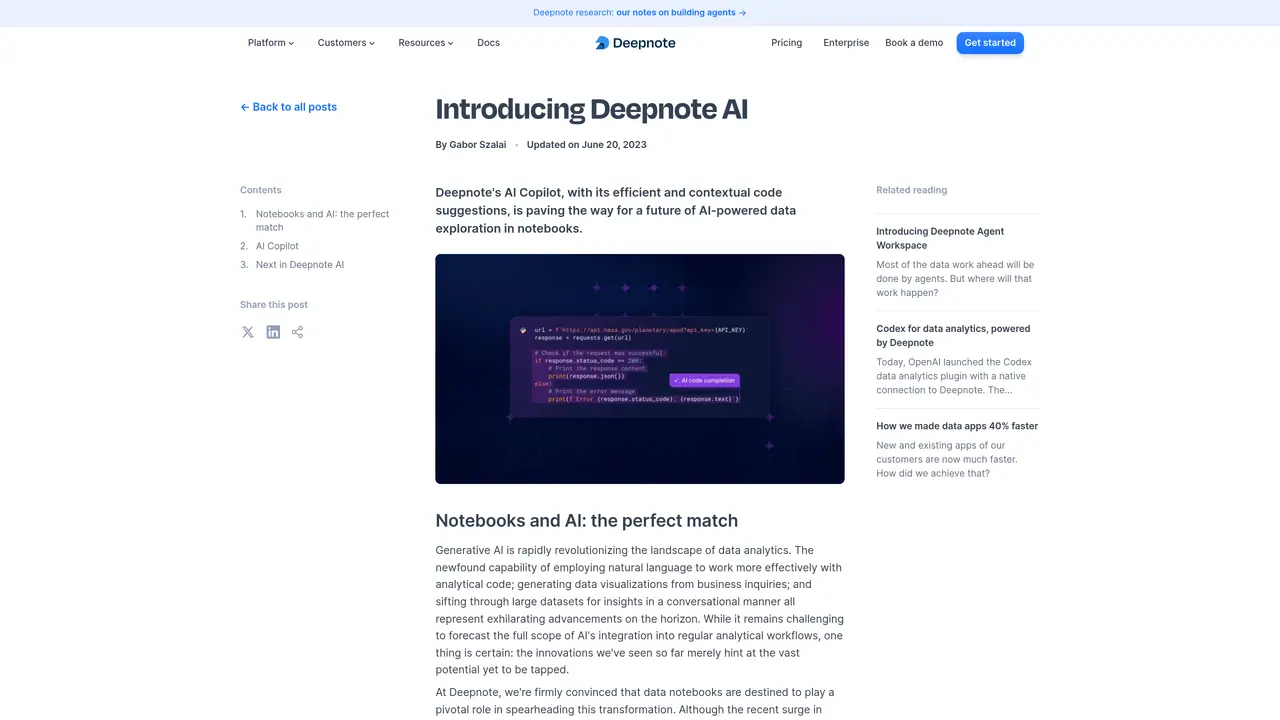
Deepnote AI is a cutting-edge tool designed to revolutionize how data projects are managed and executed. It offers a unique AI-powered notebook system that provides contextual assistance throughout your data analysis journey. From automating the creation of notebooks to offering intelligent code suggestions and explanations, Deepnote AI is tailored for data scientists, analysts, and anyone involved in data-driven projects who seeks to enhance productivity and accuracy in their work. Key Features: Automated Notebook Generation: Automatically create comprehensive data notebooks from simple prompts or questions. Context-Aware Code Suggestions: Powered by Codeium, these suggestions help streamline your coding process, making it faster and more efficient. Natural Language Code Generation: Query the system in natural language and have Deepnote AI generate the corresponding code. Explainable AI: Get clear explanations for complex code snippets, enhancing understanding and learning. Advanced Security Features: Includes RBAC, SSL certificates, and OAuth to ensure data integrity and security.
Key features
- Automated Notebook Generation
- Context-Aware Code Suggestions
- Natural Language Code Generation
- Explainable AI
- Advanced Security Features
- Robust Security Protocols
Use cases
- Data Scientists: For complex data analysis and predictive modeling.
- Academic Researchers: Utilizing AI for data-driven research and publication.
- Business Analysts: To analyze trends and make data-informed decisions.
Pros
- AI-powered contextual code suggestions and completions for faster coding workflows
- Natural language interface for generating, editing, and debugging code and SQL queries
- Seamless integration of AI assistance within notebooks, preserving workflow context and project structure
- Collaborative environment with version history and security features like RBAC and SOC2 compliance
- Partnership with Codeium for high-performance, context-aware AI models with generous context windows
Cons
- May require familiarity with Python or SQL for optimal use of AI Copilot features
- AI suggestions may occasionally produce incorrect or irrelevant code, requiring manual review
- Dependency on internet connectivity for real-time AI assistance and cloud-based features
- Advanced security and compliance features may involve setup complexity for some users
Deepnote videos
Frequently asked questions about Deepnote
What is Deepnote AI and who is it designed for?
Deepnote AI is an AI-powered assistant integrated into notebooks, designed primarily for data scientists and analysts who work with Python, SQL, or other coding languages. It aims to enhance productivity by providing contextual code suggestions and automating repetitive tasks within an interactive notebook environment.
How does Deepnote AI assist with coding tasks?
Deepnote AI offers code suggestions, natural language code generation, and explanations for complex code snippets. It leverages the context of the entire notebook—including code, data, and narrative—to provide relevant and efficient assistance, reducing boilerplate and repetitive coding work.
What are the security features of Deepnote AI?
Deepnote AI includes advanced security measures such as role-based access control (RBAC), SSL certificates, and OAuth to ensure data integrity and compliance with standards like SOC2 and HIPAA.
Can Deepnote AI generate entire notebooks from prompts?
Yes, Deepnote AI can automatically create comprehensive data notebooks from simple prompts or questions, streamlining the setup of data analysis projects.
Does Deepnote AI support collaboration and versioning?
Deepnote supports collaborative work in notebooks and includes features for history tracking and versioning, allowing users to review changes and revert to previous states as needed.
What integrations does Deepnote AI support?
Deepnote AI works with a wide range of data sources and tools, including Python, SQL, Spark, Snowpark, and integrations with data transformation frameworks like dbt and LookML.