
OpenAI builds and deploys advanced AI models like GPT-4o for autonomous agents and workflows.

DeepSQL
FreeStarting price
0Popularity
About DeepSQL
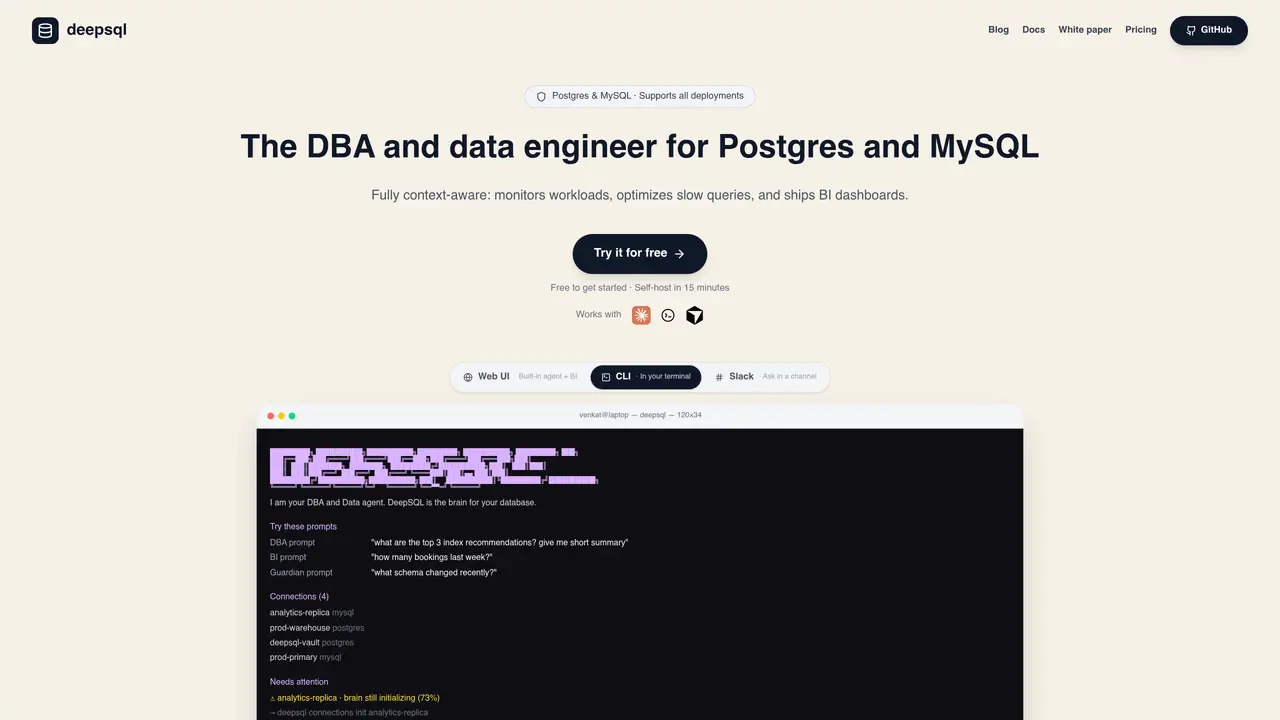
DeepSQL is a self-hostable AI database agent designed to monitor database workloads, optimize slow queries, and generate BI dashboards for Postgres and MySQL. It connects to your database via read-only credentials on a read replica, ensuring no data leaves your infrastructure. The agent learns your schema, indexes slow query logs, and allows you to interact with it through a web UI, terminal, or Slack. It also functions as an MCP server, enabling integration with tools like Claude, Codex, or Cursor for natural language database queries. DeepSQL applies company-specific business rules to calculations, ensuring metrics like MRR or active users are computed according to your team’s definitions. Installation is streamlined with a one-line command, and it includes role-based access, query policies, and audit logs for security and governance. The tool is particularly useful for database administrators, data engineers, backend developers, and data analysts seeking to automate database management and enhance query performance.
Key features
- Self-hostable within your VPC for data privacy
- Monitors database workloads and optimizes slow queries
- Generates BI dashboards from your data
- Supports natural language database queries
- Integrates with Claude, Codex, and Cursor via MCP
- Role-based access control and audit logging
- One-line installation for quick setup
- Works with Postgres and MySQL read replicas
- Applies company-specific business rules for metric calculations
- Available as a terminal CLI, web UI, or Slack bot
Use cases
- Optimizing slow queries and recommending database indexes
- Monitoring database workloads and performance trends
- Generating BI dashboards from raw database data
Pros
- Self-hostable with read-only access to a replica, ensuring no data leaves your infrastructure
- Combines database monitoring, slow query optimization, and BI dashboard generation in a single agent
- Supports natural language queries through web UI, terminal, Slack, or MCP-compatible tools like Claude and Cursor
- Applies company-specific business rules to calculations, ensuring consistent metric definitions across teams
- Includes role-based access control, query policies, and audit logs for security and governance
Cons
- Requires initial setup and configuration of a read replica for optimal performance
- May have a learning curve for teams unfamiliar with database agents or MCP servers
- Dependency on schema stability and consistent data access for accurate recommendations
Frequently asked questions about DeepSQL
What is DeepSQL and what does it do?
DeepSQL is a self-hostable AI agent that acts as a database administrator and data engineer for Postgres and MySQL. It monitors workloads, optimizes slow queries, generates BI dashboards, and allows natural language interactions through multiple interfaces.
Who is DeepSQL designed for?
DeepSQL is designed for database administrators, data engineers, backend developers, product managers, and executive teams who interact with databases and need automated monitoring, optimization, and BI capabilities.
How does DeepSQL ensure data security?
DeepSQL connects to databases via read-only credentials on a read replica, ensuring no production data leaves your infrastructure. It also includes role-based access control, query policies, and audit logs for governance.
Can DeepSQL integrate with other tools like Slack or coding agents?
Yes, DeepSQL can be accessed through a web UI, terminal, or Slack. It also functions as an MCP server, enabling integration with tools like Claude, Codex, or Cursor for natural language database queries and schema review.
How does DeepSQL handle business-specific metrics?
DeepSQL allows users to teach it company-specific business rules and conventions, such as MRR calculations or active user definitions. These rules are then applied consistently across queries, dashboards, and recommendations.
What is required to get started with DeepSQL?
DeepSQL can be installed with a one-line command and typically self-hosts in about 15 minutes. It requires access to a Postgres or MySQL database via a read replica and read-only credentials for optimal operation.