OpenAI builds and deploys advanced AI models like GPT-4o for autonomous agents and workflows.

LineBreak
FreeStarting price
0Popularity
About LineBreak
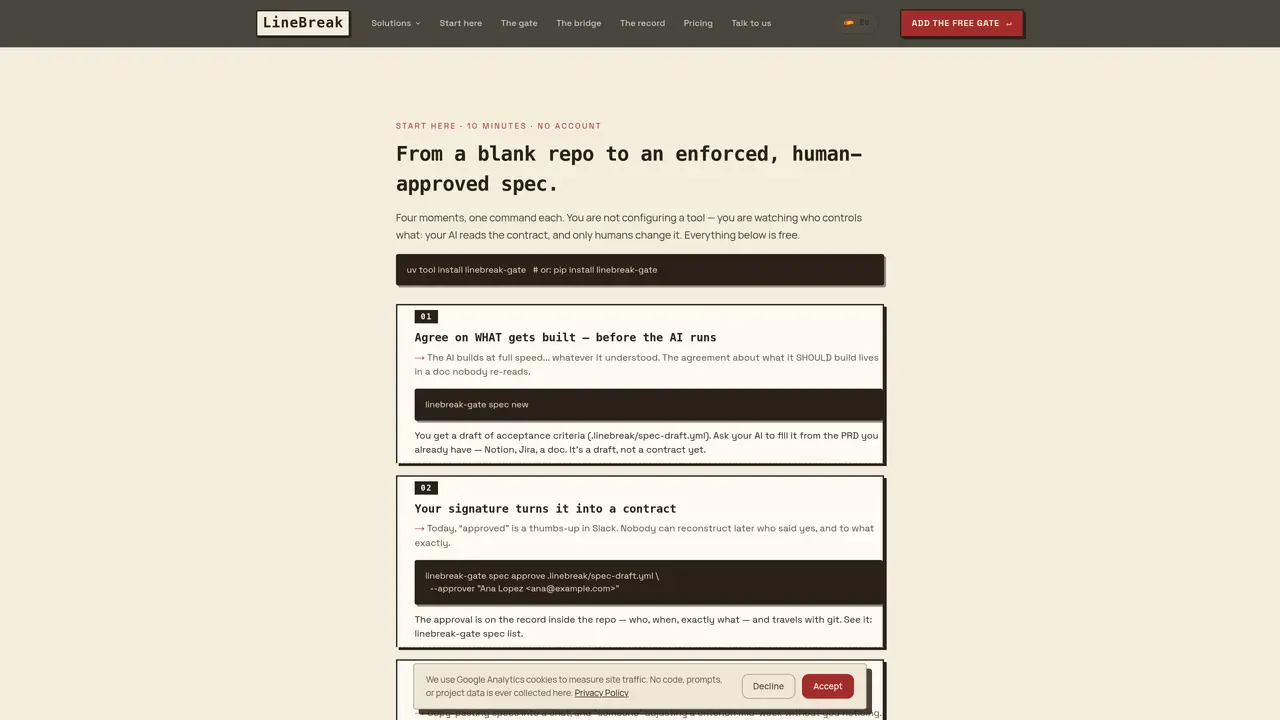
LineBreak provides a set of tools that enforce human-approved specifications for AI-generated code through a fail-closed CI gate. The workflow begins with drafting acceptance criteria from existing project requirements, which are then approved by named humans and stored as a signed record in the repository. The AI agent reads these criteria during development but cannot modify them, ensuring alignment with agreed specifications. Manual approvals are required for certain criteria, blocking CI until human sign-off is provided. The system includes a CI check that fails if approved criteria are altered, maintaining integrity. A separate MCP server serves approved criteria to AI coding agents, while a signed, offline-verifiable record tracks all approvals and changes. The free tier includes the CI gate and basic spec loop, while paid tiers add cryptographic signatures and hosted AI code review.
Key features
- Draft acceptance criteria from existing project documentation
- Human approval tracking with verifiable signatures
- Fail-closed CI gate that blocks non-compliant code
- MCP server serving approved specifications to AI agents
- Offline-verifiable approval records stored in git history
- Hosted AI code review in paid tiers
- Cryptographic signatures for tamper-evident approvals
- Repository-based workflow with no external dependencies
Use cases
- Enforcing human oversight on AI-generated code in software development
- Maintaining compliance with specifications in regulated industries
- Preventing unauthorized changes to project requirements during AI development
Pros
- Fail-closed CI gate blocks non-compliant AI-generated code
- Human approvals recorded in repository history with timestamps and approver identities
- AI agents read but cannot modify approved specifications
- Free tier available with no account or credit card required
- Supports offline verification of approval signatures
Cons
- Manual approval required for certain criteria, creating potential bottlenecks
- Pro tier required for cryptographic signatures and hosted AI review
- Limited to repository-based workflows
- No support for real-time collaboration on specifications
Frequently asked questions about LineBreak
What is LineBreak and what does it do?
LineBreak provides tools to enforce human-approved specifications for AI-generated code through a fail-closed CI gate. It ensures AI agents adhere to predefined acceptance criteria by requiring manual approvals and blocking CI until specifications are met.
Who should use LineBreak?
LineBreak is designed for teams using AI coding agents who need to maintain alignment with project requirements. It suits industries like healthcare, fintech, government, and startups where governance and compliance are critical.
How does LineBreak integrate with existing workflows?
LineBreak integrates via a CI gate and an MCP server that serves approved criteria to AI coding agents. It can be installed using commands like `uv tool install linebreak-gate` or `pip install linebreak-gate`, and works with editors like Claude Code or Cursor.
What are the key features of LineBreak?
Key features include drafting acceptance criteria, human approval workflows, a read-only MCP bridge for AI agents, CI checks that enforce specifications, and a signed record of approvals. The free tier includes the CI gate and basic spec loop, while paid tiers add cryptographic signatures.
How do I get started with LineBreak?
To get started, install the free gate using a simple command like `linebreak-gate spec new` to draft criteria, approve them with `linebreak-gate spec approve`, and enforce them via CI with `linebreak-gate check`. No account or credit card is required for the free tier.
What is the difference between the free and paid tiers?
The free tier includes the CI gate, the MCP bridge, and an unsigned record of approvals. Paid tiers add cryptographic signatures that make tampering with approved criteria fail CI automatically, providing stronger integrity guarantees.