
OpenAI builds and deploys advanced AI models like GPT-4o for autonomous agents and workflows.

Liquid AI
$10Starting price
157KMonthly visits
37Popularity
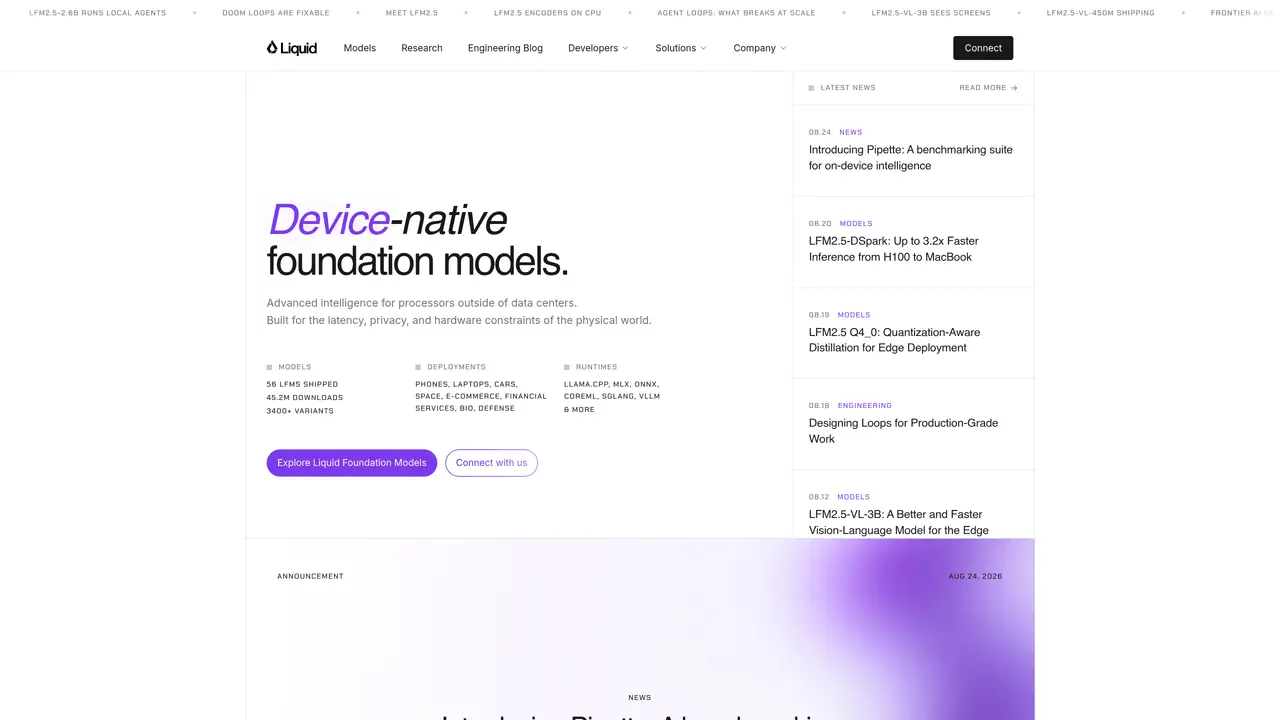
About Liquid AI
Liquid AI builds device-native foundation models (LFMs) designed to run locally across phones, laptops, vehicles, and embedded systems. These compact models are exportable to multiple runtimes including llama.cpp, MLX, ONNX, and CoreML, enabling private, low-latency reasoning and search with over 3,200 variants and proven industrial deployments. The platform is built for engineers shipping AI into products beyond the data center, serving mobile app developers, automotive software teams, embedded and robotics engineers, and ML practitioners in sectors like e-commerce, finance, healthcare, industrial, and defense. Researchers can prototype liquid neural networks, state-space models, and tokenizer upgrades, then validate with Pipette benchmarking. Organizations in regulated environments adopt LFMs to keep sensitive content local while maintaining interactive responsiveness expected on consumer hardware. The workflow involves selecting an LFM variant sized for target hardware, fine-tuning with LEAP on domain data, quantizing, and exporting a single artifact per runtime. Deployment targets include laptops, mobiles, and vehicles with private on-device inference and monitoring through existing application stacks. Documentation and example projects support bring-up on Apple Silicon and CPU-only endpoints, simplifying integration for heterogeneous fleets.
Key features
- Device-native foundation models (LFMs) with 3,200+ variants
- Export to llama.cpp, MLX, ONNX, CoreML, SGLang, and vLLM
- Fine-tuning with LEAP SDK on proprietary data
- Quantization-aware distillation and tokenizer expansion
- Private, low-latency on-device inference and monitoring
- Pipette benchmarking for validation and research
- Multimodal understanding with LFM2.5-VL for text and image grounding
- DSpark for inference acceleration and edge deployment
- Support for CPU-only, Apple Silicon, GPUs, and automotive hardware
- Deterministic runtime artifacts for packaging and reproducibility
Use cases
- Deploy in-car assistants running fully offline and privacy-preserving
- Build on-device customer support copilots for mobile apps
- Enable factory inspection with vision-language reasoning at the edge
Pros
- Supports deployment across heterogeneous hardware including phones, laptops, vehicles, and embedded systems
- Offers over 3,400 model variants optimized for edge deployment with proven industrial use cases
- Enables private, on-device inference with no data leaving the device, suitable for regulated environments
- Provides multiple runtime export options such as llama.cpp, MLX, ONNX, and CoreML for flexibility
- Includes a full-stack solution with fine-tuning (LEAP SDK), quantization, and deployment tools
Cons
- May require technical expertise to integrate and optimize models for specific hardware targets
- Limited to device-native models, which may not suit all cloud-centric or high-compute use cases
- Fine-tuning and deployment workflows may involve complexity for non-technical users
Frequently asked questions about Liquid AI
What are Liquid AI's device-native foundation models (LFMs)?
Liquid AI's LFMs are compact, general-purpose AI models designed to run locally on edge devices such as phones, laptops, vehicles, and embedded systems. They prioritize low latency, privacy, and hardware efficiency while supporting a wide range of applications.
Who should use Liquid AI's platform?
The platform is built for engineers and teams shipping AI into products beyond data centers, including mobile app developers, automotive software teams, embedded and robotics engineers, and ML practitioners in sectors like e-commerce, finance, healthcare, industrial, and defense.
What runtimes does Liquid AI support for deployment?
Liquid AI models can be exported to multiple runtimes including llama.cpp, MLX, ONNX, CoreML, SGLang, and vLLM, enabling deployment across diverse hardware and software environments.
How does the pricing model work for Liquid AI?
Liquid AI's foundation models are free to download, run, and fine-tune for companies with annual revenue under $10 million. For larger organizations, enterprise plans include commercial licenses, bespoke optimization, and dedicated support.
Can I fine-tune Liquid AI models for my specific use case?
Yes, the LEAP SDK allows users to fine-tune LFMs on domain-specific data, quantize the models, and export them for deployment, streamlining the path from prototype to production.
Does Liquid AI provide tools for benchmarking on-device models?
Yes, Liquid AI offers Pipette, a benchmarking suite designed to measure and compare the performance of on-device intelligence across different hardware configurations and model variants.
Liquid AI Website Engagement
Last Update: 10 days ago
Total Monthly Visits
0
Bounce Rate
0%
Visit Duration (avg)
0.00s
Pages Per Visit
0
Country Rank
0
United States
Global Rank
0
Category Rank
#0
Computers Electronics & Technology
Monthly Traffic
Traffic Sources
Traffic Share By Country
- United States27.9%
- India9.1%
- Germany7.7%
- Brazil3.9%
- Indonesia3.5%