
OpenAI builds and deploys advanced AI models like GPT-4o for autonomous agents and workflows.
Lmql
5.9KMonthly visits
13Popularity
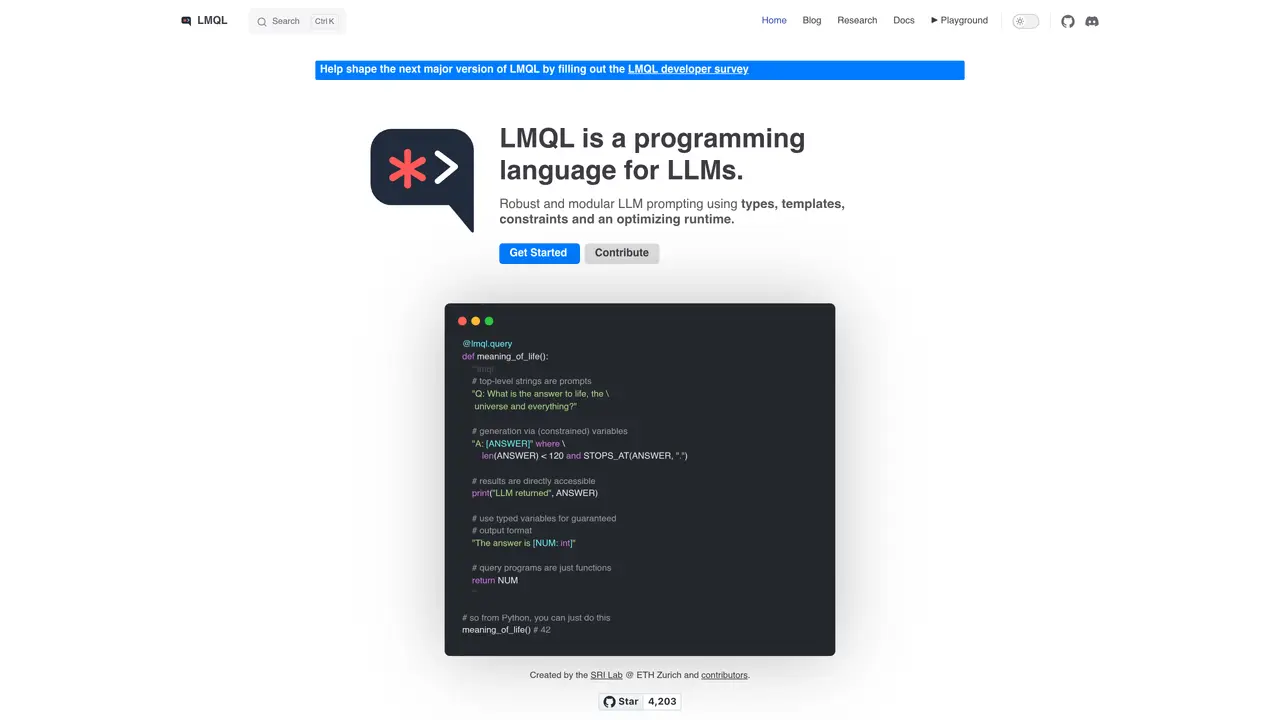
About Lmql
LMQL is the perfect tool for developers who want to take advantage of large language models (LLMs). It is a specialized query language that combines natural language prompts with the flexibility of Python, allowing developers to interact with LLMs quickly and easily. With LMQL, developers have access to a range of features, such as constraints, debugging, retrieval, and control flow, that help make the process of prompting responses from an LLM simpler. What’s more, LMQL offers support for 🤗 Transformers, allowing for a more powerful and accurate interaction with LLMs. With LMQL, developers can easily create and manage LLM applications with less time and effort, making the development process more efficient and cost-effective. For developers looking to get the most out of large language models, LMQL is the perfect tool.
Key features
- Specialized query language for interacting with LLMs
- Combines natural language prompts with Python flexibility
- Support for 🤗 Transformers for powerful and accurate interactions
- Constraints feature for simplifying prompting responses
- Debugging features for easier error identification
- Control flow features for managing complex interactions
Use cases
- Creating and managing LLM applications with ease
- Leveraging powerful and accurate 🤗 Transformers interactions
- Developing complex AI applications with control flow features
Pros
- Combines natural language prompts with Python for flexible LLM interaction
- Supports constraints, debugging, retrieval, and control flow for precise LLM responses
- Enables modular and reusable prompt components through nested queries
- Automatically ensures portability across multiple LLM backends with minimal code changes
- Provides typed variables and regex support for guaranteed output formats
Cons
- May require familiarity with programming concepts for optimal use
- Nested query features could introduce complexity for simple use cases
- Dependency on external LLM backends may limit offline or custom model usage
Frequently asked questions about Lmql
What is LMQL and what does it do?
LMQL is a programming language designed for interacting with large language models (LLMs). It combines natural language prompts with Python-like syntax, enabling developers to create, manage, and optimize LLM applications with structured constraints, templates, and control flow.
Who is LMQL suitable for?
LMQL is ideal for developers and researchers working with LLMs who need a robust, modular, and expressive way to construct prompts, enforce constraints, and manage multi-part interactions while maintaining portability across different LLM backends.
How does LMQL work with different LLM backends?
LMQL abstracts backend-specific details, allowing users to write code once and switch between backends such as Hugging Face Transformers, OpenAI, or llama.cpp with minimal changes, typically a single line of code.
Does LMQL support constraints and structured outputs?
Yes, LMQL allows developers to define hard constraints on generated outputs using variables, types, and regex patterns, ensuring responses adhere to specified formats or lengths.
Can LMQL be used for complex, multi-step prompts?
LMQL supports nested queries and procedural programming constructs, enabling the creation of modular prompt components and reusing instructions across multiple steps in a single workflow.
How do I get started with LMQL?
Users can begin with LMQL by exploring the official documentation, experimenting in the LMQL Playground, or installing the language via its GitHub repository. Example programs and templates are provided to guide initial usage.
Lmql Website Engagement
Last Update: 9 days ago
Total Monthly Visits
0
Bounce Rate
0%
Visit Duration (avg)
0.00s
Pages Per Visit
0
Country Rank
0
India
Global Rank
0
Category Rank
#0
Programming & Developer Software
Monthly Traffic
Traffic Sources
Traffic Share By Country
- United States57.8%
- India42.2%