
OpenAI builds and deploys advanced AI models like GPT-4o for autonomous agents and workflows.

LoopBudget
$5/moStarting price
0Popularity
About LoopBudget
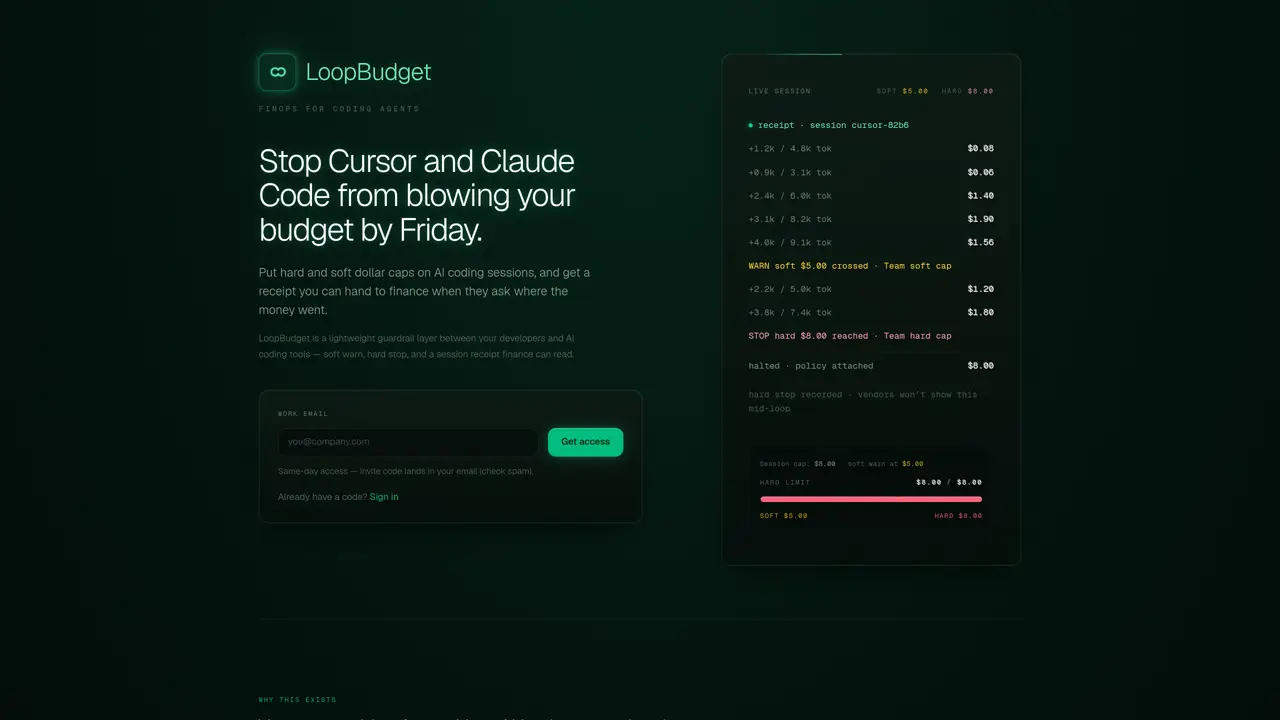
LoopBudget provides a lightweight guardrail layer between developers and AI coding tools such as Cursor and Claude Code. It enforces soft and hard dollar caps on AI coding sessions, issuing a finance-readable receipt for each session that includes token usage, costs, and enforcement events. The tool is designed to shift spend control from a monthly forensic exercise to an immediate policy that runs with every session, preventing budget overruns before they happen. LoopBudget connects to AI tools via a single org API key, allowing teams to set spending limits without adding another dashboard to their workflow. Engineering teams retain visibility into real-time usage while finance receives clear, itemized records for auditing or chargeback purposes. The solution targets teams rolling out AI coding tools across multiple developers, offering a shared policy layer that complements single-vendor controls.
Key features
- Soft and hard dollar spend caps per session
- Finance-readable session receipts with token usage and costs
- Real-time visibility into AI coding sessions
- Policy enforcement without additional dashboards
- Shared policy layer across Cursor and Claude Code
- Itemized spend records for auditing
- Session ledger for engineering and finance teams
- One-time org API key connection
Use cases
- Enforcing team-wide AI coding budget limits before overruns occur
- Providing finance teams with clear, itemized receipts for AI tool spend
- Supporting engineering leads in rolling out AI coding tools without losing budget control
Pros
- Enforces soft and hard spend caps on AI coding sessions
- Generates finance-readable receipts for each session
- Connects to Cursor and Claude Code via a single org API key
- Provides real-time visibility for engineering teams
- Shifts spend control from retrospective analysis to proactive policy
Cons
- Limited to Cursor and Claude Code integration
- Hard stops are recorded but do not forcibly terminate sessions mid-loop
- Not intended for solo developers or personal subscriptions
- Early access model with invite codes
Frequently asked questions about LoopBudget
How is LoopBudget different from Cursor or Claude Code billing controls?
Cursor and Claude Code billing controls only govern their own tool, whereas LoopBudget acts as a shared policy layer that applies soft and hard spend caps across sessions, records enforcement events on a finance-readable receipt, and maintains a single ledger for both tools.
Isn't this the same as a cloud FinOps tool?
Cloud FinOps tools are not built for AI coding-agent sessions, which involve per-session billing and granular token-level usage. LoopBudget is designed specifically for Cursor and Claude Code sessions, offering per-session soft warnings, hard stops, and itemized receipts.
Does LoopBudget support Cursor and Claude Code today?
Yes, LoopBudget currently supports Cursor and Claude Code, providing guardrails and session receipts for both tools through a single integration.
Will spending caps get in developers' way?
LoopBudget is designed to allow teams to move quickly while preventing budget overruns. Soft warnings and hard stops are enforced only when limits are reached, minimizing disruption to workflows.
What does a session receipt include?
A session receipt includes token usage, dollar cost, soft-limit warnings, hard-stop events, and enforcement records, providing a clear, itemized record for both engineering and finance teams.
Do you see our code or prompts?
No, LoopBudget does not access or store code or prompts. It only tracks token usage, session costs, and enforcement events for budget control purposes.