AI-powered website builder that generates a professional site in under a minute and includes tools for content, SEO, and analytics.
52M visits/mo+0.7%#4 Coding & Development

Local observability tool for coding agents that tracks token usage and context growth
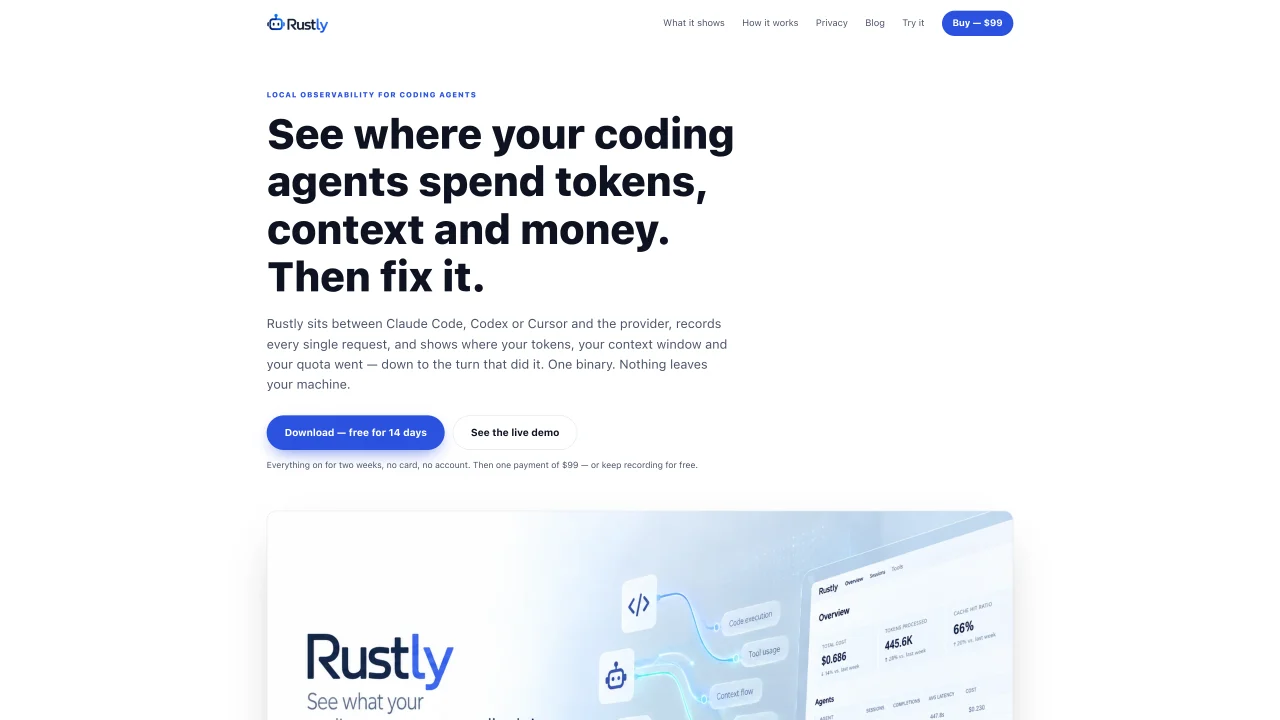
Rustly is a local observability tool designed to track and analyze how coding agents consume tokens, context windows, and API quotas. It sits between coding agents like Claude Code, Codex, or Cursor and their respective providers, recording every request without altering the workflow. The tool provides detailed breakdowns of token expenditure, cache behavior, tool schema usage, and context growth on a per-turn basis. Rustly operates entirely offline, storing all data in a local SQLite file and never transmitting information outside the user’s machine. It includes an advice engine that generates actionable recommendations based on observed usage patterns, ranked by potential savings. The tool also offers enforcement rules that can modify tool calls to reduce unnecessary token consumption, such as limiting file reads or skipping redundant operations. Historical data from past sessions is automatically imported, allowing users to analyze months of agent activity immediately after installation.
Rustly is a local observability tool that tracks and analyzes how coding agents consume tokens, context windows, and API quotas. It records every request made by agents like Claude Code, Codex, or Cursor without altering the workflow, providing detailed breakdowns of token expenditure and usage patterns.
Rustly is designed for developers and teams using coding agents such as Claude Code, Codex, Cursor, or similar tools. It is particularly useful for those looking to optimize token usage, reduce costs, and improve the efficiency of their agent-based workflows.
Rustly operates entirely offline, storing all data in a local SQLite file on the user’s machine. It never transmits information outside the user’s device, ensuring complete privacy and control over sensitive data.
Yes, Rustly includes enforcement rules that can modify tool calls to reduce unnecessary token consumption, such as limiting file reads or skipping redundant operations. These rules act through hooks that the agents respect, providing transparency and control.
Yes, Rustly automatically imports historical data from past sessions, allowing users to analyze months of agent activity immediately after installation. This includes data from tools like Claude Code and Codex, which store full transcripts on disk.
Rustly is available as a one-time purchase for $99, with no subscription or usage fees. A free trial is available for 14 days without requiring a credit card or account.
We use essential cookies to run aitoolnavio™, and optional cookies to analyze traffic and measure our marketing. You choose what we use — optional cookies stay off unless you turn them on. See our Privacy Policy.
One short email a week: fresh tools worth trying, honest takes and the updates that actually matter. No spam, unsubscribe any time.
AI-powered website builder that generates a professional site in under a minute and includes tools for content, SEO, and analytics.
AI-powered coding platform that uses agents to plan, write, and test software with real-time feedback and verifiable artifacts.
Automate code, research, and documents using agents.
AI-powered code assistant that generates, reviews, optimizes, and debugs code with natural language prompts and editor integrations.
AI assistant for safe, reliable productivity with code, collaboration, and integrations.
AI-powered IDE for autonomous coding tasks and agentic development workflows
Privacy-focused AI chatbot that generates uncensored text, code, images, and translations without storing conversations or requiring an account.
A free web-based AI chatbot and agent for writing, coding, research, and content creation with multilingual support.
Write & run code in 50+ languages, auto-complete with AI, and code faster with an intuitive interface.
An IDE that automates legacy-to-modern code migration using autonomous coding agents.
AI models that return typed decisions with calibrated confidence for software automation
Practice coding challenges, improve technical skills, get detailed explanations, compare performance with peers.
Matched on what this tool does — grouped by the job you would be replacing.
matches Token and context window tracking per turn · Cache behavior analysis and breakdown · Tool schema usage auditing
Agent observability and evaluation platform for production AI systems
Local observability dashboard for AI coding agents and autonomous tools
Control plane for AI coding agents measuring cost, safety and memory
Monitors and logs token usage and execution traces for coding agents including Claude Code
matches Enforcement rules for tool call modifications · Secret interception and blocking · Prompt-injection detection in tool output
Local policy proxy that intercepts and validates AI coding agent tool calls before execution
Policy guardrails for AI coding sessions to control spend before it occurs
Enforces design system rules in AI-generated code and pull requests