AI-powered website builder that generates a professional site in under a minute and includes tools for content, SEO, and analytics.
52M visits/mo+0.7%#4 Coding & Development

Debug, explain, and enhance deep learning models with unsupervised root cause detection and data optimization.
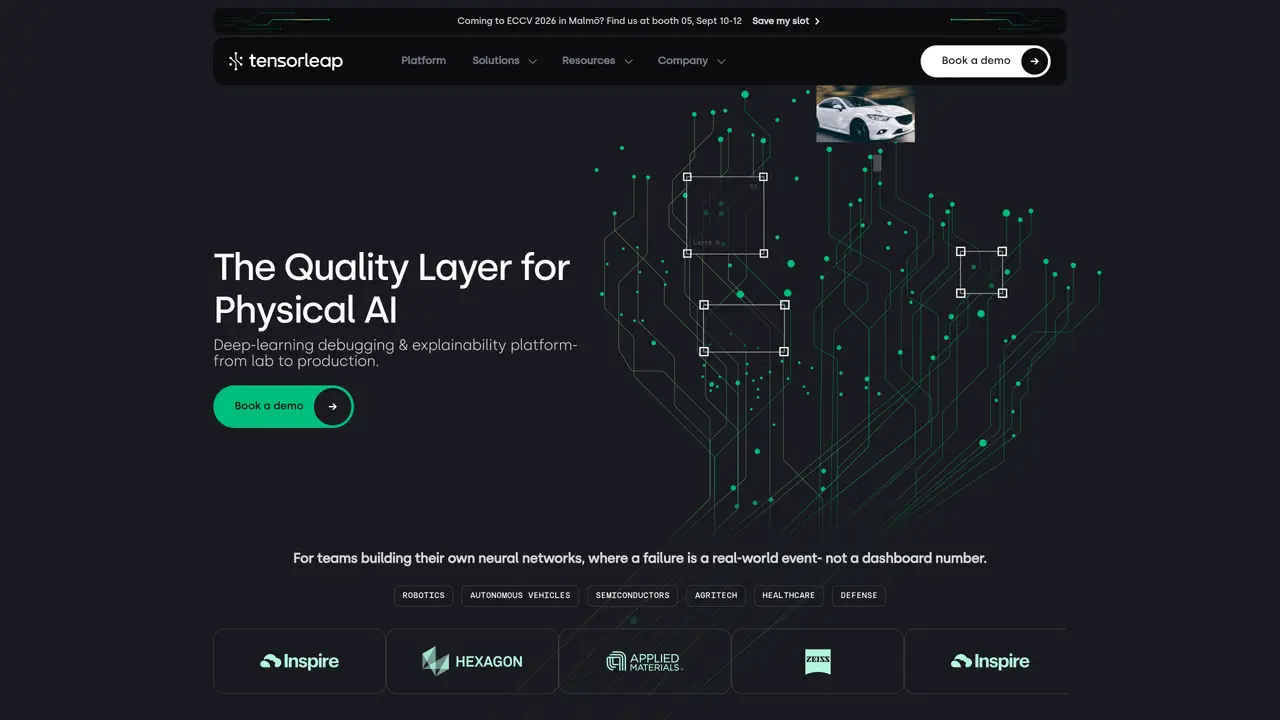
TensorLeap is a platform designed to enhance the debugging, explainability, and reliability of deep learning models. It provides data scientists and AI teams with advanced tools to analyze model behavior, uncover failures, and improve dataset quality for more robust training. The platform enables users to perform deep unit testing and development traceability, allowing teams to validate model performance across diverse data subsets and track iterations effectively. By offering data-driven insights and analytics, TensorLeap supports rapid model iteration and deployment while reducing development costs and ensuring informed decision-making. It is particularly suited for organizations working on complex AI systems where understanding model decisions and optimizing performance are critical to success. TensorLeap integrates seamlessly into existing workflows, providing actionable feedback to refine models and datasets iteratively. The platform emphasizes transparency, enabling teams to identify and address issues early in the development cycle, ultimately leading to more reliable and high-performing AI systems.
TensorLeap is a deep-learning debugging and explainability platform designed to help teams analyze model behavior, identify failures, and refine datasets for higher-quality training. It provides tools to detect failure modes, optimize models, and monitor production systems, enabling teams to move from identifying issues to implementing fixes efficiently.
TensorLeap is particularly suited for teams building neural networks where real-world failures have significant consequences, such as robotics, autonomous vehicles, semiconductors, agritech, healthcare, and defense. It is valuable for data scientists, engineers, and organizations focused on improving model reliability and performance.
TensorLeap helps debug models by revealing root causes of failures, identifying edge cases and domain gaps, and providing targeted recommendations for data or model adjustments. It supports rapid iteration by enabling users to diagnose issues, apply fixes, and retest within a single workspace.
Yes, TensorLeap is designed to fit into existing workflows and integrates with tools like W&B, MLflow, and cloud storage solutions such as S3, GCS, and Azure Blob. It supports deployment on-premise or in the cloud and offers enterprise-ready features like SSO, RBAC, and audit logs.
TensorLeap supports industries such as robotics, autonomous vehicles, semiconductors, agritech, healthcare, and defense. It is used for tasks like model behavior analysis, dataset curation, model optimization, and production monitoring to ensure reliable performance in real-world applications.
To get started with TensorLeap, you can book a demo or log in if you already have access. The platform is designed to be plug-in compatible with existing workflows, allowing teams to integrate it without disrupting their current processes.
tensorleap.ai · third-party estimates from Similarweb
Last 3 months · grows by one month every month
Share of visits · estimated visits
Coding & Development · Sep 2026
Traffic figures are third-party estimates, good for scale and trends; they can differ from a company's own numbers. Updated monthly.
We use essential cookies to run aitoolnavio™, and optional cookies to analyze traffic and measure our marketing. You choose what we use — optional cookies stay off unless you turn them on. See our Privacy Policy.
One short email a week: fresh tools worth trying, honest takes and the updates that actually matter. No spam, unsubscribe any time.
AI-powered website builder that generates a professional site in under a minute and includes tools for content, SEO, and analytics.
AI-powered coding platform that uses agents to plan, write, and test software with real-time feedback and verifiable artifacts.
Automate code, research, and documents using agents.
AI-powered code assistant that generates, reviews, optimizes, and debugs code with natural language prompts and editor integrations.
AI assistant for safe, reliable productivity with code, collaboration, and integrations.
AI-powered IDE for autonomous coding tasks and agentic development workflows
Privacy-focused AI chatbot that generates uncensored text, code, images, and translations without storing conversations or requiring an account.
A free web-based AI chatbot and agent for writing, coding, research, and content creation with multilingual support.
Write & run code in 50+ languages, auto-complete with AI, and code faster with an intuitive interface.
An IDE that automates legacy-to-modern code migration using autonomous coding agents.
AI models that return typed decisions with calibrated confidence for software automation
Practice coding challenges, improve technical skills, get detailed explanations, compare performance with peers.
Matched on what this tool does — grouped by the job you would be replacing.
matches Root cause detection using unsupervised techniques · Deep unit testing across thousands of data subsets · Development traceability for tracking model modifications and iterations
A platform for automated testing, evaluation, and improvement of machine learning models.
Enhances AI transparency, explainability, and fairness with robust monitoring.
Streamline AI app development with advanced debugging, testing, and monitoring.
Detect errors, biases, and privacy issues, track LLM performance, receive alerts, and analyze root-causes in real-time.
matches Data optimization by removing irrelevant samples and prioritizing key data · Speed in development with data-driven insights and analytics · Cost efficiency by reducing resource utilization and maximizing team productivity
matches API access for custom integrations · Speed in development with data-driven insights and analytics
AI observability platform for tracing production agents, running evals, and catching regressions before they reach users.
Optimize AI model performance and reduce costs with advanced tools.
Automate predictive model building, find best configurations, identify issues, and deploy models into production.
High-throughput, memory-efficient inference and serving engine for large language models to deploy AI faster with top-tier performance.
Accelerate inference speeds up to 100x, optimize and deploy deep learning models quickly, compatible with popular frameworks.