GitHub hosts HunyuanVideo, Tencent's open-source framework for large-scale video generation models, enabling AI-driven video creation.

vLLM
1.1MMonthly visits
50Popularity
About vLLM
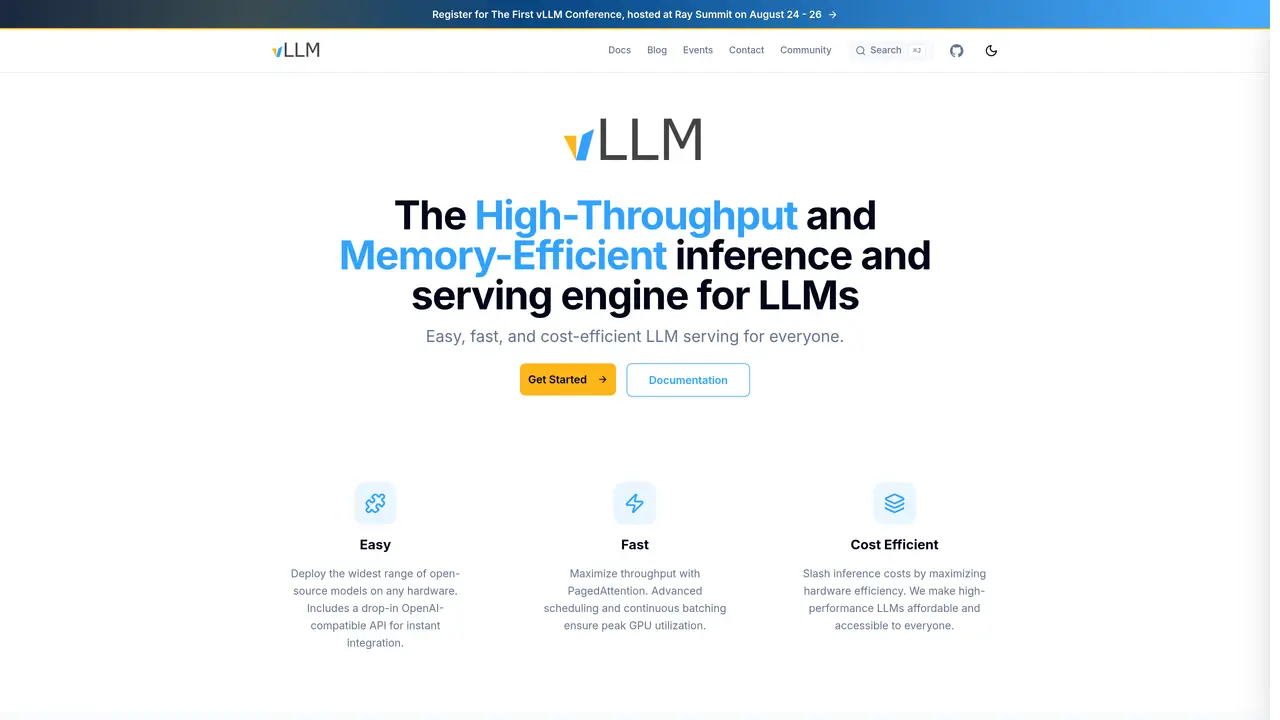
vLLM is an inference and serving engine designed to accelerate the deployment of large language models while optimizing memory usage. It enables high-throughput inference, allowing organizations to serve models efficiently even under heavy workloads. The engine supports state-of-the-art performance benchmarks, making it suitable for production environments where speed and scalability are critical. By leveraging advanced memory management techniques, vLLM reduces the overhead typically associated with running large models, enabling faster response times and lower operational costs. It is particularly well-suited for teams deploying LLMs in real-time applications such as chatbots, content generation, and automated reasoning systems. The open-source foundation of vLLM encourages community contributions and customization, while its compatibility with bring-your-own-key (BYOK) models ensures flexibility for organizations with specific compliance or security requirements. Whether used for research, prototyping, or production-grade deployments, vLLM provides a robust framework for optimizing LLM inference workflows.
Key features
- High-throughput inference for large language models
- Memory-efficient serving engine
- State-of-the-art performance benchmarks
- Support for bring-your-own-key (BYOK) models
- Open-source foundation
- Optimized for production environments
- Advanced memory management techniques
- Compatibility with real-time applications
Use cases
- Deploying LLMs in production environments for chatbots
- Optimizing inference workflows for content generation systems
- Scaling LLM serving for automated reasoning applications
Pros
- High-throughput inference with PagedAttention for optimized memory usage
- Open-source and community-driven with broad hardware compatibility
- Drop-in OpenAI-compatible API for seamless integration
- Supports a wide range of open-source models across different platforms
- Cost-efficient by maximizing hardware utilization and reducing inference overhead
Cons
- Requires Python 3.10+ and specific hardware dependencies for full functionality
- Nightly builds may introduce instability compared to stable releases
Frequently asked questions about vLLM
What is vLLM and what does it do?
vLLM is a high-throughput, memory-efficient inference and serving engine for large language models. It accelerates deployment, optimizes memory usage, and supports production-grade serving with advanced scheduling and batching.
Who is vLLM suitable for?
vLLM is suitable for organizations and developers deploying LLMs in real-time applications such as chatbots, content generation, and automated reasoning systems. It is also useful for research, prototyping, and production environments.
Does vLLM support different hardware platforms?
Yes, vLLM supports a wide range of hardware including NVIDIA GPUs, AMD ROCm GPUs, AWS Neuron, Google Cloud TPUs, Intel Gaudi XPUs, and even CPUs like Apple Silicon.
How do I get started with vLLM?
To get started, select your preferences and run the installation command provided on the website. The stable version is recommended for most users, while nightly builds offer the latest features.
Is vLLM compatible with other tools or APIs?
Yes, vLLM provides a drop-in OpenAI-compatible API, making it easy to integrate with existing tools and workflows that support OpenAI's API standards.
Where can I find documentation or support for vLLM?
Documentation is available at docs.vllm.ai, and community support can be found on Slack, GitHub, and the project's forum. The community is active and responsive to questions.
vLLM Website Engagement
Last Update: 9 days ago
Total Monthly Visits
0
Bounce Rate
0%
Visit Duration (avg)
0.00s
Pages Per Visit
0
Country Rank
0
China
Global Rank
0
Monthly Traffic
Traffic Sources
Traffic Share By Country
- China41.1%
- United States14.6%
- South Korea3.9%
- Taiwan3.3%
- India3.2%