GitHub hosts HunyuanVideo, Tencent's open-source framework for large-scale video generation models, enabling AI-driven video creation.

Intel OpenVINO
0Popularity
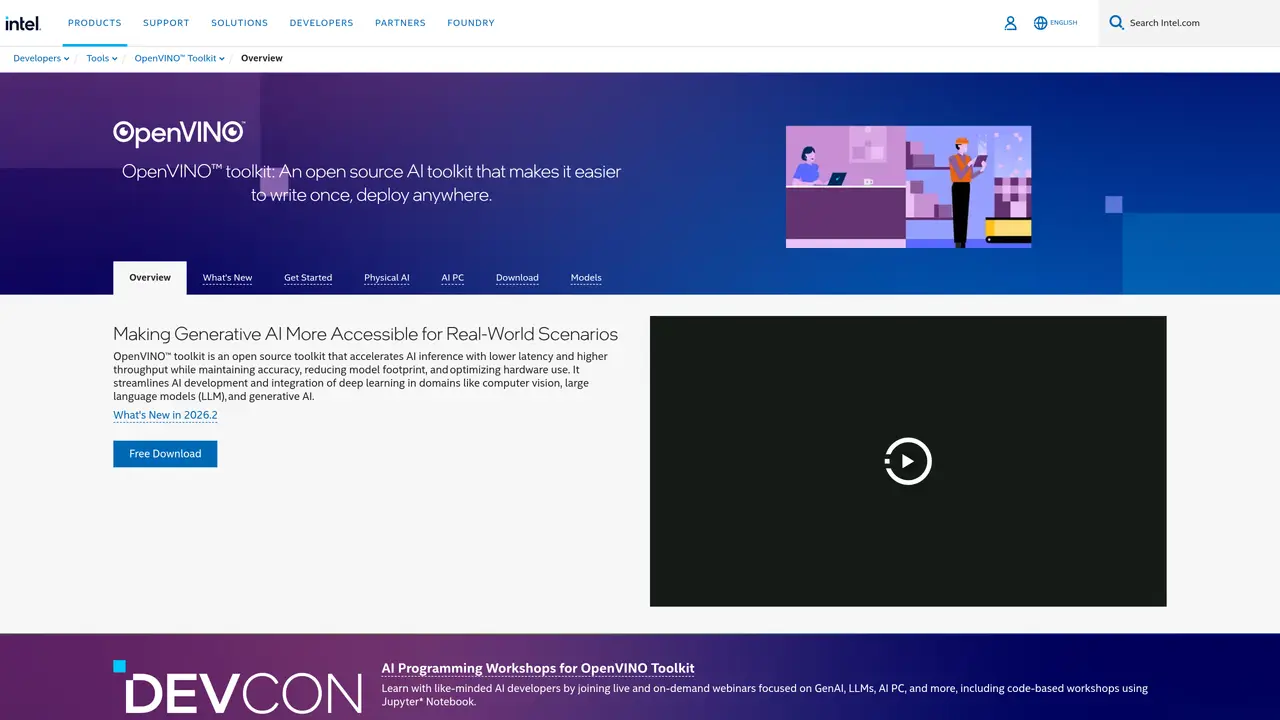
About Intel OpenVINO
Intel OpenVINO is an open-source toolkit designed to accelerate the development and deployment of AI applications across Intel hardware platforms. It provides a unified workflow for optimizing, tuning, and deploying deep learning models, enabling developers to build high-performance AI solutions with reduced complexity. The toolkit supports a wide range of Intel processors, including CPUs, GPUs, VPUs, and FPGAs, ensuring flexibility for diverse deployment environments. OpenVINO includes tools for model conversion, inference optimization, and benchmarking, allowing developers to maximize performance while maintaining accuracy. It supports popular deep learning frameworks such as TensorFlow, PyTorch, and ONNX, as well as a library of pre-trained models for common AI tasks. The toolkit is particularly well-suited for edge and embedded applications, where efficiency and low latency are critical. Developers can use OpenVINO to create AI solutions for industries like smart retail, healthcare, industrial automation, and autonomous systems. By leveraging Intel’s hardware acceleration technologies, OpenVINO enables faster inference and reduced computational overhead, making it a practical choice for real-world AI deployments.
Intel
Santa Clara, United States · Founded 1968
- Founders
- Robert Noyce, Gordon Moore, Andrew Grove
- Founded
- 1968
- Headquarters
- Santa Clara, United States
- Legal status
- Public company
Key features
- Optimize model accuracy and performance
- Support for multiple hardware platforms
- Pre-trained models and libraries
- Integration with popular deep learning frameworks
- Wide range of use cases supported
- Easy deployment across various platforms
Use cases
- Smart cities development
- Autonomous vehicle development
- Image and video processing applications
Pros
- Supports optimization and deployment across multiple Intel hardware platforms, including CPUs and AI accelerators
- Integrates with popular deep learning frameworks such as TensorFlow and Caffe
- Provides pre-trained models and libraries for rapid AI application development
- Enables high-performance inference with Intel’s deep learning acceleration technology
- Facilitates deployment in diverse environments, from edge devices to cloud infrastructure
Cons
- Primarily optimized for Intel hardware, limiting flexibility on non-Intel platforms
- May require additional configuration for compatibility with certain AI frameworks or models
- Steep learning curve for developers unfamiliar with Intel’s toolchain or hardware acceleration
Frequently asked questions about Intel OpenVINO
What is Intel OpenVINO?
Intel OpenVINO is an open-source toolkit for optimizing and deploying AI inference models across Intel hardware, including CPUs, GPUs, and VPUs. It accelerates deep learning workloads and supports deployment in edge and cloud environments.
Who should use Intel OpenVINO?
Developers and organizations building AI applications for edge devices, embedded systems, or cloud deployments that require optimized performance on Intel hardware. It suits use cases like computer vision, autonomous systems, and smart infrastructure.
How does OpenVINO optimize AI models?
OpenVINO uses model optimization techniques such as quantization, pruning, and hardware-specific tuning to improve inference speed and efficiency without compromising accuracy. It supports models trained in frameworks like TensorFlow, PyTorch, and ONNX.
What hardware platforms does OpenVINO support?
OpenVINO supports a wide range of Intel processors, including CPUs, integrated GPUs, and dedicated accelerators like the Intel Movidius VPU and Intel Gaussian & Neural Accelerator (GNA). It also works with third-party hardware through OpenVINO’s plugin architecture.
Can OpenVINO work with custom models?
Yes, OpenVINO allows developers to convert, optimize, and deploy custom models trained in popular frameworks. It provides tools to import models from TensorFlow, PyTorch, Caffe, and ONNX, and supports custom layer integration for unique architectures.
What are the typical use cases for OpenVINO?
Common use cases include real-time video analytics, autonomous vehicle systems, smart retail solutions, industrial automation, and healthcare applications like medical imaging. It is designed for latency-sensitive and resource-constrained environments.