
OpenAI builds and deploys advanced AI models like GPT-4o for autonomous agents and workflows.

YantrikDB
FreeStarting price
0Popularity
About YantrikDB
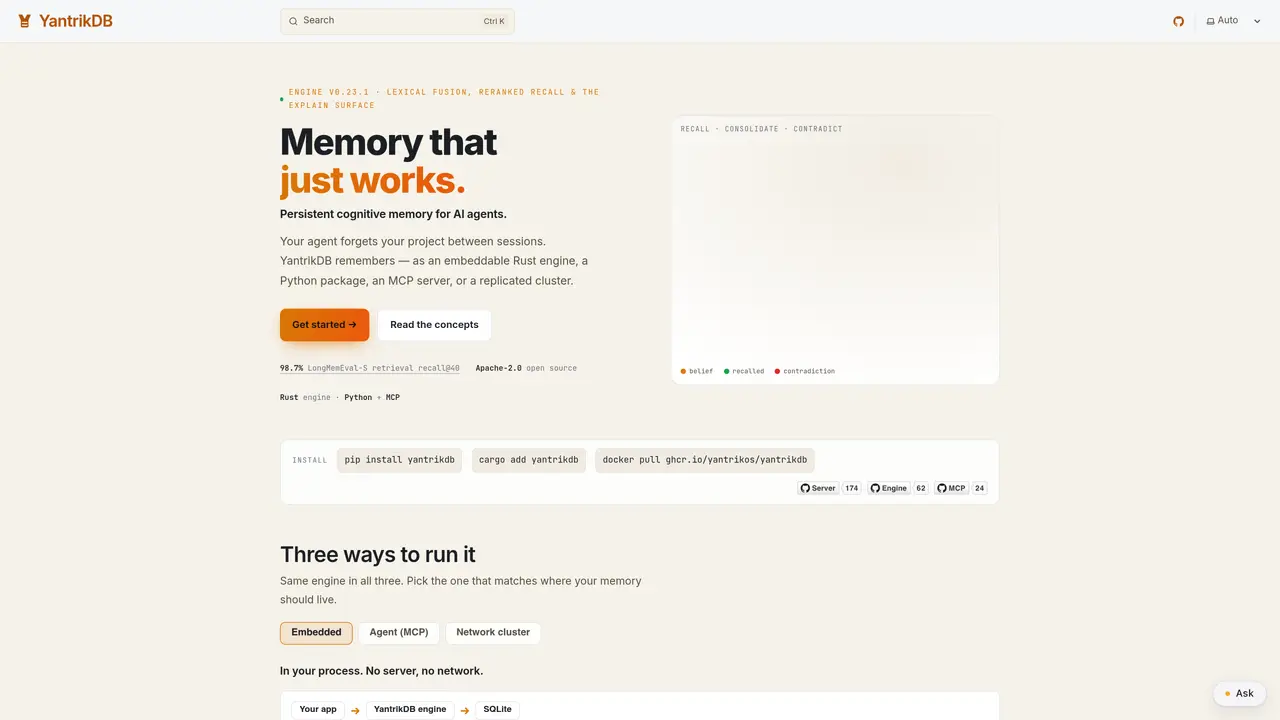
YantrikDB provides persistent cognitive memory for AI agents, ensuring continuity across sessions where standard agents typically forget project details. The tool functions as an embeddable Rust engine, a Python package, an MCP server, or a replicated cluster, offering flexibility in deployment. It supports three primary modes: embedded within an application for single-agent use, as an MCP server for existing assistants, or as a network cluster for shared memory across multiple agents or users. The engine uses lexical fusion and reranked recall to retrieve relevant memories efficiently, with features like namespace isolation, conflict detection, and consolidation of related fragments. Memory records include source attribution, revision history, and entity linking, enabling traceable decision-making. The system handles contradictions by flagging disputes without overwriting prior beliefs, allowing policies to determine resolution. A web-based demo illustrates recall, conflict review, and memory lifecycle, while a sample store demonstrates long-term memory retention and inspector tools for reviewing corrections and entity relationships.
Key features
- Lexical fusion and reranked recall for memory retrieval
- Namespace isolation and multi-tenancy support
- Conflict detection and dispute flagging
- Revision history and source attribution tracking
- Entity linking and memory consolidation
- MCP server for tool-based memory access
- Replicated cluster with authentication and failover
- Web-based demo and inspector tools
Use cases
- Single-agent memory persistence within an application
- Shared memory for multiple agents or users via MCP server
- Long-term memory storage and review with inspector tools
Pros
- Persistent memory across agent sessions
- Three deployment options: embedded, MCP server, or replicated cluster
- Conflict detection and revision history for traceable decisions
- Namespace isolation and entity linking for scoped recall
- Open-source Rust engine with Python and MCP support
Cons
- No free tier or hosted service mentioned
- WebAssembly demo uses lower-quality embeddings
- Requires Rust or Python environment for local use
- Cluster mode adds infrastructure and operational costs
Frequently asked questions about YantrikDB
What is YantrikDB and what problem does it solve?
YantrikDB is a persistent cognitive memory database designed for AI agents, addressing the issue of agents forgetting project details between sessions. It provides continuity by storing, retrieving, and managing memories across interactions.
Who should use YantrikDB?
YantrikDB suits developers and teams building AI agents that require long-term memory, such as coding assistants, multi-agent systems, or collaborative environments where shared memory is essential.
How can I deploy YantrikDB?
YantrikDB can be deployed as an embeddable Rust engine, a Python package, an MCP server, or a replicated cluster. The deployment choice depends on whether memory should be local to an application, shared across sessions, or accessible by multiple agents or users.
Does YantrikDB support conflict resolution in memories?
Yes, YantrikDB flags contradictions in stored memories without overwriting prior beliefs. It allows policies to determine how conflicts are resolved, ensuring traceable and auditable decision-making.
What are the key features of YantrikDB?
Key features include lexical fusion, reranked recall, namespace isolation, conflict detection, memory consolidation, source attribution, revision history, and entity linking. It also supports traceable decision-making and long-term memory retention.
How do I get started with YantrikDB?
Getting started involves installing the Rust engine or Python package, configuring the deployment mode (embedded, MCP server, or cluster), and integrating it with your AI agent or application. Documentation and quick-start guides are available on the website.