Privacy-focused AI chatbot that generates uncensored text, code, images, and translations without storing conversations or requiring an account.
20M visits/mo+18.6%#13 Coding & Development

Turns user requests into actions inside an application using its own tools and knowledge
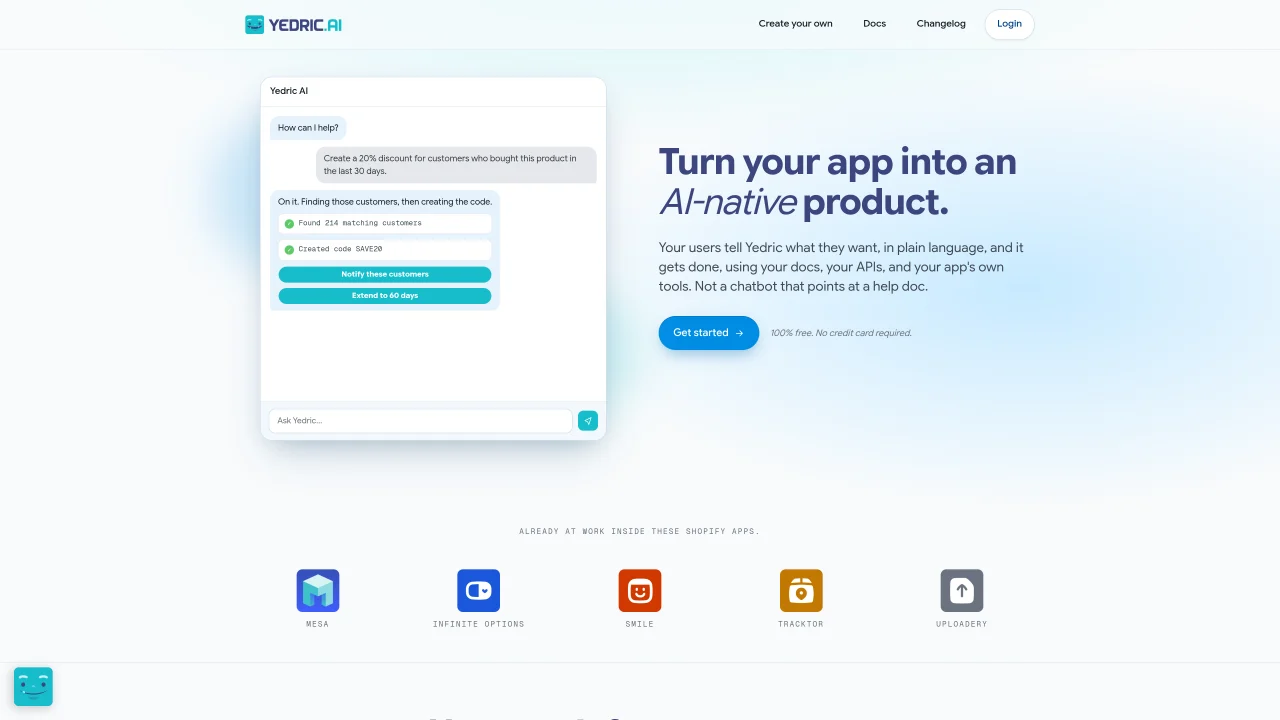
Yedric AI enables applications to become AI-native by allowing users to request outcomes in plain language and having the system execute those actions directly. The tool connects to an application’s documentation, APIs, and internal tools so it can perform tasks such as creating discount codes, updating customer tags, or adjusting settings without requiring users to navigate menus or read guides. It supports context-aware interactions, meaning it understands where a user is within the application and tailors responses accordingly. Yedric integrates with multiple AI models including OpenAI, Anthropic, and Gemini, and allows users to bring their own API keys to avoid platform markups. The system is designed with security features such as JWT, API keys, signed sessions, and Shopify-specific flows to prevent credential leaks. It also provides observability tools to track user requests, actions taken, and potential issues.
Yedric AI enables applications to become AI-native by allowing users to request outcomes in plain language and having the system execute those actions directly. It connects to an application’s documentation, APIs, and internal tools to perform tasks without requiring users to navigate menus or read guides.
Yedric AI is designed for businesses and developers looking to integrate AI-driven automation into their applications. It suits teams that want to streamline workflows by enabling users to perform complex tasks through natural language requests.
Yedric AI integrates with multiple AI models, including OpenAI, Anthropic, and Gemini. Users can bring their own API keys to avoid platform markups, ensuring flexibility and control over the AI models used.
Yedric AI includes security features such as JWT, API keys, signed sessions, and Shopify-specific flows to prevent credential leaks. These measures ensure that user data and interactions remain secure.
Yes, Yedric AI provides observability tools to track user requests, actions taken, and potential issues. This helps users monitor and improve the performance of their AI assistant.
To get started, visit the Yedric AI website and follow the onboarding process to integrate the tool with your application. The setup involves connecting your application’s documentation, APIs, and internal tools to enable AI-driven actions.
We use essential cookies to run Aitoolnavio, and optional cookies to analyze traffic and measure our marketing. You choose what we use — optional cookies stay off unless you turn them on. See our Privacy Policy.
One short email a week: fresh tools worth trying, honest takes and the updates that actually matter. No spam, unsubscribe any time.
Privacy-focused AI chatbot that generates uncensored text, code, images, and translations without storing conversations or requiring an account.
AI assistant for safe, reliable productivity with code, collaboration, and integrations.
A free web-based AI chatbot and agent for writing, coding, research, and content creation with multilingual support.
Automate code, research, and documents using agents.
AI-powered coding platform that uses agents to plan, write, and test software with real-time feedback and verifiable artifacts.
AI-powered code assistant that generates, reviews, optimizes, and debugs code with natural language prompts and editor integrations.
AI-powered IDE for autonomous coding tasks and agentic development workflows
AI models that return typed decisions with calibrated confidence for software automation
Write & run code in 50+ languages, auto-complete with AI, and code faster with an intuitive interface.
Practice coding challenges, improve technical skills, get detailed explanations, compare performance with peers.
Professional visual AI engine for node-based image, video, 3D, audio and generative workflows with full control over models and outputs.
An IDE that automates legacy-to-modern code migration using autonomous coding agents.
Matched on what this tool does — grouped by the job you would be replacing.
matches Tool calling for direct action execution · Context-aware responses based on app location · Shopify-specific security flows
Control your computer and apps from any chat.
Autonomous AI agent that executes multi-step tasks across thousands of apps and services
matches Integration with OpenAI, Anthropic, and Gemini models · Observability and logging of user interactions
matches Documentation and knowledge base ingestion
Unified API gateway for routing and managing AI model requests
OpenAI-compatible API for server-side multi-agent orchestration, LLM routing, and centralized observability.
Unified API gateway for 39 language models with pay-as-you-go pricing
An LLM Gateway that functions as an intelligent middleware for all your LLM needs.
AI-powered documentation search that turns docs into a ChatGPT-like widget with sub-2s answers and no coding required.
Upload PDF, TXT or DOCX files and chat with them using an OpenAI or Google Gemini API key