
Frontier-grade Claude models with agentic workflows, strong coding, and enterprise guardrails delivered via developer console, web app, and cloud partners.

Human-in-the-Loop API
0Popularity
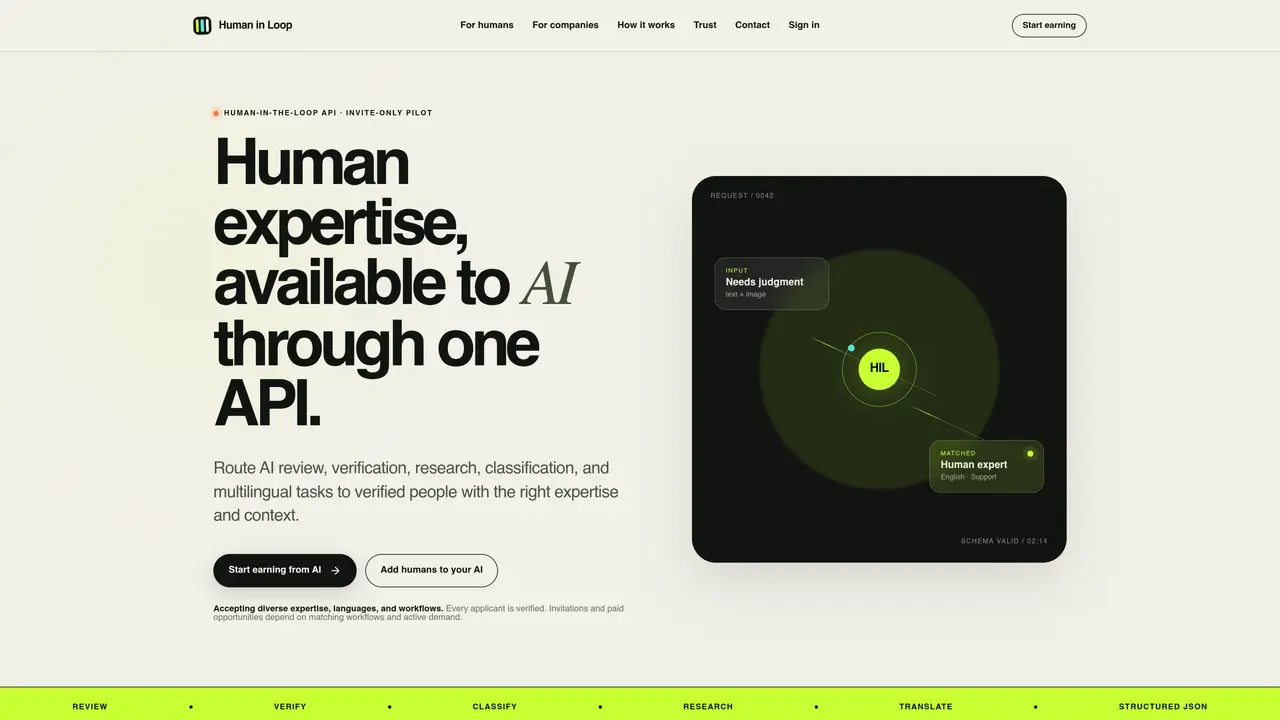
About Human-in-the-Loop API
The Human-in-the-Loop API bridges AI systems and human expertise by routing tasks such as review, verification, research, classification, translation, and multilingual evaluation to verified individuals based on specialized skills, language proficiency, and availability. It enables companies to embed human judgment into AI workflows for contexts requiring accountability, cultural nuance, or contextual understanding, while providing a structured JSON interface for seamless software integration and automated validation. The system supports both real-time and batch processing, ensuring responses are delivered in a format compatible with downstream systems for audit trails and decision tracking. Companies submit tasks with defined requirements—such as language, expertise, and output format—while human contributors apply their verified knowledge to deliver independent assessments. The API is designed for workflows where automation alone is insufficient, such as high-stakes evaluations, support escalations, or multilingual content moderation. By combining software speed with human context, it allows businesses to enhance AI reliability without sacrificing efficiency. Individuals with relevant expertise can contribute their skills and earn compensation when their profile matches available opportunities.
Key features
- Human review and verification
- Classification and ranking tasks
- Multilingual expertise matching
- Structured JSON output schemas
- Real-time and batch processing modes
- Expertise and language-based routing
- Audit trail for human decisions
- Support for text and image inputs
Use cases
- Adding human review to AI support workflows
- Validating AI-generated data for accuracy
- Classifying or ranking content with human judgment
Pros
- Verified human experts matched by expertise and language
- Structured JSON outputs for software integration
- Supports real-time and batch processing
- Multilingual and domain-specific expertise available
- Audit trail for human decisions
Cons
- Invite-only pilot access
- Requires API integration and workflow setup
- Limited to text and image inputs
Frequently asked questions about Human-in-the-Loop API
What is the Human-in-the-Loop API?
The Human-in-the-Loop API connects AI workflows to verified human experts for tasks requiring context, accountability, or verification. It routes requests such as review, verification, research, classification, translation, and multilingual tasks to individuals based on expertise, language, and availability.
Who can use the Human-in-the-Loop API?
The API is designed for companies that need to integrate human judgment into their AI pipelines, as well as individuals with relevant skills who can contribute their expertise and earn from AI work. Access is currently invite-only during the pilot phase.
How does the matching process work?
The system matches requests to verified human experts based on required expertise, language, and availability. Each applicant undergoes verification, and invitations or paid opportunities depend on matching workflows and active demand.
What types of tasks can the API handle?
The API supports tasks such as model-output review, ranking, classification, quality checks, research, translation, and multilingual evaluations. It accepts both text and image inputs and returns structured JSON outputs for software integration.
How do I get started with the Human-in-the-Loop API?
Companies can apply for API access by showing their workflow, required expertise, languages, and volume for review. Individuals can start earning by sharing their languages, expertise, and availability, and getting invited when verified AI evaluation work matches their profile.
Does the API support real-time and batch processing?
Yes, the API handles both real-time and batch processing. Real-time requests are processed within minutes, while batch processing is available for higher throughput needs. The system returns results in a structured format compatible with downstream systems.