
Frontier-grade Claude models with agentic workflows, strong coding, and enterprise guardrails delivered via developer console, web app, and cloud partners.

Kita
$4.50Starting price
126Monthly visits
0Popularity
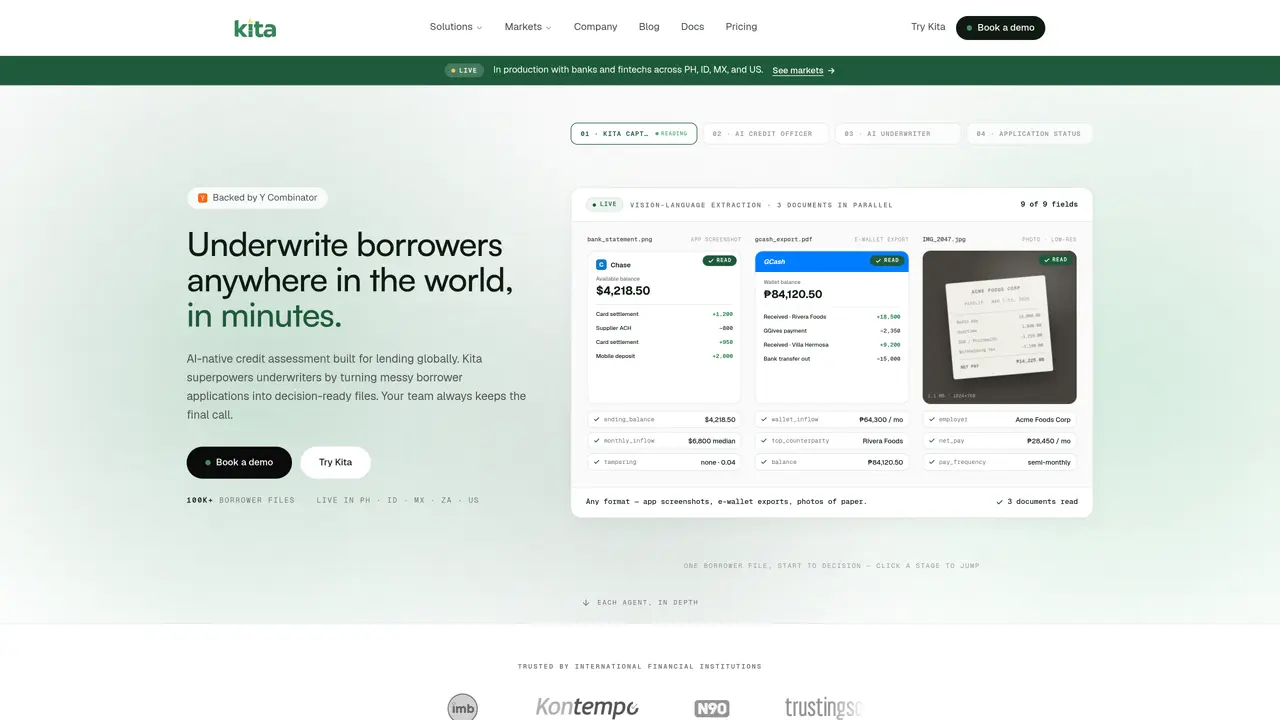
About Kita
Kita is a document intelligence platform designed for lenders and financial institutions operating in emerging markets. It converts unstructured borrower documents—such as bank statements, e-wallet records, government IDs, and utility bills—into fraud-checked, decision-ready risk signals for underwriting. The platform uses a Credit Agent to manage document collection via WhatsApp and email, reducing incomplete submissions and borrower drop-off during loan origination. Its core extraction engine, Capture, leverages vision-language models to read low-quality inputs like photos, scans, and screenshots, outputting structured data in JSON, CSV, or Excel formats. Kita also includes document-level fraud detection and risk assessment tailored to local formats, supporting a wide range of financial documents. The platform integrates with loan origination systems (LOS) through both a web-based UI and a documented API, enabling seamless workflow adoption. Kita operates on a usage-based pricing model with a free tier, while Growth and Enterprise plans require direct contact for pricing. Its hyperlocalized focus addresses the challenges of emerging-market document formats, often overlooked by traditional OCR solutions, and is backed by Y Combinator (W26).
Key features
- Document capture and verification via Credit Agent (WhatsApp/email workflows)
- Vision-language model extraction for low-quality inputs (photos, scans, screenshots)
- Structured data output in JSON, CSV, or Excel
- Document-level fraud detection and risk assessment
- Local format support for emerging-market documents
- Loan origination system (LOS) integrations via web UI and API
- Fraud-checked, decision-ready underwriting signals
- Usage-based pricing with a free tier
Use cases
- Automating document processing for loan underwriting in emerging markets
- Fraud detection and risk assessment from borrower financial documents
- Structured data extraction from non-standard, low-quality document formats
Pros
- Supports vision-language extraction for low-quality documents like photos, scans, and screenshots
- Includes document-level fraud detection and risk assessment tailored to local formats
- Provides an AI Credit Officer for automated borrower communication via WhatsApp, SMS, or email
- Offers structured data output in JSON, CSV, or Excel formats for seamless integration
- Designed specifically for emerging markets with hyperlocalized document formats
Cons
- Limited to financial institutions and lenders operating in emerging markets
- May require manual review for complex or highly unstructured documents
- Integration with existing systems depends on API compatibility and technical setup
Frequently asked questions about Kita
What is Kita and what does it do?
Kita is an AI-native document intelligence platform designed for lenders and financial institutions, particularly in emerging markets. It converts unstructured borrower documents like bank statements, e-wallet records, and IDs into fraud-checked, structured risk signals for underwriting.
Who is Kita designed for?
Kita is designed for lenders and financial institutions operating in emerging markets, including banks, fintechs, microfinance institutions, CDFIs, community banks, and SMB lenders.
How does Kita help reduce borrower drop-off during loan origination?
Kita uses an AI Credit Officer that engages borrowers via WhatsApp, SMS, or email in their preferred language to ensure document collection is complete, reducing incomplete submissions and borrower drop-off.
What types of documents can Kita process?
Kita can process a wide range of financial documents, including bank statements, e-wallet exports, government IDs, utility bills, payslips, and even low-quality photos or screenshots of paper documents.
Does Kita integrate with existing loan origination systems?
Yes, Kita integrates with loan origination systems (LOS) through both a web-based UI and a documented API, enabling seamless workflow adoption.
What pricing model does Kita use?
Kita operates on a usage-based pricing model with a free tier available. Growth and Enterprise plans require direct contact for pricing.
Kita Website Engagement
Last Update: 9 days ago
Total Monthly Visits
0
Bounce Rate
0%
Visit Duration (avg)
—
Pages Per Visit
0
Country Rank
—
Unknown
Global Rank
0