
Frontier-grade Claude models with agentic workflows, strong coding, and enterprise guardrails delivered via developer console, web app, and cloud partners.

Saphira AI
5.2KMonthly visits
12Popularity
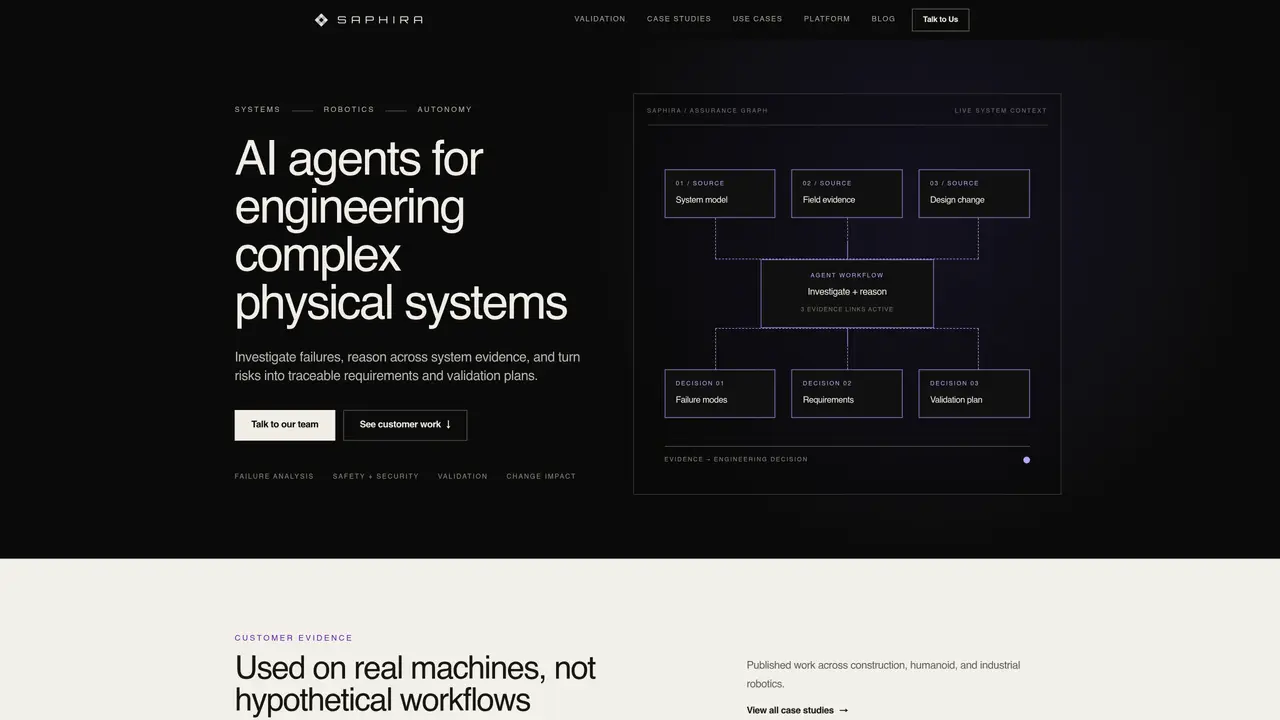
About Saphira AI
Saphira AI provides a unified validation factory for physical AI systems, integrating hazard analysis, safety requirements, simulated scenarios, and certification evidence into a single closed loop. The platform is designed to streamline the validation process for AI-driven physical systems, ensuring compliance with safety standards and regulatory requirements. It supports developers, engineers, and compliance teams by automating the generation of safety cases and evidence, reducing manual effort and accelerating certification. Saphira AI is particularly useful for industries such as robotics, autonomous vehicles, and industrial automation where safety and compliance are critical. By consolidating hazard analysis, scenario simulation, and certification documentation, the platform helps teams achieve faster time-to-market while maintaining rigorous safety standards. It is built to address the unique challenges of validating AI in physical environments, where traditional testing methods may fall short.
Key features
- Hazard analysis for AI systems
- Safety requirements generation
- Simulated scenario testing
- Certification evidence automation
- Closed-loop validation process
- Compliance with safety standards
- Integration with physical AI workflows
- Automated safety case generation
- Regulatory requirement tracking
- Evidence documentation for certification
Use cases
- Validating autonomous vehicle safety systems
- Ensuring compliance for industrial robotics
- Generating certification evidence for AI-driven medical devices
Pros
- Unifies hazard analysis, safety requirements, simulated scenarios, and certification evidence into a single closed-loop platform
- Automates generation of safety cases and evidence, reducing manual effort and accelerating certification
- Supports traceability from failure analysis to requirements, mitigations, and validation plans
- Designed for real-world physical AI systems with inspectable reasoning and source-linked expert review
- Integrates with existing engineering stacks and workflows
Cons
- May require initial setup of system context and evidence model to align with existing workflows
- Dependent on the quality and completeness of input data sources for accurate analysis
- Primarily focused on safety-critical industries, which may limit applicability to non-physical AI systems
Frequently asked questions about Saphira AI
What does Saphira AI do?
Saphira AI provides a unified validation platform for physical AI systems, integrating hazard analysis, safety requirements, simulated scenarios, and certification evidence into a single closed loop. It automates the generation of safety cases and evidence to streamline validation and accelerate certification.
Who is Saphira AI suitable for?
Saphira AI is designed for developers, engineers, and compliance teams working with AI-driven physical systems, particularly in industries like robotics, autonomous vehicles, and industrial automation where safety and compliance are critical.
How does Saphira AI integrate with existing workflows?
Saphira AI connects with the sources of truth already used by teams, such as designs, requirements, tests, and field data. It reuses the same system context as work expands, allowing different teams to begin with different problems while maintaining consistency.
What are the key features of Saphira AI?
Key features include failure and incident investigation, safety and security analysis, requirements and change impact management, validation and test planning, and a reusable AI system for expert engineering work with live assurance graphs.
Does Saphira AI support third-party validation?
Yes, Saphira AI is a member of the NVIDIA Halos AI Systems Inspection Lab, and its safety engineers review generated analyses before they reach an assessor, ensuring rigor in the validation process.
How do teams typically get started with Saphira AI?
Teams often begin by addressing the workflow blocking a program today, such as a hard decision or a specific safety or validation challenge. Saphira AI reuses the same system context as the work expands, allowing for incremental adoption.
Saphira AI Website Engagement
Last Update: 9 days ago
Total Monthly Visits
0
Bounce Rate
0%
Visit Duration (avg)
0.00s
Pages Per Visit
0
Country Rank
0
United States
Global Rank
0
Monthly Traffic
Traffic Sources
Traffic Share By Country
- United States78.3%
- India18.4%
- Spain3.3%