
Frontier-grade Claude models with agentic workflows, strong coding, and enterprise guardrails delivered via developer console, web app, and cloud partners.

warehousd
0Popularity
About warehousd
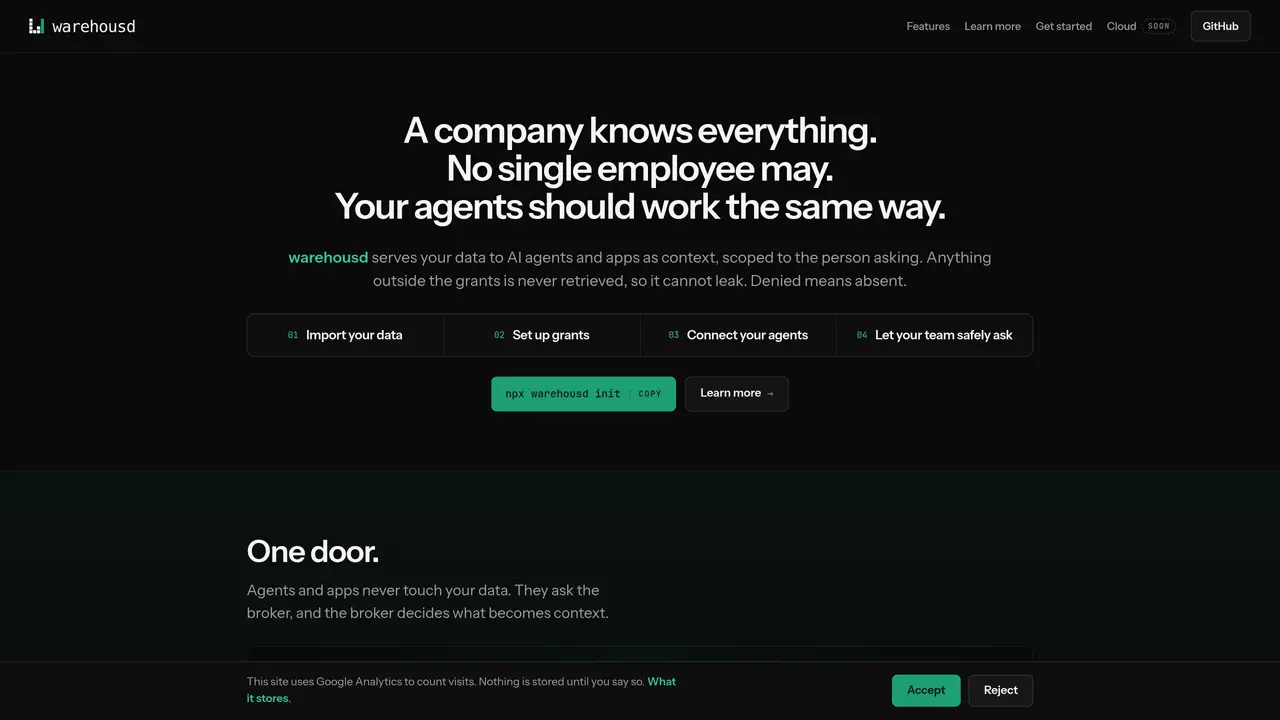
warehousd acts as a permission boundary that serves company data to AI agents and applications as context, restricted to the specific user requesting it. It prevents data leakage by ensuring that any information outside granted permissions is never retrieved or included in responses. The system operates by brokering requests: agents and apps query the broker, which checks active grants, field permissions, filters, and document scope before allowing or denying access. Each user receives a tailored context based on their role and permissions, with denied fields remaining entirely absent rather than hidden. The tool supports both agent-based workflows via MCP and application-based workflows via a plain HTTP API. It integrates with existing databases and can be deployed locally or on managed platforms like Fly.io, Railway, or Docker Compose. A demo project is available to explore functionality with synthetic data before connecting real systems.
Key features
- Field-level permission grants with expiration
- MCP server for agent integration
- HTTP API for application integration
- Audit logging for access decisions
- Support for multiple database providers
- Synthetic data seeding for testing
- Role-based context scoping
- Document-level filtering
Use cases
- Restricting legal case file access to specific clients per user role
- Limiting HR candidate data exposure to relevant hiring team members
- Providing support agents with ticket analytics while blocking customer contact details
Pros
- Prevents data leakage by denying access to unpermitted fields entirely
- Supports both agent-based (MCP) and application-based (API) integrations
- Self-hosted deployment with compatibility for multiple database providers
- Granular control over field-level permissions and document scope
- Provides audit trails for granted and denied access requests
Cons
- Cloud version is not yet available; waitlist only
- Requires self-hosting or managed deployment
- No explicit mention of multi-language support
Frequently asked questions about warehousd
What does warehousd do?
warehousd acts as a permission boundary that serves company data to AI agents and applications as context, restricted to the specific user requesting it. It ensures data outside granted permissions is never retrieved or included in responses.
Who is warehousd designed for?
The tool is designed for organizations that need to safely provide AI agents and applications with access to company data while enforcing strict role-based permissions. It suits legal firms, HR departments, finance teams, and other data-sensitive environments.
How does warehousd handle data permissions?
warehousd brokers requests by checking active grants, field permissions, filters, and document scope before allowing or denying access. Denied fields are entirely absent from responses rather than hidden, preventing accidental data exposure.
What workflows does warehousd support?
It supports agent-based workflows via the MCP protocol and application-based workflows through a plain HTTP API. Agents and apps query the broker, which enforces permissions before returning tailored context to each user.
Can warehousd be integrated with existing systems?
Yes, warehousd integrates with existing databases and can be deployed locally or on managed platforms like Fly.io, Railway, or Docker Compose. It connects to your database and operates as a separate broker layer.
How do I get started with warehousd?
Users can initialize a project with a single command, such as 'npx warehousd init', and follow the setup steps to import data, configure grants, and connect agents or applications. A demo project with synthetic data is available for exploration.