
Frontier-grade Claude models with agentic workflows, strong coding, and enterprise guardrails delivered via developer console, web app, and cloud partners.

Zauth
11KMonthly visits
18Popularity
About Zauth
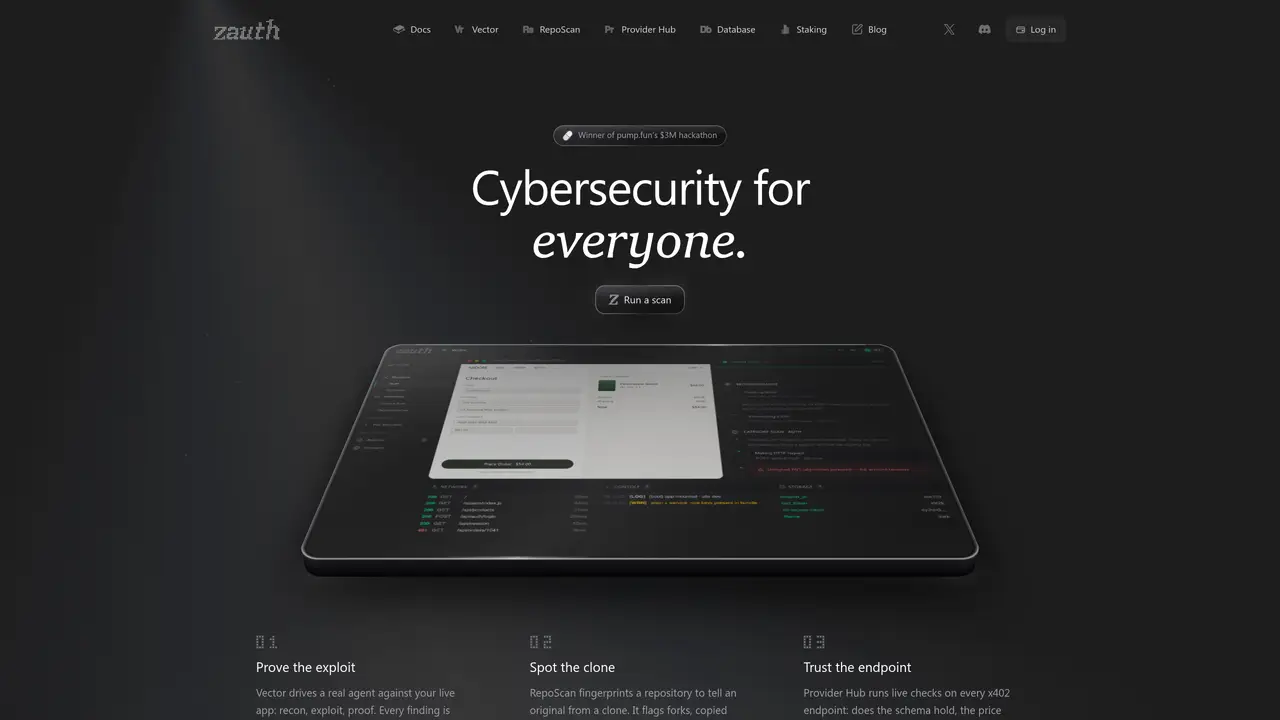
Zauth secures agentic applications, repositories, and x402 endpoints by combining automated web pentesting, code provenance analysis, and endpoint monitoring into a single stack. It runs isolated, containerized pentests that perform recon, interaction, exploit attempts, and reporting without requiring production credentials or user access. The tool scans GitHub repositories to detect copied code and suspicious provenance, producing trust scores that support integration decisions, audits, and investment due diligence. For x402 service providers, Zauth monitors uptime and latency in real time, issues failure alerts, and publishes verified endpoints to a public registry that agents can query before making payments. Teams use Zauth to catch vulnerabilities early, validate code authenticity, and ensure reliable service interactions in autonomous workflows. Security engineers, application owners, and protocol operators rely on its fast, automated assessments, while investors and integrators use trust scores to triage repositories before partnerships or grants. Ops teams maintain SLAs and prove reliability to downstream agents through telemetry and uptime tracking.
Key features
- Containerized pentest engine with Chromium, bash, disposable email, and crypto wallet
- Automated recon, interaction, exploit attempts, and structured reporting
- GitHub repository provenance scanning and similarity detection
- Trust scoring for code authenticity and integration decisions
- Real-time uptime and latency monitoring for x402 endpoints
- Instant failure alerts and SLA tracking
- Public registry of verified x402 endpoints for agent pre-payment verification
- Isolated execution without production credential access
- Actionable reports for remediation and audit trails
- Dashboard with pentest timelines, trust scores, and endpoint telemetry
Use cases
- Run autonomous pentests on production web apps to detect exploitable risks before incidents occur
- Assess third-party code provenance and trustworthiness before integration or investment
- Monitor and verify x402 endpoints for uptime and reliability before agent transactions
Pros
- Finds real, exploitable vulnerabilities with live proof-of-concept attacks rather than static signatures
- Provides code provenance analysis to detect cloned repositories and fake contributor histories
- Offers continuous endpoint monitoring for uptime, latency, and schema compliance in real time
- Delivers flat-pricing models without requiring production credentials or deep code access
- Publishes verified endpoints in a public registry that agents can query before making payments
Cons
- Requires live application access for full pentesting, which may not suit all deployment environments
- Endpoint monitoring depends on continuous probing, which could introduce additional network overhead
- Code provenance analysis relies on repository metadata, which may not cover all obfuscation techniques
Frequently asked questions about Zauth
What does Zauth actually do?
Zauth secures agentic applications, repositories, and x402 endpoints by running automated pentests, analyzing code provenance, and monitoring endpoint reliability in real time.
Who should use Zauth?
Security engineers, application owners, protocol operators, investors, and integrators rely on Zauth to validate code authenticity, catch vulnerabilities early, and ensure reliable service interactions.
How does Zauth pricing work?
Zauth offers flat pricing based on the depth of assessment needed, such as quick scans, deep dives, or full code audits, without requiring enterprise-level contracts.
Does Zauth integrate with existing tools?
Zauth provides APIs and browser overlays that work across terminals and screeners, allowing seamless integration into existing workflows without requiring additional agent installation.
What are the main limitations of Zauth?
Zauth requires live application access for full pentesting, and its endpoint monitoring may introduce additional network overhead. Code provenance analysis also depends on repository metadata.
How do I get started with Zauth?
Users can start by visiting Zauth's documentation site, selecting a scan type (Vector, RepoScan, or Provider Hub), and following the provided guides or API references to initiate assessments.
Zauth Website Engagement
Last Update: 9 days ago
Total Monthly Visits
0
Bounce Rate
0%
Visit Duration (avg)
—
Pages Per Visit
0
Country Rank
0
United Kingdom
Global Rank
0