GitHub hosts HunyuanVideo, Tencent's open-source framework for large-scale video generation models, enabling AI-driven video creation.

Berth
$0Starting price
0Popularity
About Berth
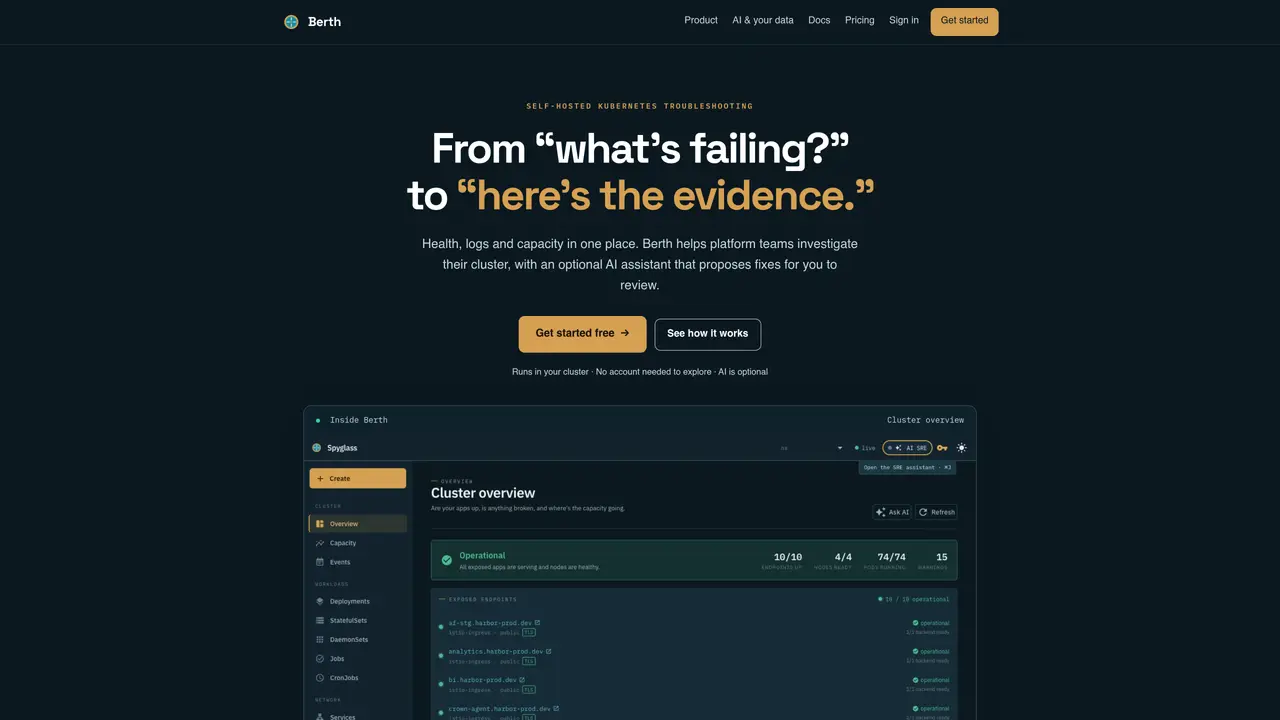
Berth is a self-hosted workbench designed for troubleshooting Kubernetes clusters. It provides a unified view of cluster health, logs, and capacity, enabling platform teams to investigate issues efficiently. The tool allows users to follow evidence from symptoms to relevant workloads without rebuilding context repeatedly. An optional AI assistant can investigate clusters using read-only tools, proposing fixes for review while ensuring no changes are made without explicit approval. The dashboard operates directly within the user’s cluster, giving administrators full control over network access, storage, and credentials. Berth supports both local models via Ollama and cloud-based models through Anthropic or Bedrock APIs, with usage history and incident memory stored on the user’s own infrastructure. The tool is intended for trusted cluster administrators who require real-time visibility into cluster state without relying solely on historical monitoring.
Key features
- Cluster overview with health and capacity metrics
- Endpoint health tracing through DNS, TLS, routes, and backend readiness
- Workload investigation with pod status, events, logs, and resource usage
- Capacity planning with requested vs. used resource comparison
- Optional AI assistant for cluster investigations
- Usage history and incident memory stored locally
- Support for Ollama, Anthropic, and Bedrock models
- Traffic splitting and expose-an-app flow analysis
Use cases
- Investigating failing connections and endpoints in Kubernetes clusters
- Troubleshooting workload issues using consolidated logs and events
- Planning capacity adjustments with real-time resource usage data
Pros
- Self-hosted deployment within the user's Kubernetes cluster
- Unified view of health, logs, and capacity in a single interface
- Optional AI assistant for read-only investigations with tool call transparency
- Supports both local and cloud-based AI models with user-provided compute
- No account required to explore the dashboard
Cons
- Per-user cluster authorization and multi-cluster management not available
- AI model setup and compute costs are separate from the tool
- Requires trusted cluster administrator access for full functionality
- Community plan limited to 10 nodes
Frequently asked questions about Berth
What is Berth and what does it do?
Berth is a self-hosted Kubernetes dashboard that provides a unified view of cluster health, logs, and capacity. It enables platform teams to troubleshoot issues by following evidence from symptoms to relevant workloads without rebuilding context repeatedly.
Who should use Berth?
Berth is designed for trusted cluster administrators who require real-time visibility into cluster state without relying solely on historical monitoring. It is intended for teams managing Kubernetes clusters and needing efficient troubleshooting capabilities.
How does the AI assistant in Berth work?
The optional AI assistant investigates clusters using read-only tools, gathering evidence and suggesting fixes for review. It cannot make changes without explicit approval, ensuring full control remains with the user. The assistant supports local models via Ollama or cloud-based models through Anthropic or Bedrock APIs.
What are the pricing models for Berth?
Berth offers a free Community plan for up to 10 nodes and a single cluster, with no card required. Enterprise plans are available for larger clusters and include additional features like cloud AI models and spend guardrails. Model usage and compute costs are separate and billed by the respective providers.
Can Berth be integrated with existing Kubernetes workflows?
Yes, Berth can be deployed directly within a Kubernetes cluster using a Helm chart or run as a container with access to the user's kubeconfig. It supports existing container workflows and allows users to control network access, storage, and credentials.
What are the limitations of Berth?
Berth is designed for trusted cluster administrators and does not include per-user cluster authorization or multi-cluster management. The AI agent cannot apply changes to the cluster without explicit approval, and per-user RBAC is not yet available.