Collaboration and version control platform for software development and AI model hosting.
645M visits/mo-0.6%#1 Coding & Development

Heroku enables developers to deploy, manage, and scale applications quickly with minimal server management, supporting multiple languages and frameworks.
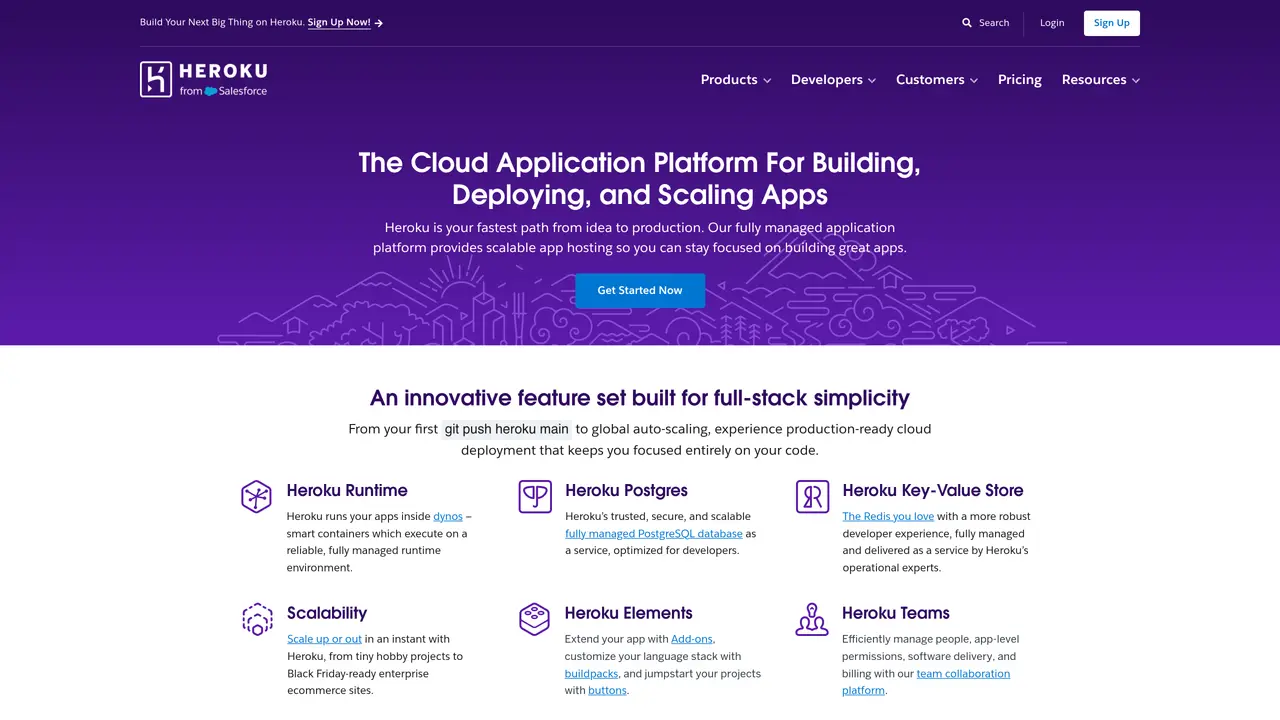
Heroku is a cloud platform designed for developers and businesses to deploy, manage, and scale applications with ease. It removes the complexity of server management, allowing users to focus on building and running applications rather than infrastructure. The platform supports a wide range of programming languages and frameworks, enabling custom application development without extensive setup. Heroku provides powerful tools for building, deploying, and scaling applications efficiently, making it suitable for projects of any size. It emphasizes reliability and security, offering a stable environment for running applications without the need for manual server maintenance. Developers can deploy applications with just a few clicks, reducing time-to-market and operational overhead. The platform is widely adopted by startups and large enterprises alike, providing flexibility and scalability to meet diverse business needs. Heroku’s ecosystem includes integrations and add-ons that extend functionality, further simplifying the development and deployment process.
Heroku
San Francisco, United States · Founded 2007
Heroku is a cloud application platform designed for developers and businesses to build, deploy, and scale applications without managing infrastructure. It suits developers, startups, and enterprises seeking a streamlined path from idea to production.
Heroku simplifies deployment by allowing users to push code via Git, which automatically builds and runs the application in managed containers called dynos. This eliminates the need for manual server setup and maintenance.
Yes, Heroku supports a polyglot platform with built-in support for languages such as Python, Java, Node.js, Ruby, Go, PHP, Scala, and Clojure, among others.
Heroku Elements is a marketplace offering add-ons, integrations, and buildpacks that extend the platform's functionality, allowing users to easily enhance their applications with additional services.
Heroku provides scaling capabilities, allowing applications to scale up or out to meet demand, from small projects to enterprise-level traffic spikes like Black Friday sales.
Heroku offers managed data services such as Heroku Postgres, a fully managed PostgreSQL database, and Heroku Key-Value Store, a managed Redis service, both optimized for developer use.
heroku.com · third-party estimates from Similarweb
Last 4 months · grows by one month every month
Share of visits by channel
No measurable traffic from Paid Referrals.
Share of visits · estimated visits
Other countries: 45.9%
How people reach this site from other AI tools
5.1K a month · 0.5% of all visits
Coding & Development · Sep 2026
Traffic figures are third-party estimates, good for scale and trends; they can differ from a company's own numbers. Updated monthly.
We use essential cookies to run aitoolnavio™, and optional cookies to analyze traffic and measure our marketing. You choose what we use — optional cookies stay off unless you turn them on. See our Privacy Policy.
One short email a week: fresh tools worth trying, honest takes and the updates that actually matter. No spam, unsubscribe any time.
Collaboration and version control platform for software development and AI model hosting.
A cloud platform for deploying, scaling, and managing web apps and AI workloads with Git-based CI/CD and edge functions.
Standardize application packaging and execution with portable containers for consistent local and cloud workflows.
An IDE that automates legacy-to-modern code migration using autonomous coding agents.
AI-first electronic design automation for ICs, advanced packaging, and systems with hardware-assisted acceleration and elastic cloud delivery.
Unified AI-powered platform for real-time monitoring, analytics, and security across cloud infrastructure, applications, and services.
Cloud platform for developing, training, and scaling AI models with a serverless GPU environment.
Create cloud servers with ease, enjoy full control, automated backups, secure networking, and reliable support.
AI-powered platform for full-stack observability, anomaly detection, and automated root cause analysis without coding.
Backend platform providing Postgres databases, authentication, storage and compute for applications and agents
Rent GPU computing resources for running AI models at a low cost.
Unified Arm compute platform spanning Neoverse servers, Cortex, C1, Mali, and Ethos for consistent, scalable AI deployment from cloud to edge.
Matched on what this tool does — grouped by the job you would be replacing.
matches One-click application deployment · Automated scaling for performance and traffic demands · No manual server management required
Deploy and scale AI applications on cloud servers with minimal setup and built-in security.
AI-powered PaaS for deploying, scaling, and managing apps on AWS with automated CI/CD and cost-optimized infrastructure.
AI tool that autonomously builds and deploys web services with one click, handling databases, APIs, and hosting without infrastructure management.
Deploy, manage, and scale APIs and applications in the cloud with a streamlined dashboard, intelligent automation, and real-time performance insights.
matches Supports multiple programming languages and frameworks · Flexible pricing plans for businesses of all sizes
Open-source backend platform providing Postgres, authentication, APIs, and real-time features to build scalable apps quickly.
AI-powered VPS hosting that automates setup, optimizes resources, and deploys websites quickly with security and reliability.