GitHub hosts HunyuanVideo, Tencent's open-source framework for large-scale video generation models, enabling AI-driven video creation.

PIDSnap
FreeStarting price
102Monthly visits
0Popularity
About PIDSnap
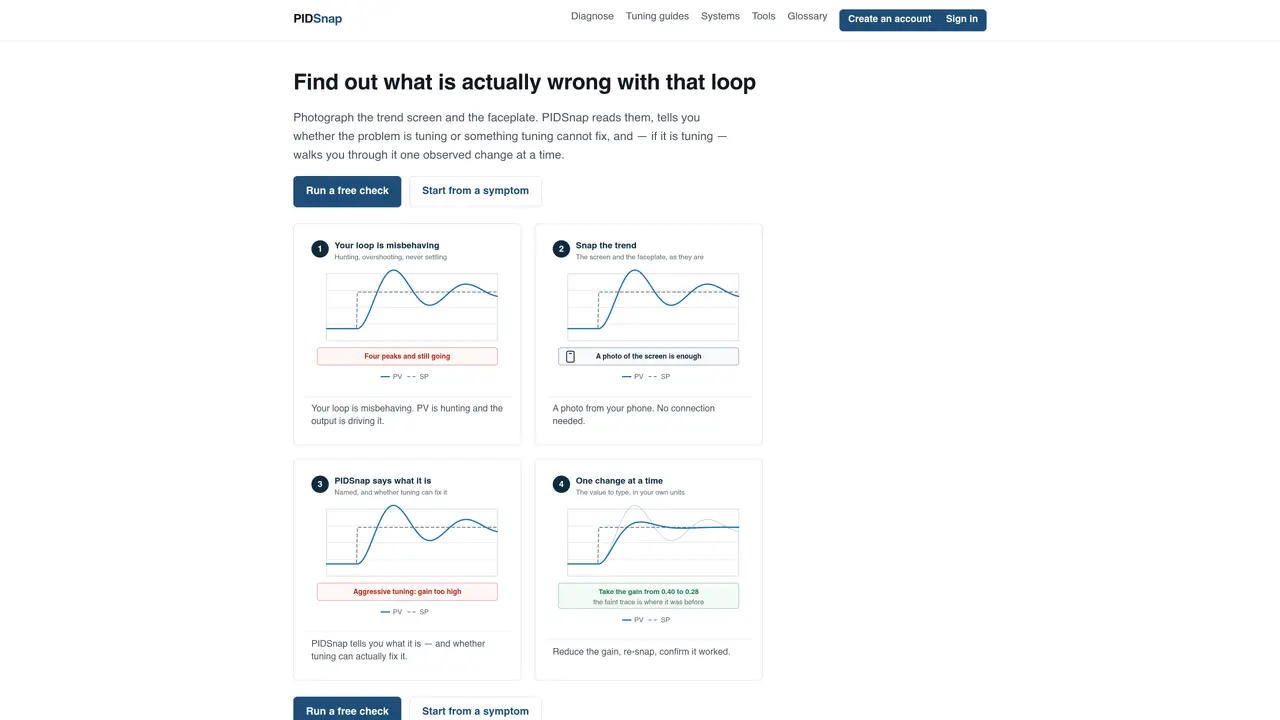
PIDSnap analyzes photographs of PID loop trend screens and faceplates to diagnose control issues and guide tuning adjustments. It distinguishes between problems that can be solved by tuning and those requiring mechanical intervention, such as valve stiction or output saturation. The tool performs a pre-flight check of loop configuration to identify structural issues before any tuning begins. Users upload trend images via a phone or computer, and PIDSnap classifies the response into one of eight fundamental loop signatures. If tuning is viable, it provides step-by-step guidance with observation-based criteria for each adjustment, ensuring changes are validated before proceeding. The process avoids model-based assumptions and relies solely on user-confirmed values from the faceplate. All outputs are informational and require manual implementation by the user, who remains responsible for process safety and compliance with management-of-change procedures. PIDSnap operates without direct connection to control systems and does not generate or store plant-specific data beyond the uploaded images.
Key features
- Photograph-based trend and faceplate analysis
- Eight loop signature classifications (stiction, saturation, windup, etc.)
- Pre-flight configuration checks (16 deterministic tests)
- Step-by-step guided tuning with observation criteria
- Shareable report cards for loop diagnostics
- Converter tools for PID parameters and units
- Symptom-based diagnosis guides
- Money-back guarantee for non-tuning problems
Use cases
- Diagnosing valve stiction from stepped process variable trends
- Identifying output saturation in control loops
- Guiding PID tuning adjustments for oscillating loops
Pros
- Classifies loop behavior into eight fundamental signatures
- Provides observation-gated tuning guidance with user-confirmed values
- Performs free pre-flight configuration checks before tuning
- Offers refunds for sessions where tuning proves ineffective
- No connection to control systems required
Cons
- No free tier beyond initial checks and first session
- Limited to photographic input of trends and faceplates
- Requires manual implementation of all recommendations
- No API or automation capabilities
Frequently asked questions about PIDSnap
What does PIDSnap do?
PIDSnap analyzes photographs of PID loop trend screens and faceplates to diagnose control issues and guide tuning adjustments. It classifies loop problems into eight fundamental signatures and provides step-by-step tuning guidance when applicable.
Who is PIDSnap suitable for?
PIDSnap is designed for industrial process control professionals, such as control engineers and technicians, who need to diagnose and tune PID loops without direct system access.
How does PIDSnap work?
Users upload photographs of trend screens and faceplates, which PIDSnap analyzes to diagnose issues. It then provides specific tuning adjustments or identifies mechanical problems that require intervention.
Does PIDSnap require a connection to the control system?
No, PIDSnap operates without direct connection to control systems. It relies solely on user-uploaded images and does not generate or store plant-specific data beyond the uploaded images.
What happens if tuning is not the solution?
PIDSnap identifies when a problem is mechanical, such as valve stiction or output saturation, and advises that tuning cannot resolve the issue. It suggests manual intervention instead.
How do I get started with PIDSnap?
Users can start by uploading photographs of trend screens and faceplates via a phone or computer. PIDSnap then guides them through diagnosis and tuning adjustments, if applicable.
PIDSnap Website Engagement
Last Update: 9 days ago
Total Monthly Visits
0
Bounce Rate
0%
Visit Duration (avg)
—
Pages Per Visit
0
Country Rank
—
Unknown
Global Rank
—