

Efficiently answer research queries, translate natural language to SQL, and utilize OpenAI WebGPT and larger language models.
92M visits/mo-3.7%#3 Chatbots & Assistants
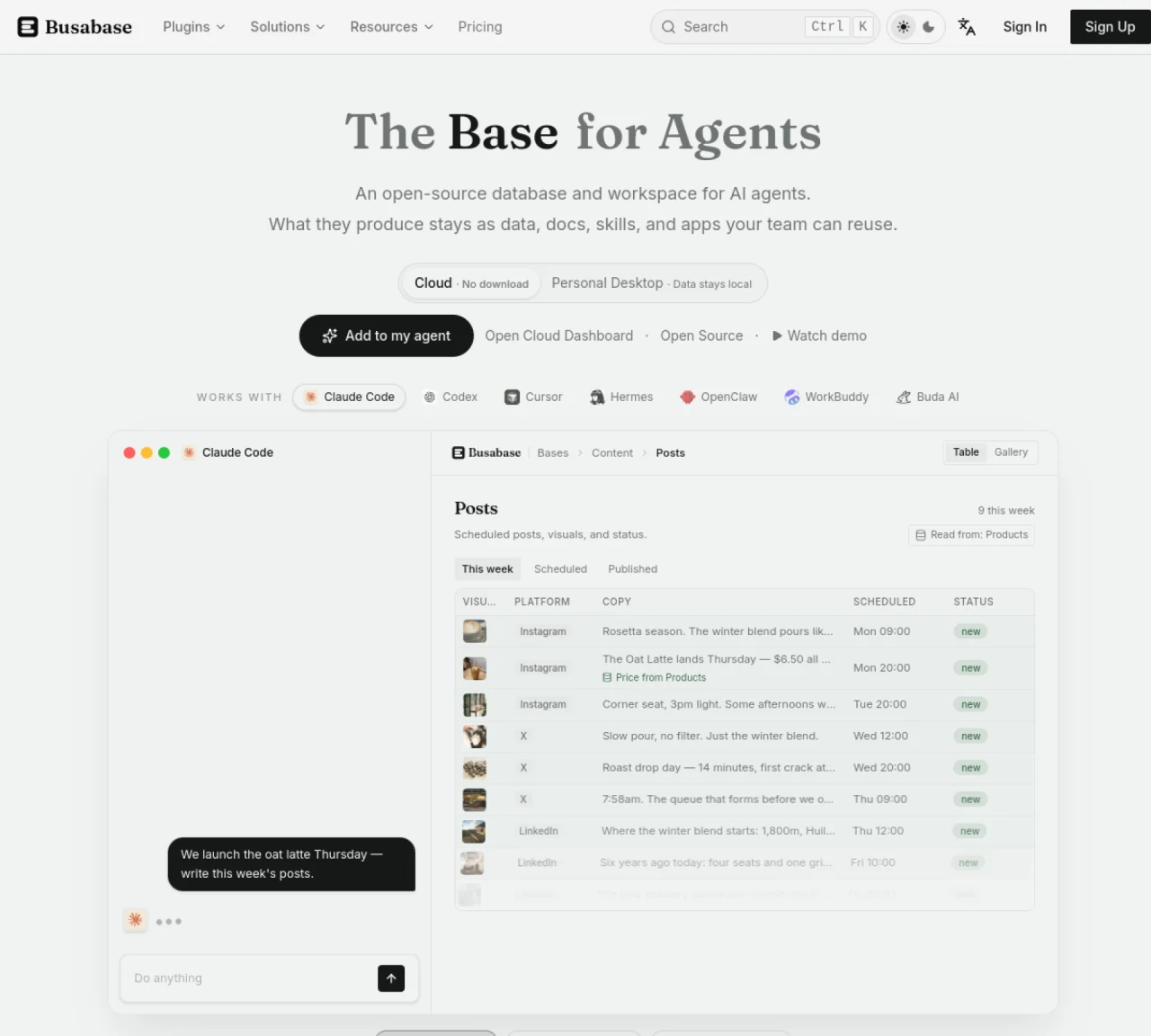
Busabase is an open-source database and workspace designed to centralize and preserve the outputs of AI agents and teams. It allows organizations to capture data, documents, skills, and applications generated by AI in a shared environment that remains accessible even when team members leave. The platform supports structured tables for data storage, a knowledge base for verified answers, internal apps built on the same data, and reusable agent workflows called skills. Teams can connect existing AI agents such as Claude Code, Codex, Cursor, or Hermes to Busabase, ensuring that all outputs are recorded with attribution and version history. The workspace is intended for use cases like customer support, marketing, content operations, and compliance, where visibility, reuse, and accountability are critical. Busabase operates both as a cloud service and a personal desktop application, with data remaining local in the desktop version.
Busabase is an open-source database and workspace designed to centralize and preserve the outputs of AI agents and teams. It captures data, documents, skills, and applications generated by AI in a shared environment, ensuring visibility, reuse, and accountability even when team members leave.
Busabase is intended for organizations that rely on AI agents, including AI consulting teams, content operations, customer support, marketing, and compliance teams. It suits any group needing to track, review, and reuse AI-generated work across workflows.
Busabase connects to existing AI agents such as Claude Code, Codex, Cursor, Hermes, and others through plugins, MCP, OpenAPI, or the CLI. This allows agents to write directly into the Busabase workspace while maintaining version history and attribution.
Yes, Busabase offers a personal desktop application where data remains local, ensuring offline access and control. The cloud version is also available for teams needing centralized, cloud-based collaboration.
Busabase supports structured tables for data storage, a knowledge base for verified answers, internal apps built on shared data, reusable agent workflows (skills), and playbooks for team processes. It is used for customer support, marketing, content operations, compliance, and more.
Busabase acts as a shared memory for teams by storing decisions, meeting notes, and context that agents can reference in future tasks. This ensures continuity and prevents knowledge loss when team members leave, as all work remains in the workspace.
We use essential cookies to run aitoolnavio™, and optional cookies to analyze traffic and measure our marketing. You choose what we use — optional cookies stay off unless you turn them on. See our Privacy Policy.
One short email a week: fresh tools worth trying, honest takes and the updates that actually matter. No spam, unsubscribe any time.
Efficiently answer research queries, translate natural language to SQL, and utilize OpenAI WebGPT and larger language models.
Open-source backend platform providing Postgres, authentication, APIs, and real-time features to build scalable apps quickly.
Securely store, analyze, and scale data while enhancing security and performance with encryption and automated backups.
Column-oriented OLAP database for real-time analytics at scale
Open-source graph database for storing, managing, and analyzing connected data with real-time insights and application development.
Trace family history, uncover ancestral matches, and utilize advanced genetic features.
Monitor progress, automate data analysis, create and share custom reports securely.
Automate SQL creation, streamline data management, and cost-effective solution for individuals and small teams.
Connect, analyze, and automate data from various sources, creating dashboards and reports effortlessly.
Personalized book recommendations and a library of reviews and ratings.
Automate tasks, customize workflows, and securely manage data for increased efficiency and ease.
Scale up/down, ensure data consistency, and deploy on any cloud platform effortlessly.
Matched on what this tool does — grouped by the job you would be replacing.
matches Knowledge base with verified answers and sources · Reusable agent workflows (skills) · Version history and attribution tracking
Shared workspace for teams and AI agents to capture decisions and turn them into reusable skills
Shared, versioned memory and coordination layer for AI agents
Shared knowledge base for teams to capture and reuse work methods
Centralizes company knowledge from existing tools into a shared context layer for AI agents
matches Open-source database and workspace · Structured tables for data storage · Internal apps built on shared data
matches Connects to AI agents via plugins and APIs · Multi-agent collaboration with scoped permissions · Hosted agent workspaces
Open-source backend platform providing Postgres, authentication, APIs, and real-time features to build scalable apps quickly.
Create customizable tables, databases, and spreadsheets, share data securely with team members.
Open-source workspace to visually build, deploy, and manage AI agents with over 1,000 integrations and built-in context storage.
A Git-backed workspace that lets multiple AI agents collaborate on files with version control and SaaS data sync.
Run projects with agents in shared, reviewable channels.
Hosted AI workspaces for teams with agents, approvals, and usage tracking