

Automate error tracking, monitor application performance, and gain insights with advanced analytics.
2.9M visits/mo-2.4%#50 Coding & Development
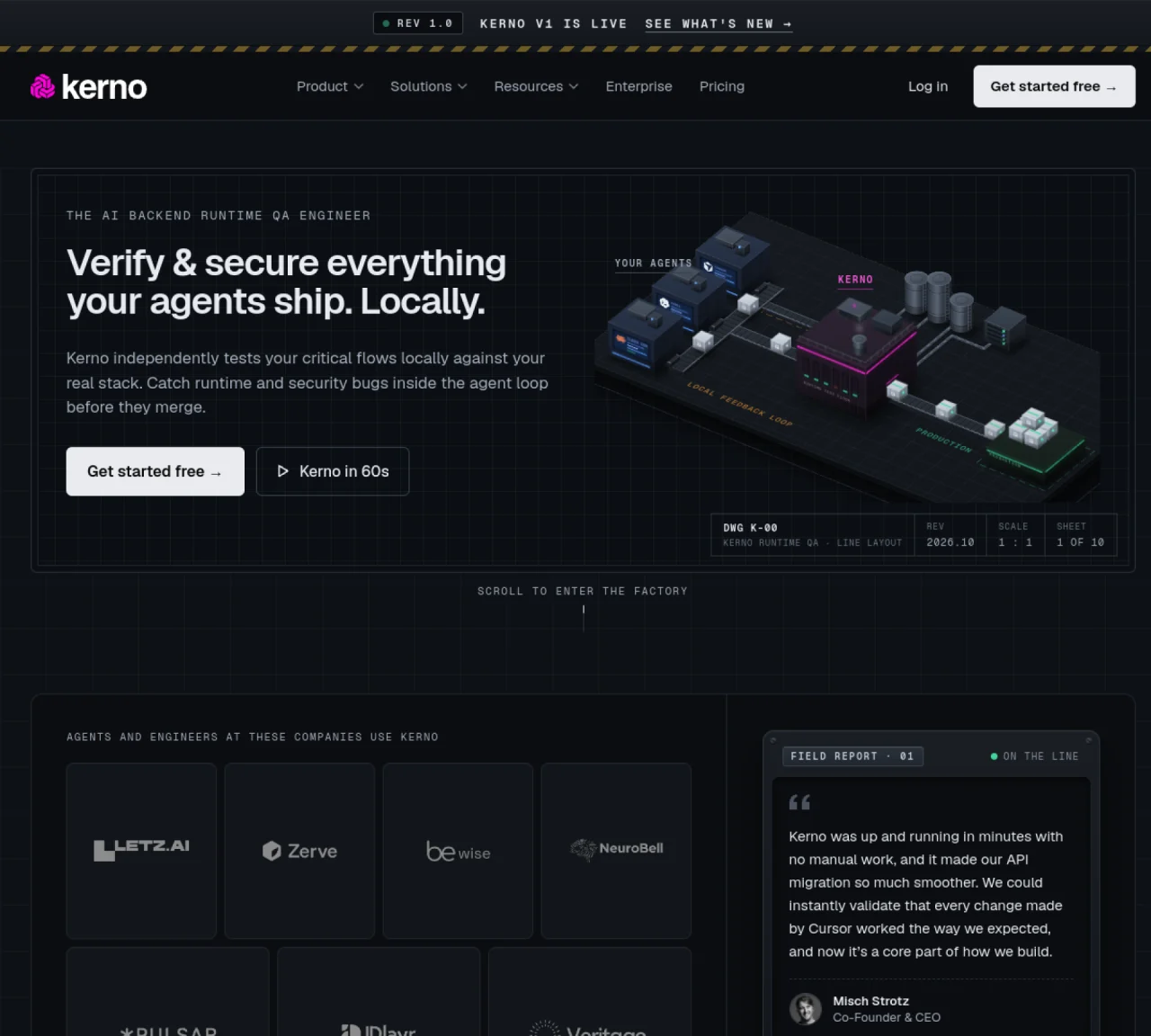
Kerno functions as a runtime quality and security layer for backend systems, designed to catch functional and security bugs that only emerge during execution. It verifies code changes against a live stack and dependencies before they merge, reducing regressions and manual QA overhead. The tool maps critical user flows and entry points, then writes and runs end-to-end tests to validate changes. It provides structured feedback to developers and coding agents, ensuring consistent quality across teams. Kerno supports testing for backend components such as databases, message queues, and APIs, and integrates with CI pipelines to prevent failures after deployment. The platform aims to shift verification left, catching issues at the source rather than in later stages like CI or production. It is intended for engineering teams building backend services or AI agents that require robust runtime validation.
Kerno acts as a runtime quality and security layer for backend systems, catching functional and security bugs that only emerge during execution. It verifies code changes against a live stack and dependencies before they merge, reducing regressions and manual QA overhead.
Kerno is intended for engineering teams building backend services or AI agents that require robust runtime validation. It supports developers and coding agents by providing structured feedback to ensure consistent quality across teams.
Kerno integrates with CI pipelines to prevent failures after deployment. It maps critical user flows and entry points, then writes and runs end-to-end tests to validate changes, providing local feedback loops for faster verification.
Kerno supports testing for backend components such as databases, message queues, APIs, and async workers. It verifies changes against real stacks like Postgres, ClickHouse, and Kafka.
Kerno automates the verification of critical flows and entry points, catching runtime and security issues before they merge. This reduces the need for manual testing and debugging, freeing up engineering time for development.
Yes, Kerno provides structured feedback and persistent code context to coding agents, ensuring they catch runtime issues at the source. It has been used successfully with agents like Cursor and Claude Code.
kerno.io · third-party estimates from Similarweb
Last 3 months · grows by one month every month
Share of visits by channel
Share of visits · estimated visits
Coding & Development · Sep 2026
Traffic figures are third-party estimates, good for scale and trends; they can differ from a company's own numbers. Updated monthly.
We use essential cookies to run aitoolnavio™, and optional cookies to analyze traffic and measure our marketing. You choose what we use — optional cookies stay off unless you turn them on. See our Privacy Policy.
One short email a week: fresh tools worth trying, honest takes and the updates that actually matter. No spam, unsubscribe any time.
Automate error tracking, monitor application performance, and gain insights with advanced analytics.
Instant threat detection and response, AI-powered prevention, unified dashboard for full visibility and control.
Open-source platform combining product analytics, session replay, A/B testing, and feature flags in one toolkit for product engineers.
AI development platform for experiment tracking, model optimization, and team collaboration in machine learning workflows.
Open-source framework for reliable, cross-browser web testing with auto-waiting, parallel execution, and built-in debugging tools.
CodeRabbit is an AI tool that helps you review and improve your code easily.
Labelbox is an enterprise-grade data labeling platform designed to help organizations create, manage, and deploy AI applications.
An AI-native cloud testing platform for developers and QA teams to automate cross-browser and real-device tests with self-healing automation and reporting.
Parallel AI coding agent IDE that runs multiple agents side by side in isolated git worktrees for faster, comparative development.
AI-powered bug reporting and feedback collaboration tool that streamlines issue identification and resolution for developers.
Monitor IT infrastructure, detect and resolve system issues, and proactively identify risks and threats.
Create tests, evaluate results in real-time with analytics, and save time and money with advanced automation.
Matched on what this tool does — grouped by the job you would be replacing.
matches End-to-end backend flow testing · Runtime bug detection · CI integration
AI-powered tool that automatically generates API and unit tests by capturing real application data, reducing manual effort and catching bugs early.
AI-powered platform for creating, running, and managing end-to-end web tests using plain-language prompts without coding.
AI-powered QA automation that lets teams define tests in plain language, run them via CI/CD or Slack, and auto-log bugs to Jira or Trello.
Zero-config AI browser testing platform
matches Security vulnerability scanning · Automated remediation and patching
Static analysis tool that scans codebases to detect errors, memory leaks, and security flaws, helping teams ship secure software faster.
ProtectAI offers a comprehensive solution for protecting AI and ML systems against vulnerabilities.
Scan code and repositories for vulnerabilities with automated remediation and patching to secure applications before deployment.
AI security scanning platform that detects exploitable vulnerabilities in code, logic, and infrastructure and delivers fixes via PRs and CI/CD pipelines.