Meshy turns text prompts or images into fully textured 3D models in minutes.

NVIDIA Cosmos 3
0Popularity
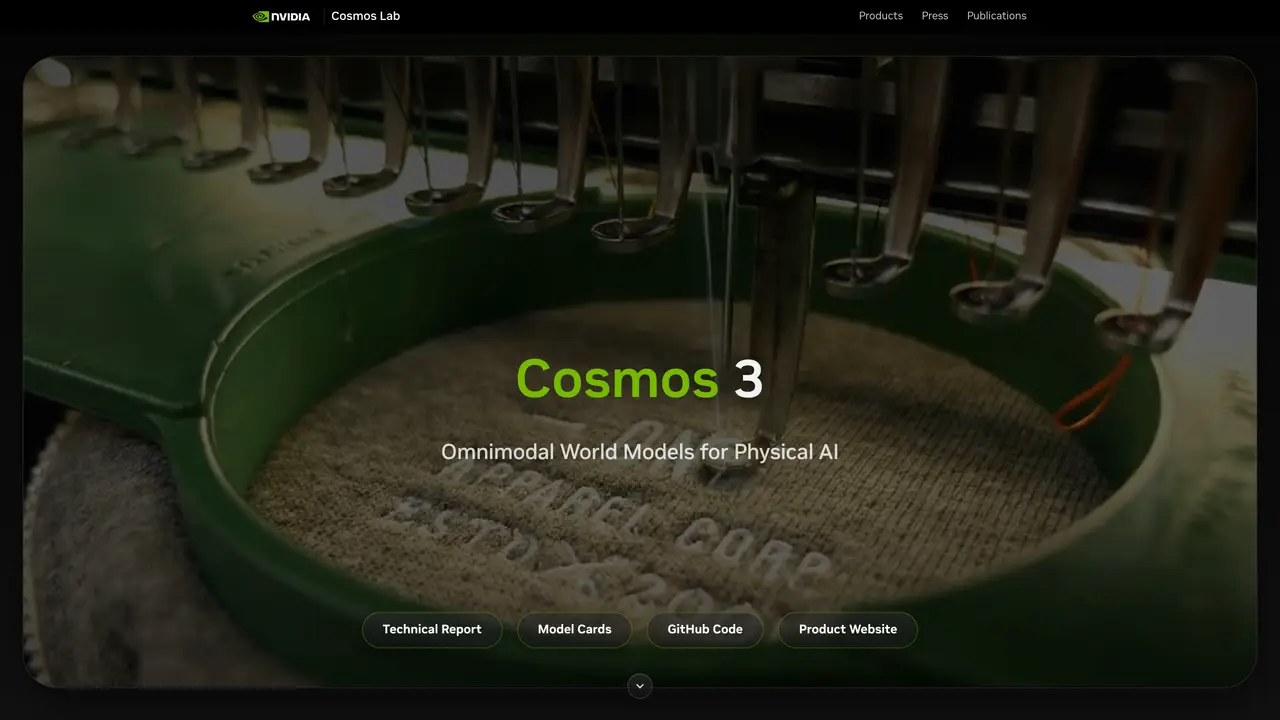
About NVIDIA Cosmos 3
NVIDIA Cosmos 3 is an open omnimodal world foundation model designed for developers building robots, autonomous vehicles, embodied agents, and other physical AI systems. It integrates text, images, video, audio, and actions into a single model workflow, enabling developers to connect perception, reasoning, simulation, generation, and action for physical AI development. The model supports physical reasoning, world simulation, synthetic data generation, and policy model development, making it suitable for tasks like robot manipulation, autonomous driving, warehouse monitoring, and smart spaces. Teams can use Cosmos 3 to generate physics-aware synthetic data, simulate physical environments, and develop action policies that bridge world understanding to real-world behavior. The model is particularly valuable for robotics developers, autonomous vehicle teams, simulation engineers, and researchers working on embodied AI systems that require multimodal input and output capabilities. Developers can fine-tune or post-train Cosmos 3 on specialized datasets to adapt it to specific physical AI tasks, such as camera-based perception, task-specific reasoning, or domain-specific simulations.
Nvidia
Santa Clara, United States · Founded 1993
- Founders
- Jensen Huang, Chris Malachowsky, Curtis Priem
- Founded
- 1993
- Headquarters
- Santa Clara, United States
- Legal status
- Public company
Key features
- Open omnimodal world foundation model
- Unified workflow for text, images, video, audio, and actions
- Physical reasoning and world simulation
- Synthetic data generation for physical AI training
- Action prediction and policy model development
- Support for robotics, autonomous vehicles, and embodied agents
- Physics-aware simulation and reasoning
- Fine-tuning and post-training on specialized datasets
- Integration with robotics and autonomous system workflows
- Omnimodal input and output capabilities
Use cases
- Train robots and embodied AI agents using world simulation and action prediction
- Generate physics-aware synthetic data for physical AI development
- Develop policy models for autonomous vehicles, warehouse monitoring, and smart spaces
Pros
- Unified omnimodal architecture supporting text, images, video, audio, and actions within a single model
- Enables physics-aware reasoning and simulation for physical AI systems
- Supports synthetic data generation and policy model development for real-world applications
- Facilitates fine-tuning and post-training for specialized physical AI tasks
- Demonstrates strong performance in robot manipulation, autonomous driving, and smart spaces
Cons
- Requires significant computational resources for training and inference due to its multimodal nature
- Complexity of integrating multiple modalities may pose challenges for developers without specialized expertise
- Outputs may occasionally lack precision in highly dynamic or ambiguous physical scenarios
Frequently asked questions about NVIDIA Cosmos 3
What is NVIDIA Cosmos 3?
NVIDIA Cosmos 3 is an open omnimodal world foundation model designed for physical AI systems. It integrates multiple modalities such as text, images, video, audio, and actions into a unified workflow for perception, reasoning, simulation, generation, and action.
Who is Cosmos 3 suitable for?
Cosmos 3 is particularly valuable for robotics developers, autonomous vehicle teams, simulation engineers, and researchers working on embodied AI systems that require multimodal input and output capabilities.
How does Cosmos 3 handle different modalities?
Cosmos 3 uses a shared omnimodal world model with a Unified MoT architecture that couples different modalities with each capability, enabling fluid transitions between text, images, video, audio, and actions.
Can Cosmos 3 be fine-tuned for specific tasks?
Yes, developers can fine-tune or post-train Cosmos 3 on specialized datasets to adapt it to specific physical AI tasks such as camera-based perception, task-specific reasoning, or domain-specific simulations.
What types of applications can Cosmos 3 support?
Cosmos 3 supports applications like robot manipulation, autonomous driving, warehouse monitoring, smart spaces, synthetic data generation, and physics-aware simulation for physical AI development.
How do I get started with Cosmos 3?
To get started, visit the Cosmos Lab website for technical reports, model cards, and GitHub code. The resources provide guidance on integrating and fine-tuning the model for your specific use case.